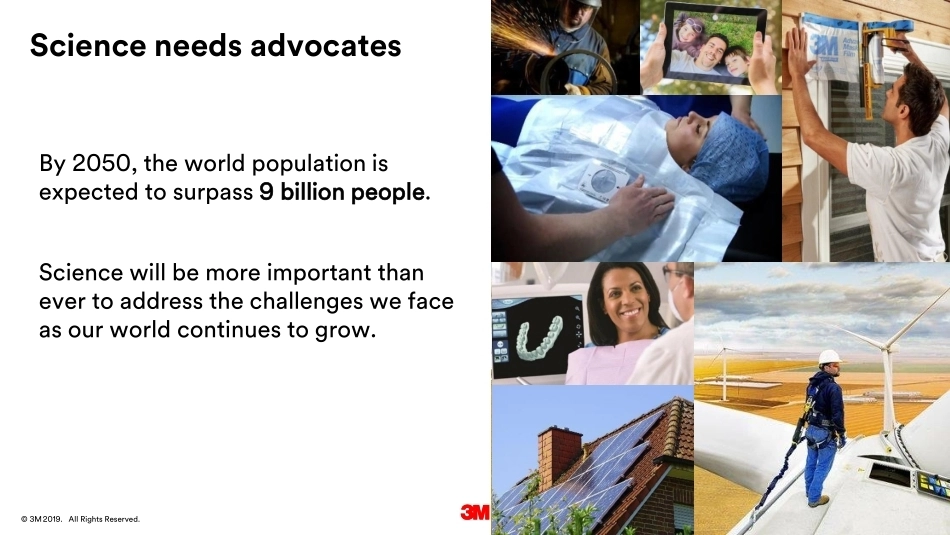
State of Science Index2019 Global findings 每日免费阅读行业报告1、每日星球内分享10+精品报告;2、不定时分享国际投行报告,脱水研报等;3、行业报告均为公开内容,版权归原作者所有,星球仅分享内部学习。扫描右侧二维码即刻加入【行业报告(免费) 】星球(此页只为更多需要行业报告的朋友提供便利,希望不会影响您的阅读,谢谢理解!)2All Rights Reserved.2019.© 3MScience needs advocates2By 2050, the world population is expected to surpass 9 billion people.Science will be more important than ever to address the challenges we face as our world continues to grow. 3All Rights Reserved.2019.© 3MSupply and demand of natural resources, including fossil fuels, minerals, renewables, water, and food will experience a powerful transformation.A gradual but powerful shift in the composition, location, and sheer size of the Earth’s population is at the core of nearly all observable global trends.Digitization is fundamentally changing how businesses and individuals interact, make decisions, and conduct daily operations.The center of world economic influence is transitioning from dominance of developed countries towards an increasingly multipolar environment.And that’s not all…Reimagining natural resourcesShiftingdemographicsDigital transformationEvolving economic landscapeDoes science matter?At 3M we recognize the importance of science and use it every day to improve the lives of people around the world.But what do others around the world think about science? Do they see, feel and appreciate the impact of science the same way we do?© 3M 2019. All Rights Reserved. 45. All Rights Reserved.2019© 3MWhere we surveyed Year 2•General population (with global sample of 3M Key Business Decision Influencer and Influential Information Seekers included)•~1000 respondents per country*New in Wave 2: Spain replaced France and South Korea Replaced Saudi Arabia Developed ■Canada, Germany, Japan, Singapore, South Korea*, Spain*, UK, USEmerging ■Brazil, China, India, Mexico, Poland, South Africa6All Rights Reserved.2019.© 3MAudienceRepresentative sample of national population adults (18+) in each country based on age, gender, region, race/ethnicity (where applicable)*Countries14 countriesBrazil, Canada, China, Germany, India, Japan, Mexico, Poland, Singapore, South Africa, South Korea, Spain, UK, USSample size~1,000 per country (14,025 globally) Surveymethodology & timing 15-minute survey, combination offline and onlineFielding/interviewing completed Jul. 13-Sep. 10, 2018; data cleaning, quality control checking, weighting completed Sep. 10-Oct. 10, 2017; global and country specific analysis, content strategy development late Sept.-early Nov. 2018Year-over-year tracking12-country tracking average•Two countries were removed (Saudi Arabia and France) and added (South Korea and Spain) in the 2nd wave, and as such, results can only be compared between the 12 countries that were surveyed across both years. •When comparisons year over year are made, the 12-country tracking average is used for both 2017 and 2018 results, rather than the 14-country total.Margin of errorAt the 95% confidence level•14-country total: +/- 0.83 percentage points•12-country tracking average: +/- 0.9 percentage points•Each individual country: +/- 3.10 percentage pointsScience was defined as**:Science is the process of pursuing knowledge about the world and how things in the world work through logically gathering, observing, experimenting and applying truths on a particular subject*Additional weighting also done on education, income, urban vs. rural for certain countries to achieve better national representation and ensure sample is consistent year over year**Science definition provided in two-thirds of the survey Survey methodologyExecutive summary8All Rights Reserved.2019.© 3MYear 2 key global findings Image of scienceImpact of scienceExpectations of scienceAround the world, people are curious about science and want to learn more.Curiosity is viewed as the most important quality for scientists as well.Scientists are seen as highly credible but unapproachable. Human connection trumps technology. Science skepticism is still alive and well. Improving science appreciation and advocacy starts with exceptional communication to make science more relatable. 9All Rights Reserved.2019.© 3MTheme 1 key findings: Image of science Genuine concern for future generations fuels interest in science. • 72% of people are curious about science, vs. indifferent (18%) or intimidated (10%).• Though 85% say they know little to nothing about science, about the same amount—85%— wish they knew more.• Top driver of science interest today is belief that advancements are going to benefit future generations (59%).**When thinking about science, you are…72%18%10%CuriousIndifferentIntimidatedCuriosity is THE most important quality for scientists, almost half the world says.• 45% agree that the most important quality for a scientist to have is curiosity, followed by intelligence (36%).• Yet, few recognize all the different types of careers that require science. While 73% identify an astronaut as a STEM career, far fewer understand that electricians (50%), ...




发表评论取消回复