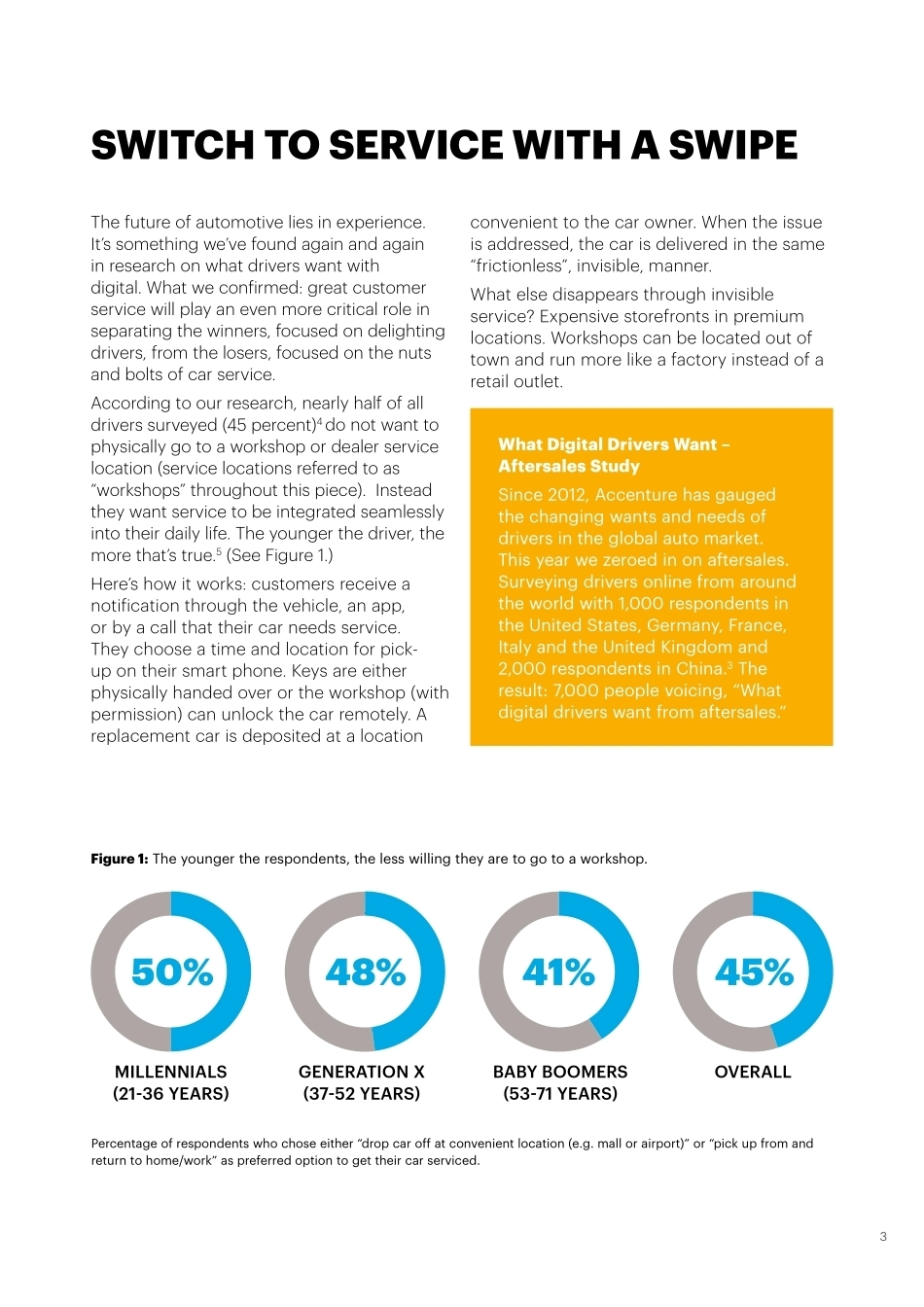
Technology exists now to make the discomfort of aftersales service experience disappear, rendering it invisible to the driver. Why not optimize the experience? After all, it generates 20 percent of revenue, and roughly 50 percent of profits for OEMs1 in a sector valued at 479,371 million USD2 by the end of 2017.Yet dealers spend significantly more on the lower margin end of the customer spectrum: car sales. In a study by Accenture, it’s clear that invisible service is something drivers are willing to pay for. OEMs and aftermarket players need to get into the driver’s seat to overhaul aftersales, or risk being left behind. When it comes to service expectations, buyers have been groomed by the best in digital, with brands like Amazon®, Apple® and Spotify®. Where what’s desired is a swipe away. Comfortable. Fast. Invisible. Car drivers want the same in their aftersales experience—service with a swipe—making the inconvenient, convenient. 2The future of automotive lies in experience. It’s something we’ve found again and again in research on what drivers want with digital. What we confirmed: great customer service will play an even more critical role in separating the winners, focused on delighting drivers, from the losers, focused on the nuts and bolts of car service. According to our research, nearly half of all drivers surveyed (45 percent)4 do not want to physically go to a workshop or dealer service location (service locations referred to as “workshops” throughout this piece). Instead they want service to be integrated seamlessly into their daily life. The younger the driver, the more that’s true.5 (See Figure 1.) Here’s how it works: customers receive a notification through the vehicle, an app, or by a call that their car needs service. They choose a time and location for pick-up on their smart phone. Keys are either physically handed over or the workshop (with permission) can unlock the car remotely. A replacement car is deposited at a location MILLENNIALS(21-36 YEARS)GENERATION X(37-52 YEARS)BABY BOOMERS(53-71 YEARS)OVERALL50%48%41%45%Figure 1: The younger the respondents, the less willing they are to go to a workshop.convenient to the car owner. When the issue is addressed, the car is delivered in the same “frictionless”, invisible, manner. What else disappears through invisible service? Expensive storefronts in premium locations. Workshops can be located out of town and run more like a factory instead of a retail outlet. Percentage of respondents who chose either “drop car off at convenient location (e.g. mall or airport)” or “pick up from and return to home/work” as preferred option to get their car serviced.What Digital Drivers Want – Aftersales StudySince 2012, Accenture has gauged the changing wants and needs of drivers in the global auto market. This year we zeroed in on aftersales. Surveying drivers online from around the world with 1,000 respondents in the United States, Germany, France, Italy and the United Kingdom and 2,000 respondents in China.3 The result: 7,000 people voicing, “What digital drivers want from aftersales.” SWITCH TO SERVICE WITH A SWIPE338+17+5+40+L42+11+3+44+L 36+8+2+54+L46+11+3+40+LDrop Off at Convenient Location (e.g. mall or airport)What’s perhaps most critical to note for the industry: drivers are willing to pay for invisibility. In fact, 72 percent said they are open to paying a monthly flat fee for service and maintenance. More than half6 said they would part with around 45 dollars per visit to not have to deal with the hassle of going to a workshop. Beyond inconvenience, there’s also anxiety around how long service will take and uncertainty about what exactly is being done in the case of a repair, not to mention how much it will cost. Invisible service creates transparency, mitigating the unknown, as information is delivered real-time through online and app channels.Figure 3: 60% of respondents are willing to pay for convenience services such as “overnight servicing” and “pick up from and return to home.”■ Willing to pay $1–50 ■ Willing to pay $51–100 ■ Willing to pay more than $100 ■ Not willing to payOvernight ServicingPick Up from and Return to HomePick Up from and Return to Work60% 60% 55% 46% Figure 2: Millennials prefer flat fees from automotive services. ■ Prefer flat fee options ■ Do nor prefer flat fee optionsMILLENNIALS81%19%BABY BOOMERS60%40%GENERATION X74%26%OVERALL72%28%LOWERING BARRIERS4“Once you experience the smartness that you have in your vehicle, there’s no way you’ll look back.”7– Jim Hackett, Ford CEO Spotlight China: Aftersales Clearly “Yinxing”—Invisible While the rest of the world struggles to catch up, China is ahead when it comes to making aftersales “yinxing” or invisible. In comparison, powerhouse automotive markets like the US and Germany lag. Given the global nature of the industry, it’s something OEMs can’t afford. They need to step up their aftersales game locally. Some, like Easy Auto10, a German aftersales player, are catching up. The ...






发表评论取消回复