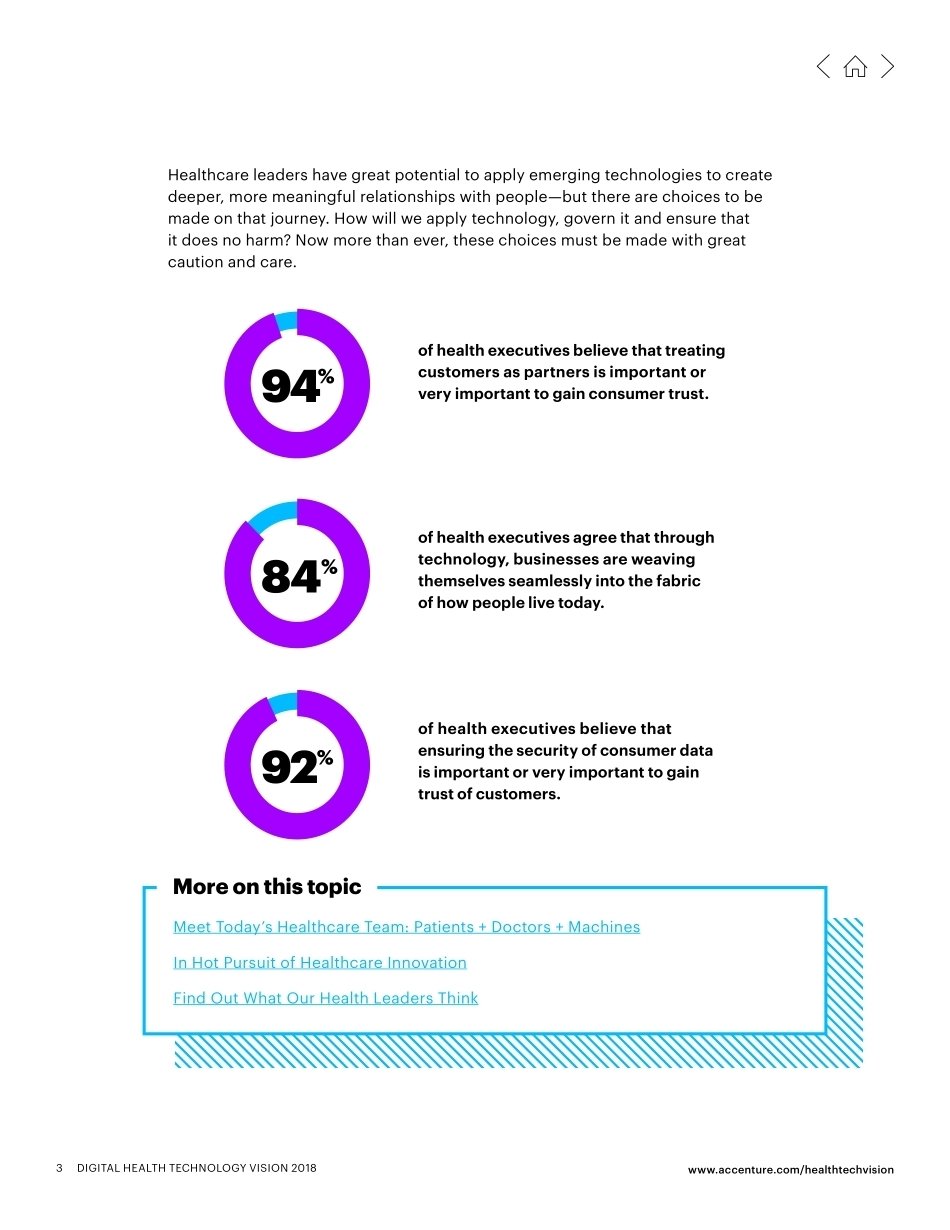
DIGITAL HEALTH TECH VISION 2018Intelligent Enterprise UnleashedAccenture ConsultingIntroductionTHE WORLD HAS REACHED A POINTwhere technology is deeply embedded in our lives—and the lines between business and personal are blurred more than ever. Healthcare organizations are increasingly unleashing the power of intelligent technologies, using them to deliver personalized, efficient and informed care. However, with such innovation comes responsibility. For people to get the full benefits of digitally enabled healthcare services, providers and health plans must prioritize trust and responsibility.The Accenture Digital Health Technology Vision 2018 explores five trends that underscore the importance of building a foundation of trust as technology has a greater impact on our lives: Citizen AI, Extended Reality, Data Veracity, Frictionless Business and Internet of Thinking.We see these trends in two categories—the enablers of an intelligent healthcare enterprise, and the consequences. The technology enablers Extended Reality, Frictionless Business and Internet of Thinking demonstrate how integration and personalization can help people in new ways. Citizen AI and Data Veracity reveal the consequences when technology is deeply intertwined in our lives and in our care. 2 DIGITAL HEALTH TECHNOLOGY VISION 2018www.accenture.com/healthtechvisionHealthcare leaders have great potential to apply emerging technologies to create deeper, more meaningful relationships with people—but there are choices to be made on that journey. How will we apply technology, govern it and ensure that it does no harm? Now more than ever, these choices must be made with great caution and care. More on this topicMeet Today’s Healthcare Team: Patients + Doctors + MachinesIn Hot Pursuit of Healthcare InnovationFind Out What Our Health Leaders Thinkof health executives believe that treating customers as partners is important or very important to gain consumer trust.of health executives agree that through technology, businesses are weaving themselves seamlessly into the fabric of how people live today.of health executives believe that ensuring the security of consumer data is important or very important to gain trust of customers.94% 84% 92% 3 DIGITAL HEALTH TECHNOLOGY VISION 2018www.accenture.com/healthtechvisionArtificial intelligence (AI) now has a deeper touch in healthcare. It is much more than a technological tool—it is part of the workforce. AI is using algorithms to diagnose patient wounds via smartphone.1 It is allowing caretakers and doctors to remotely monitor the elderly so that they may safely live independently.2 AI is helping health systems to digitally verify a patient’s insurance information.3 More and more, AI touches the end-to-end care experience—and it will only grow in scale. A majority of health executives (85 percent) surveyed agree that every human will be directly impacted on a daily basis by an AI-based decision within the next three years. Meanwhile, AI is growing up. Just as a child begins to learn to be responsible on his or her own, AI is gaining knowledge without simply being programmed. Learning-based AIs build models based on vast amounts of training data. They spot patterns and self-check against test data for success across a variety of factors. And the more data an AI is given, the better its predictions become.The power of AI in healthcare is both awesome and alarming, considering the potential implications of one bad decision. Healthcare organizations must recognize this impact and build AI with responsibility, fairness and transparency—but many aren’t there yet. Eighty-one percent of health executives agree that organizations are not prepared to face the societal and liability issues that will require them to explain their AI-based actions and decisions, should issues arise. CITIZEN AI Raising AI to Benefit Providers, Plans and PatientsTrend 14 DIGITAL HEALTH TECHNOLOGY VISION 2018www.accenture.com/healthtechvisionWhen AI is “raised” successfully, it can begin to do more to help the healthcare enterprise. For instance, AI might support human decision making in a wider variety of areas, such as providing a recommended treatment plan or accepting or rejecting medical claims. In healthcare, this is life or death business. Healthcare leaders must ensure that the data used to inform AI solutions are created without any embedded bias. Bias can be harmful to people. For instance, if a healthcare organization builds a model around heart disease detection, and the model is full of data about older white males, it may yield incorrect results such as a denied claim, or cause harm such as an inaccurate diagnosis, for a young African American. For this reason, companies using AI must be very mindful of what is in the data used to train their AI. They must continuously test for and mitigate biases to minimize risk, error and potential harm. [See Decoding AI.]Raising it rightDECODING AIExplainable AI In healthcare, being able ...





发表评论取消回复