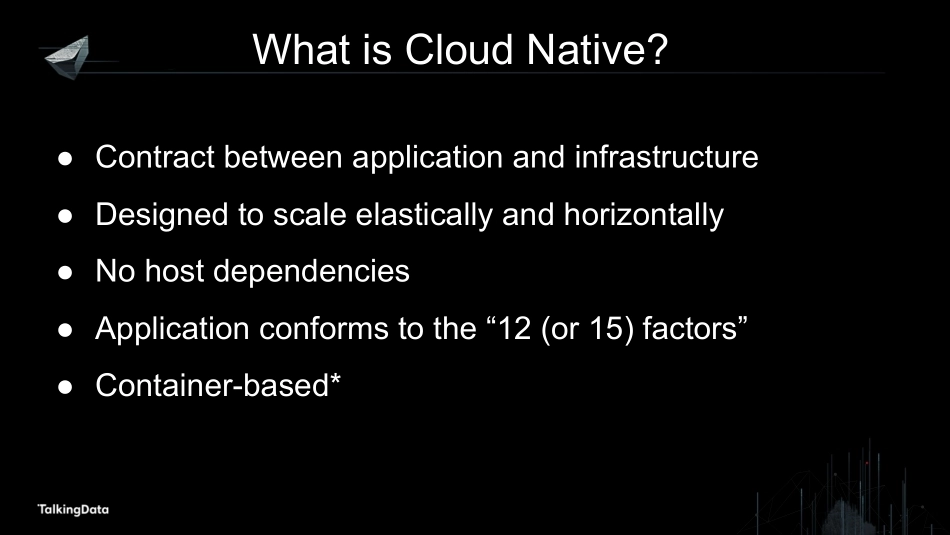
Cloud Native Applications主讲人:Capital One 首席工程师 Kevin Hoffman Agenda● Define Cloud Native● Cloud Native practices and the “15 factors”● From Monoliths to the Cloud● Q&AWhat is Cloud Native?● Contract between application and infrastructure● Designed to scale elastically and horizontally● No host dependencies● Application conforms to the “12 (or 15) factors”● Container-based*Team Discipline● Structure around rapid, continuous delivery● Embrace agility● Embrace the cloud● Adopt practices aimed at thriving on cloud platforms云道The Way of the Cloud● Favor Simplicity● Test First, Test Everything● Release Early, Release Often● Automate Everything● Build Ecosystems, not Monoliths云道15 Factors of Cloud Native● Based on Heroku’s original “12 factor” list (12factor.net)● Characteristics of a cloud native application● Some easier to adopt than others● Adopting all factors pays huge dividends十五个因素One codebase, One App● Single version-controlled codebase, many deploys● Multiple apps should not share code○ Microservices need separate release schedules○ Upgrade, deploy one without impacting others● Tie build and deploy pipelines to single codebase第一API First●Service ecosystem requires a contract○Public API●Multiple teams on different schedules○Code to contract/API, not code dependencies●Use well-documented contract standards○Protobuf IDL, Swagger, Apiary, etc●API First != REST First○RPC can be more appropriate in some situations第二Dependency Management● Explicitly declare dependencies● Include all dependencies with app release● Create immutable build artifact (e.g. docker image)● Rely on smallest docker image○ Base on scratch if possible● App cannot rely on host for system tools or libraries第三Design, Build, Release, Run● Design part of iterative cycle○ Agile doesn’t mean random or undesigned● Mature CI/CD pipeline and teams○ Design to production in days not months● Build creates immutable artifact● Release automatically deploys to environment○ Environment contains config, not release artifact第四Configuration, Credentials, Code● “3 Cs” volatile substances that explode when combined● Password in a config file is as bad as password in code● App must accept “3 Cs” from environment and only use harmless defaults● Test - could you expose code on github and not reveal passwords, URLs, credentials?第五Logs●Emit formatted logs to stdout●Code should not know about destination or purpose of log emissions●Use downstream log aggregator○collect, store, process, expose logs○ELK, Splunk, Sumo, etc●Use structured logs to allow query and analysis○JSON, csv, K=V, etc●Logs are not metrics第六Disposability● App must start as quickly as possible● App must stop quickly and gracefully● Processes start and stop all the time in the cloud● Every scale up/down disposes of processes○ Slow dispose == slow scale● Slow dispose or startup can cause availability gaps第七Backing Services● Assume all resources supplied by backing services● Cannot assume mutable file system○ “Disk as a Service” (e.g. S3, virtual mounts, etc)● Every backing service is bound resource○ URL, credentials, etc -> environment config● Host does not satisfy NFRs○ Backing services and cloud infrastructure第八Environment Parity● “Works on my machine”○ Cloud-native anti-pattern. Must work everywhere*● Every commit is candidate for deployment● Automated acceptance tests○ Provide no confidence if environments don’t match第九Administrative Processes● Database migrations● Run-once scripts or jobs● Avoid using for batch operations, consider instead:○ Event sourcing○ Schedulers○ Triggers from queues, etc○ Lambdas/functions第十Port Binding● In cloud, infrastructure determines port● App must accept port assigned by platform● Containers have internal/external ports○ App design must embrace this● Never use reserved ports● Beware of container “host mode” networking第十一Stateless Processes● What is stateless?● Long-term state handled by a backing service● In-memory state lives only as long as request● Requests from same client routed to different instances○ “Sticky sessions” cloud native anti-pattern第十二Concurrency● Scale horizontally using the process model● Build disposable, stateless, share-nothing processes● Avoid adding CPU/RAM to increase scale/throughput● Where possible, let platform/libraries do threading○ Many single-threaded svcs > 1 multi-threaded monolith第十三Telemetry第十四● Monitor apps in the cloud like satellite in orbit● No tether, no live debugger● Application Perf Monitoring (APM)● Domain Telemetry● Health and system logsAuthentication & Authorization● Security should never be an afterthought● Auth should be explicit, documented decision○ Even if anonymous access is allowed○ Don’t allow anonymous access 😄● Bearer tokens/OAuth/OIDC best practices● Audit all attempts to access第十五Migrating Monoliths to the Cloud●Make a rule - stop adding to the monolith○All new code must be cloud native●Prioritize features○Where will you get most benefit from cloud native?●Come up with a plan○Decompose monolith over time○Fas...





发表评论取消回复