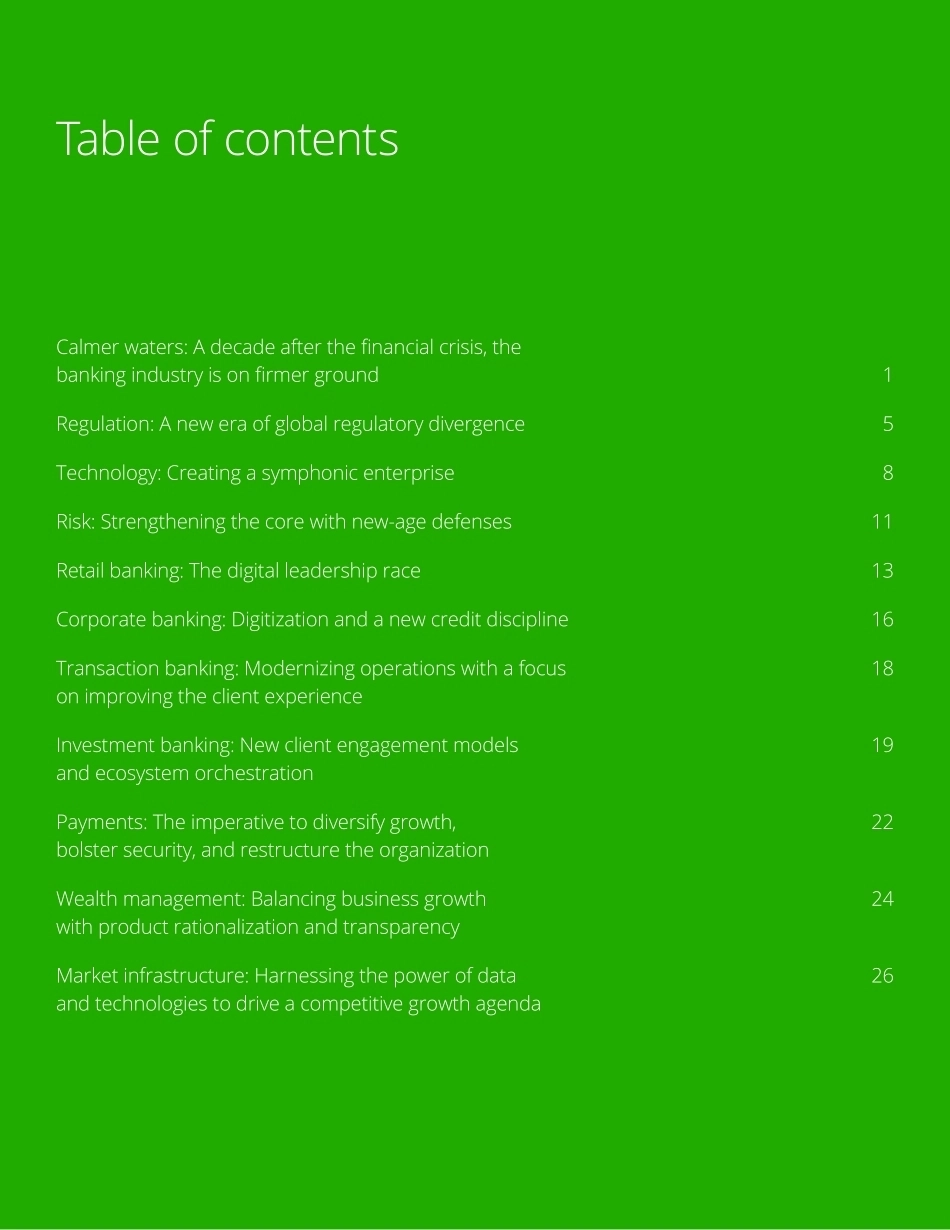
2019 Banking and Capital Markets Outlook Reimagining transformation2019 Banking and Capital Markets Outlook: Reimagining transformation2Brochure / report title goes here | Section title goes here 02Table of contentsCalmer waters: A decade after the financial crisis, thebanking industry is on firmer ground 1Regulation: A new era of global regulatory divergence 5Technology: Creating a symphonic enterprise 8Risk: Strengthening the core with new-age defenses 11Retail banking: The digital leadership race 13Corporate banking: Digitization and a new credit discipline 16Transaction banking: Modernizing operations with a focus 18on improving the client experienceInvestment banking: New client engagement models 19and ecosystem orchestrationPayments: The imperative to diversify growth, 22bolster security, and restructure the organization Wealth management: Balancing business growth 24 with product rationalization and transparency Market infrastructure: Harnessing the power of data 26and technologies to drive a competitive growth agenda 2019 Banking and Capital Markets Outlook: Reimagining transformation1Calmer watersA decade after the financial crisis, the banking industry is on firmer groundThe global banking system is not only bigger and more profitable but also more resilient than at any time in the last 10 years (figure 1). According to The Banker’s Top 1000 World Banks Ranking for 2018, total assets reached$124 trillion, while return on assets (ROA) stood at 0.9 percent. Similarly, tier 1 capital ratio as a proportion of assets rose to 6.7 percent, significantly higher than in 2008.1But the recovery since the financial crisis has not been uniform across regions. US banks, compared to their European counterparts, are ahead on multiple measures. Aggressive policy interventions and forceful regulations helped propel US banks to health more quickly. And more recently, favorable GDP growth, tax cuts, and rising rates have further bolstered the state of the industry. Total assets in the United States reached a peak of $17.5 trillion.2 Capital levels are up as well, with average tier 1 capital ratio standing at 13.14 percent. Return on equity (ROE) for the industry is at a post-crisis high of 11.83 percent.3 Efficiency ratios also are at their best. Similarly, on other metrics, such as nonperforming loans and number of failed institutions, the US banking industry is robust.However, the same cannot be said of the banking industry in Europe. Structural deficiencies, overcapacity, low/negative interest rates, and the absence of a pan-European banking regulatory agency have all likely contributed to European banks experiencing persistent profitability challenges. Figure 1. Growth of the global banking industryIn the last decade, the top 1,000 world banks have grownAssets ($T)Return on assets (%)Tier 1 capital/assets (%)Sources: Danielle Myles, “Top 1000 World Banks 2018,” The Banker, July 2, 2018; Danielle Myles, “Top 1000 World Banks 2017,” The Banker, July 3, 2017; Charles Piggott, “Top 1000 World Banks 2009,” The Banker, June 24, 2009.BiggerMore profitableBetter capitalized$96.420082017$123.720082017.1%.9%200820174.4%6.7%2019 Banking and Capital Markets Outlook: Reimagining transformation2Many European banks have become smaller, retrenching from international markets and exiting former profitable businesses. Consider the fact that profits of the top five European banks dropped from $60 billion in 2007 to $17.5 billion in 2017.4 However, European banks are showing some improvement. ROE for Western European banks in the top 1,000 world banks grew to 8.6 percent in 2017, compared with 5.5 percent in 2016.5 In the Asia Pacific (APAC) region, the growth of Chinese banks has been the most stunning development in the last 10 years. The Chinese banking industry has surpassed that of the European Union (EU) in terms of size. The world’s four largest banks in 2018 are Chinese; in 2007, none of the top 10 banks in the world were Chinese.6 Chinese banks are also doing well in terms of profitability—the larger banks reported a 15.3 percent ROE in 2017.7 However, the concern with economic growth and the tariff war with the United States are already affecting prospects.8 Meanwhile, Japanese banks, which escaped the financial crisis, have long suffered the effects of slow domestic growth and low/negative interest rates.9Despite this overall optimistic picture for the global banking industry, uncertainties loom on the horizon. Real GDP growth forecasts from the International Monetary Fund (IMF) point to a deceleration in all regions, including China and Emerging Asia (figure 2). In the latest forecast, Deloitte economists are predicting a 25 percent probability of a recession in the United States in 2019. In this scenario, tariffs and dilution of the stimulus effect could weaken US economic growth in late 2019 or early 2020.10Figure 2. Real GDP growth by region, 2013–2023In the last decade, the top 1,000 world banks have grown20122018201...






发表评论取消回复