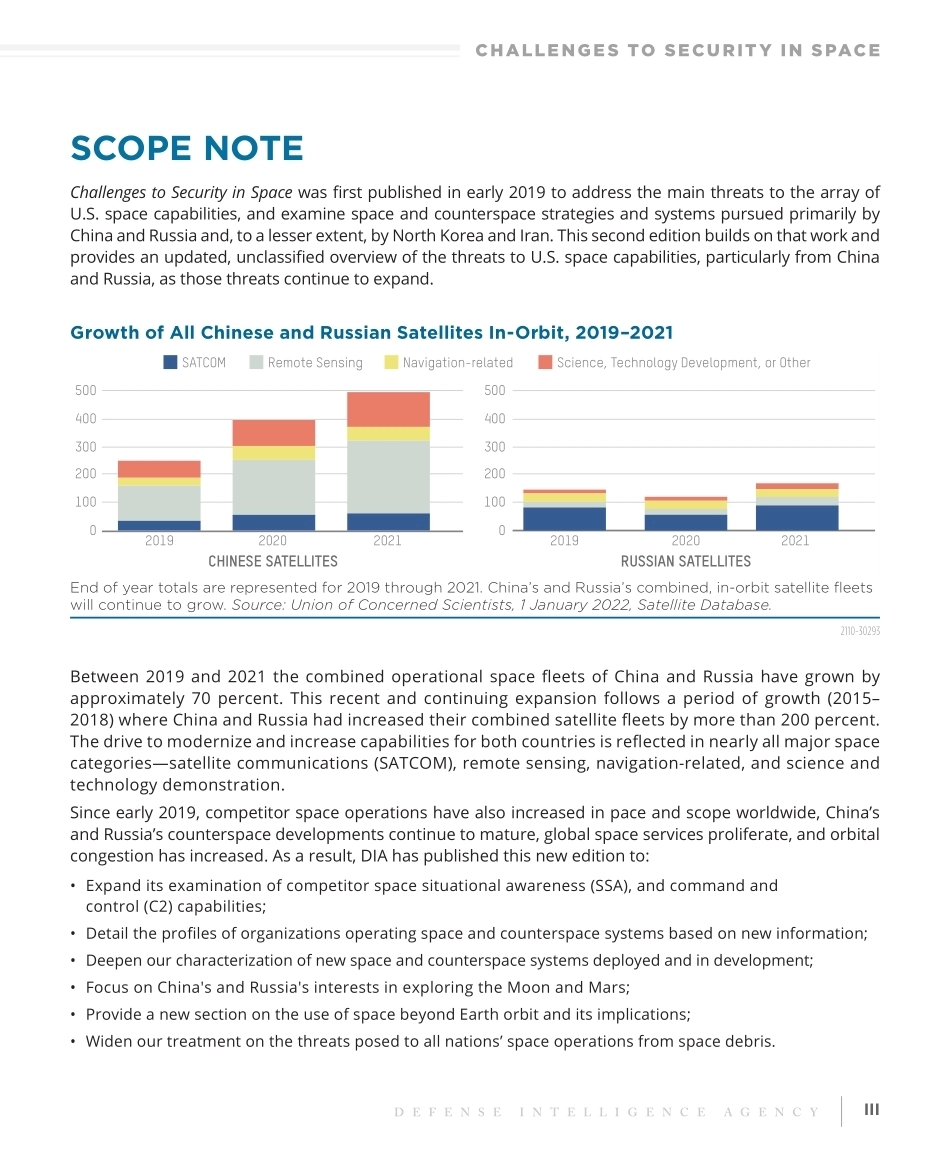
D E F E N S E I N T E L L I G E N C E A G E N C YCommitted to Excellence in Defense of the NationCHALLENGES TOSECURITY IN SPACESpace Reliance in an Era of Competition and Expansion2022This report contains copyrighted material. Copying and disseminating the contents are prohibited without the permission of the copyright owners. Images and other previously published material featured or referenced in this publication are attributed to their source. ISBN 978-0-16-095566-2This report is available online at www.dia.mil/Military-Power-PublicationsFor media and public inquiries about this report, contact DIA-PAO@dodiis.milFor more information about the Defense Intelligence Agency, visit DIA’s website at www.dia.mil Information cutoff date, March 2022 DIA_E_00039_A Cover image, Cislunar space domain viewed from beyond the far side of the Moon: Shutterstock, UnsplashIICHALLE NGES TO SECURIT Y IN SPACESCOPE NOTEChallenges to Security in Space was first published in early 2019 to address the main threats to the array of U.S. space capabilities, and examine space and counterspace strategies and systems pursued primarily by China and Russia and, to a lesser extent, by North Korea and Iran. This second edition builds on that work and provides an updated, unclassified overview of the threats to U.S. space capabilities, particularly from China and Russia, as those threats continue to expand.Between 2019 and 2021 the combined operational space fleets of China and Russia have grown by approximately 70 percent. This recent and continuing expansion follows a period of growth (2015–2018) where China and Russia had increased their combined satellite fleets by more than 200 percent. The drive to modernize and increase capabilities for both countries is reflected in nearly all major space categories—satellite communications (SATCOM), remote sensing, navigation-related, and science and technology demonstration.Since early 2019, competitor space operations have also increased in pace and scope worldwide, China’s and Russia’s counterspace developments continue to mature, global space services proliferate, and orbital congestion has increased. As a result, DIA has published this new edition to: • Expand its examination of competitor space situational awareness (SSA), and command and control (C2) capabilities;• Detail the profiles of organizations operating space and counterspace systems based on new information;• Deepen our characterization of new space and counterspace systems deployed and in development;• Focus on China's and Russia's interests in exploring the Moon and Mars;• Provide a new section on the use of space beyond Earth orbit and its implications;• Widen our treatment on the threats posed to all nations’ space operations from space debris.Growth of All Chinese and Russian Satellites In-Orbit, 2019–2021CHINESE SATELLITESRUSSIAN SATELLITES201920202021201920202021Science, Technology Development, or OtherSATCOMRemote SensingNavigation-related01002003004005000100200300400500End of year totals are represented for 2019 through 2021. China’s and Russia’s combined, in-orbit satellite fleets will continue to grow. Source: Union of Concerned Scientists, 1 January 2022, Satellite Database.2110-30293D E F E N S E I N T E L L I G E N C E A G E N C YIIIEXECUTIVE SUMMARY Space Reliance In An Era Of Competition And ExpansionCapabilities. Space-based capabilities impact many day-to-day aspects of the American way of life. These capabilities enable functions that affect our homes, transportation, electric power grids, banking systems, and our global communications. Satellites provide access to a broad range of information and enable many services in real time, from watching breaking news to monitoring our deployed armed forces around the world day or night. These and other benefits enabled by space systems are the result of more than 60 years of dedicated work by government agencies—military and civilian—supported by many commercial space providers. Space systems also enable the United States and our allies to project combat power to areas of conflict and instability and allow our armed forces to collect vital intelligence on foreign threats, to navigate and maneuver rapidly, and to communicate with each other anywhere around the globe to ensure our security and quick response to international military and humanitarian crises.Competition. Space competition between the United States and the former Soviet Union began in earnest with Moscow’s launch of the world’s first artificial satellite, Sputnik-1, in 1957. China’s emergence as a space power in the late 20th and early 21st century and Russia’s post-Soviet resurgence have expanded the militarization of space as both countries integrate space and counterspace capabilities into their national and warfighting strategies to challenge the United States. Adversaries have observed more than 30 years of U.S. military operations supported by space systems and are now seeking ways to expand their own...




发表评论取消回复