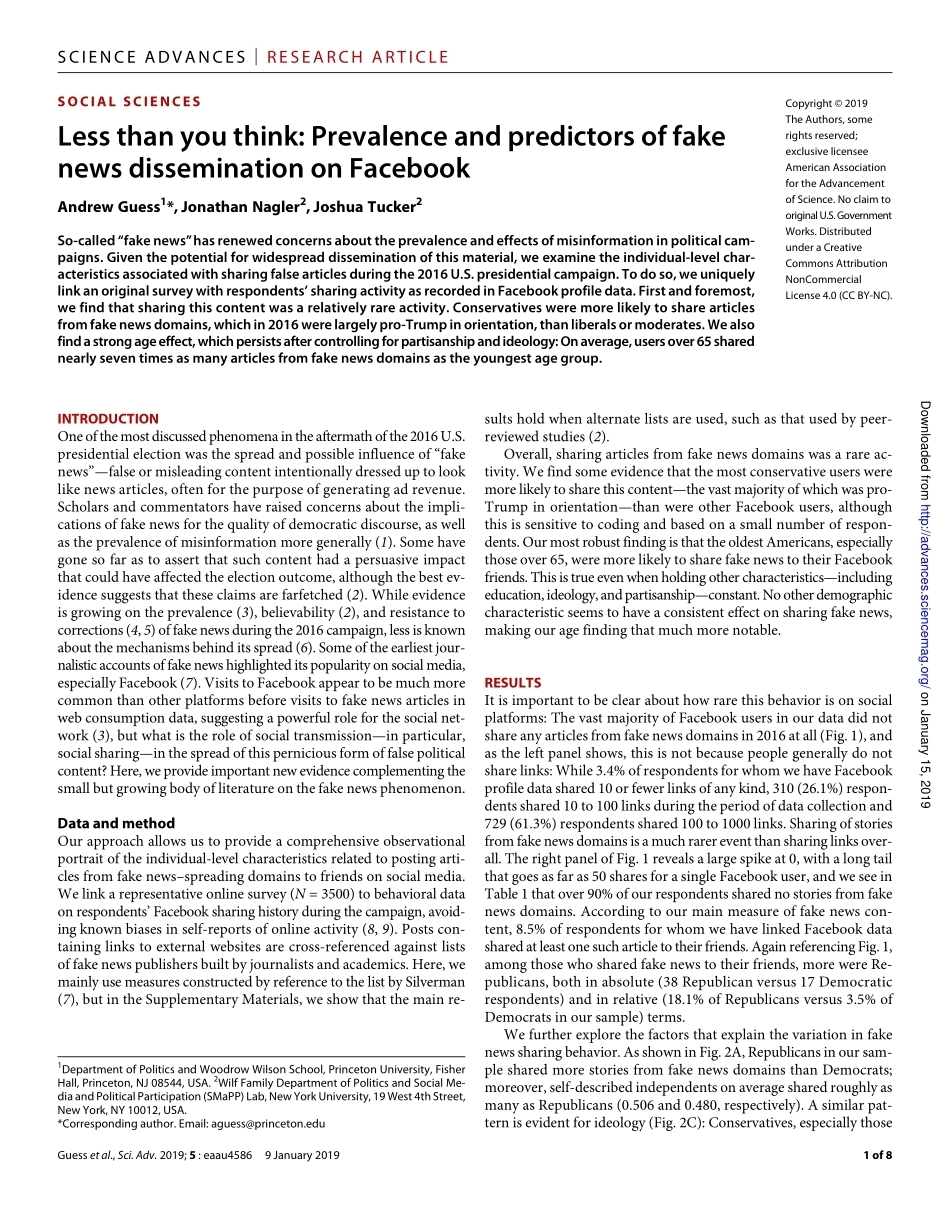
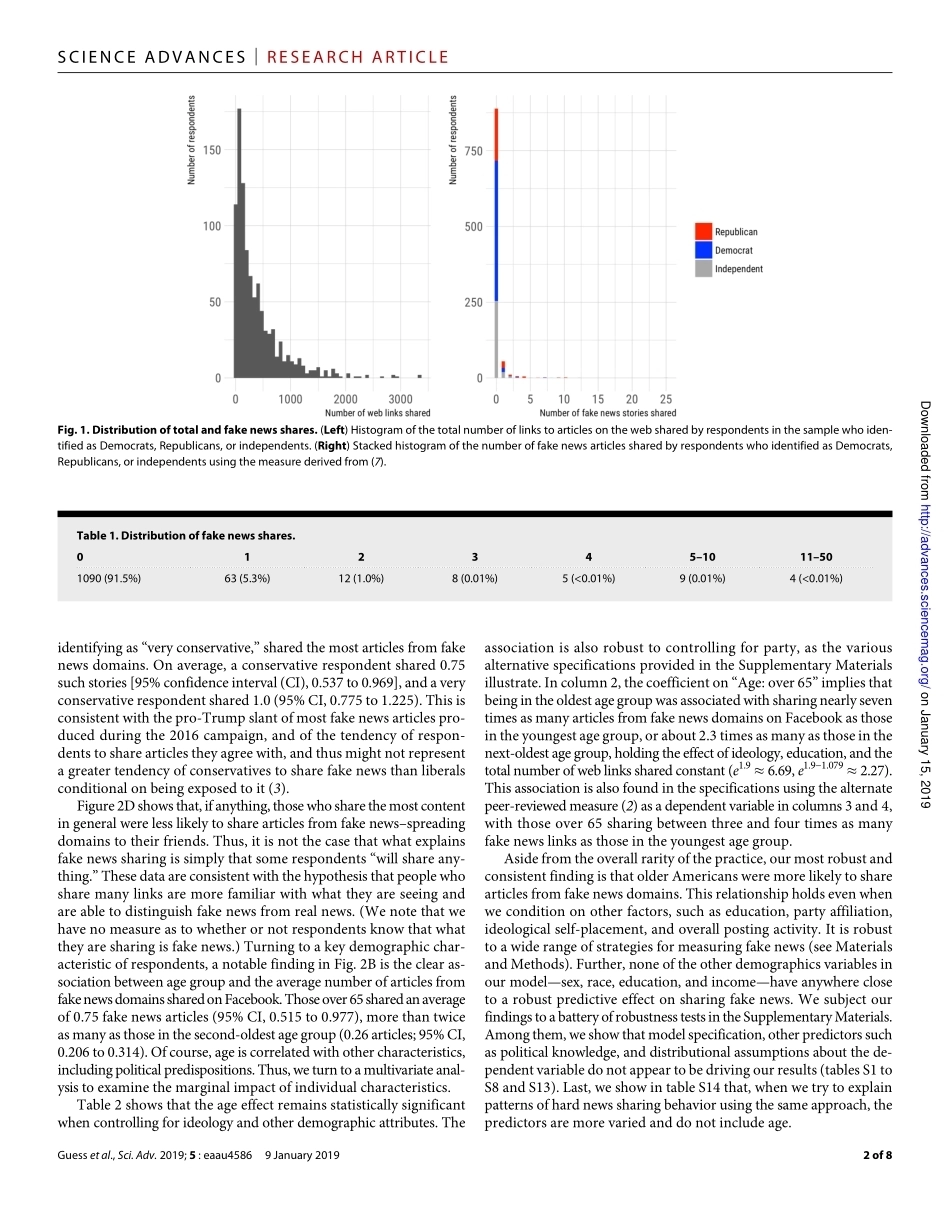
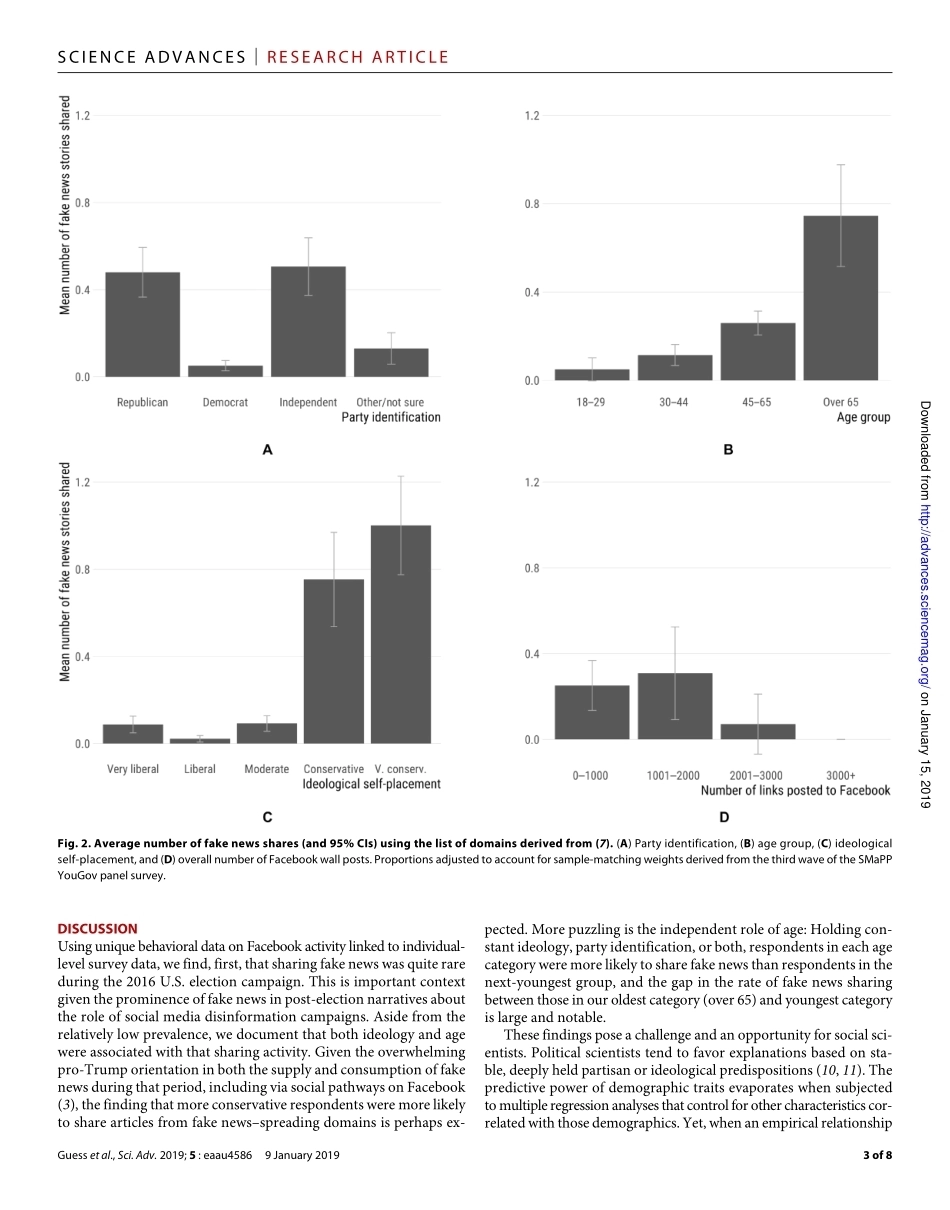
Guess et al., Sci. Adv. 2019; 5 : eaau4586 9 January 2019SCIE N C E A D V A NCES | RESEA R CH A RT ICL E1 of 8SOCIAL SCIENCESLess than you think: Prevalence and predictors of fake news dissemination on FacebookAndrew Guess1*, Jonathan Nagler2, Joshua Tucker2So-called “fake news” has renewed concerns about the prevalence and effects of misinformation in political cam-paigns. Given the potential for widespread dissemination of this material, we examine the individual-level char-acteristics associated with sharing false articles during the 2016 U.S. presidential campaign. To do so, we uniquely link an original survey with respondents’ sharing activity as recorded in Facebook profile data. First and foremost, we find that sharing this content was a relatively rare activity. Conservatives were more likely to share articles from fake news domains, which in 2016 were largely pro-Trump in orientation, than liberals or moderates. We also find a strong age effect, which persists after controlling for partisanship and ideology: On average, users over 65 shared nearly seven times as many articles from fake news domains as the youngest age group.INTRODUCTIONOne of the most discussed phenomena in the aftermath of the 2016 U.S. presidential election was the spread and possible influence of “fake news”—false or misleading content intentionally dressed up to look like news articles, often for the purpose of generating ad revenue. Scholars and commentators have raised concerns about the impli-cations of fake news for the quality of democratic discourse, as well as the prevalence of misinformation more generally (1). Some have gone so far as to assert that such content had a persuasive impact that could have affected the election outcome, although the best ev-idence suggests that these claims are farfetched (2). While evidence is growing on the prevalence (3), believability (2), and resistance to corrections (4, 5) of fake news during the 2016 campaign, less is known about the mechanisms behind its spread (6). Some of the earliest jour-nalistic accounts of fake news highlighted its popularity on social media, especially Facebook (7). Visits to Facebook appear to be much more common than other platforms before visits to fake news articles in web consumption data, suggesting a powerful role for the social net-work (3), but what is the role of social transmission—in particular, social sharing—in the spread of this pernicious form of false political content? Here, we provide important new evidence complementing the small but growing body of literature on the fake news phenomenon.Data and methodOur approach allows us to provide a comprehensive observational portrait of the individual-level characteristics related to posting arti-cles from fake news–spreading domains to friends on social media. We link a representative online survey (N = 3500) to behavioral data on respondents’ Facebook sharing history during the campaign, avoid-ing known biases in self-reports of online activity (8, 9). Posts con-taining links to external websites are cross-referenced against lists of fake news publishers built by journalists and academics. Here, we mainly use measures constructed by reference to the list by Silverman (7), but in the Supplementary Materials, we show that the main re-sults hold when alternate lists are used, such as that used by peer- reviewed studies (2).Overall, sharing articles from fake news domains was a rare ac-tivity. We find some evidence that the most conservative users were more likely to share this content—the vast majority of which was pro- Trump in orientation—than were other Facebook users, although this is sensitive to coding and based on a small number of respon-dents. Our most robust finding is that the oldest Americans, especially those over 65, were more likely to share fake news to their Facebook friends. This is true even when holding other characteristics—including education, ideology, and partisanship—constant. No other demographic characteristic seems to have a consistent effect on sharing fake news, making our age finding that much more notable.RESULTSIt is important to be clear about how rare this behavior is on social platforms: The vast majority of Facebook users in our data did not share any articles from fake news domains in 2016 at all (Fig. 1), and as the left panel shows, this is not because people generally do not share links: While 3.4% of respondents for whom we have Facebook profile data shared 10 or fewer links of any kind, 310 (26.1%) respon-dents shared 10 to 100 links during the period of data collection and 729 (61.3%) respondents shared 100 to 1000 links. Sharing of stories from fake news domains is a much rarer event than sharing links over-all. The right panel of Fig. 1 reveals a large spike at 0, with a long tail that goes as far as 50 shares for a single Facebook user, and we see in Table 1 that over 90% of our respondents shared no stories from fake news domains. According to our main...




发表评论取消回复