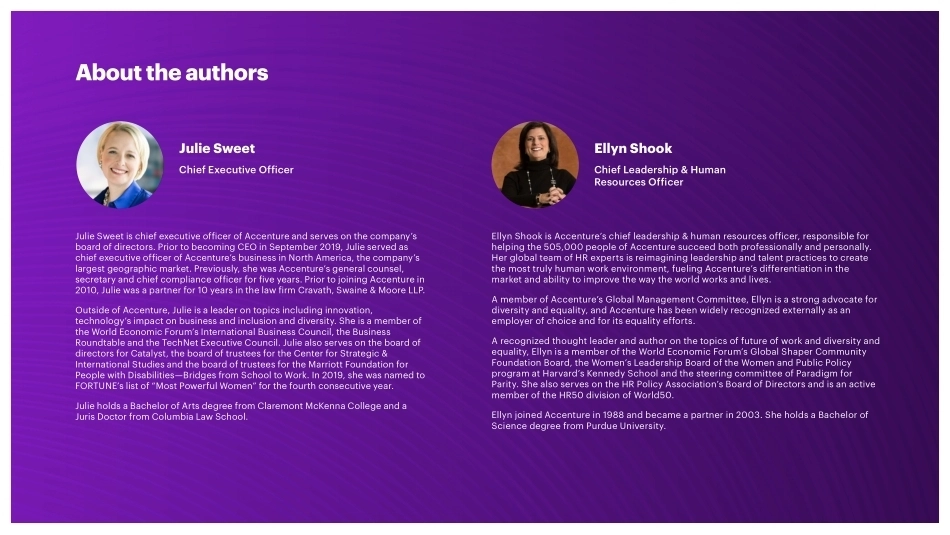
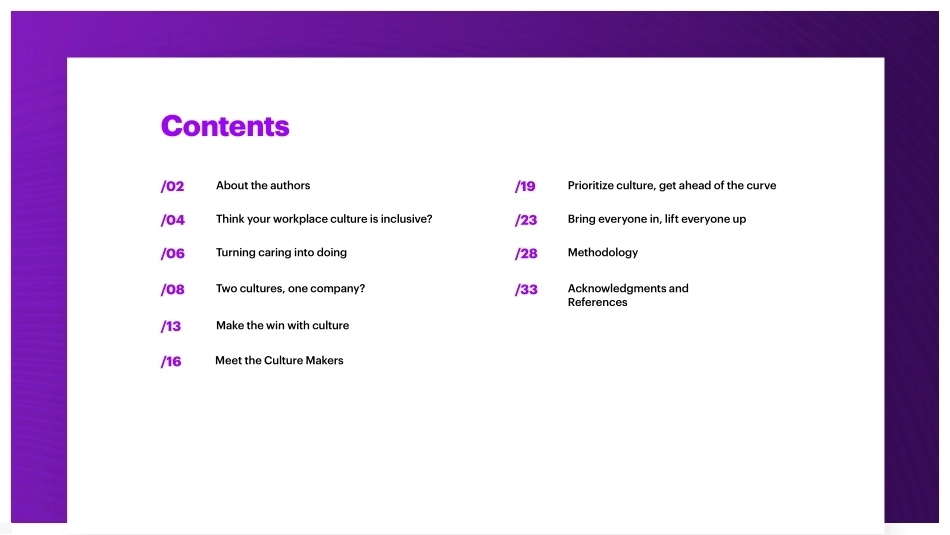
Provocative thinking, transformative insights, tangible outcomesTHE HIDDEN VALUE OF CULTURE MAKERS Where Culture Makers lead, organizations grow twice as fast GETTING TO EQUAL 20202GETTING TO EQUAL 2020About the authors Julie SweetChief Executive OfficerJulie Sweet is chief executive officer of Accenture and serves on the company’s board of directors. Prior to becoming CEO in September 2019, Julie served as chief executive officer of Accenture’s business in North America, the company’s largest geographic market. Previously, she was Accenture’s general counsel, secretary and chief compliance officer for five years. Prior to joining Accenture in 2010, Julie was a partner for 10 years in the law firm Cravath, Swaine & Moore LLP. Outside of Accenture, Julie is a leader on topics including innovation, technology’s impact on business and inclusion and diversity. She is a member of the World Economic Forum’s International Business Council, the Business Roundtable and the TechNet Executive Council. Julie also serves on the board of directors for Catalyst, the board of trustees for the Center for Strategic & International Studies and the board of trustees for the Marriott Foundation for People with Disabilities—Bridges from School to Work. In 2019, she was named to FORTUNE’s list of “Most Powerful Women” for the fourth consecutive year. Julie holds a Bachelor of Arts degree from Claremont McKenna College and a Juris Doctor from Columbia Law School. Chief Leadership & Human Resources OfficerEllyn Shook is Accenture’s chief leadership & human resources officer, responsible for helping the 505,000 people of Accenture succeed both professionally and personally. Her global team of HR experts is reimagining leadership and talent practices to create the most truly human work environment, fueling Accenture’s differentiation in the market and ability to improve the way the world works and lives.A member of Accenture’s Global Management Committee, Ellyn is a strong advocate for diversity and equality, and Accenture has been widely recognized externally as an employer of choice and for its equality efforts.A recognized thought leader and author on the topics of future of work and diversity and equality, Ellyn is a member of the World Economic Forum’s Global Shaper Community Foundation Board, the Women’s Leadership Board of the Women and Public Policy program at Harvard’s Kennedy School and the steering committee of Paradigm for Parity. She also serves on the HR Policy Association’s Board of Directors and is an active member of the HR50 division of World50.Ellyn joined Accenture in 1988 and became a partner in 2003. She holds a Bachelor of Science degree from Purdue University.Ellyn Shook3GETTING TO EQUAL 2020About the authorsTwo cultures, one company? MethodologyThink your workplace culture is inclusive? Make the win with cultureTurning caring into doingMeet the Culture MakersAcknowledgments and References Prioritize culture, get ahead of the curveBring everyone in, lift everyone upContents/02/13/04/16/28/06/19/08/23/334GETTING TO EQUAL 2020THINK YOUR WORKPLACE CULTURE IS INCLUSIVE?Your employees might think differently. Closing this perception gap will yield substantial benefits for companies and their employees.5GETTING TO EQUAL 2020In addition, employees care increasingly about workplace culture and believe it’s important to help them thrive in the workplace (reported by 77 percent of women and 67 percent of men). Their voices are rising, loud and clear, while a growing number of companies recognize the importance of equality.Yet despite growing awareness, progress just isn’t fast enough.Why aren’t companies more diverse and inclusive, when the business case in favor of a culture of equality strengthens each year? And why is the share of women in leadership positions still so low?Our global survey of senior company leaders and employees dives deeply into the workplace culture perception gap. Closing that gap will help companies thrive in a hyper-competitive economic environment and benefit all employees. Findings and recommendations from this research can empower leaders to take action, no matter where they are on their journey to a culture of equality.We are at an inflection point: When it comes to workplace culture, there is a large gap between what leaders think is going on and what employees say is happening on the ground.Two thirds of leaders (68 percent) feel they create empowering environments—in which employees can be themselves, raise concerns and innovate without fear of failure—but just one third (36 percent) of employees agree. 68%36%of employeesof leaders6GETTING TO EQUAL 2020TURNING CARING INTO DOING7GETTING TO EQUAL 2020On one level, the message is getting through: Our analysis of public company statements over the past decade shows a 30-fold increase in the volume of references to culture. But even still, just one in ten companies mentioned culture publicly in 2019 [see methodology section for more details]....



发表评论取消回复