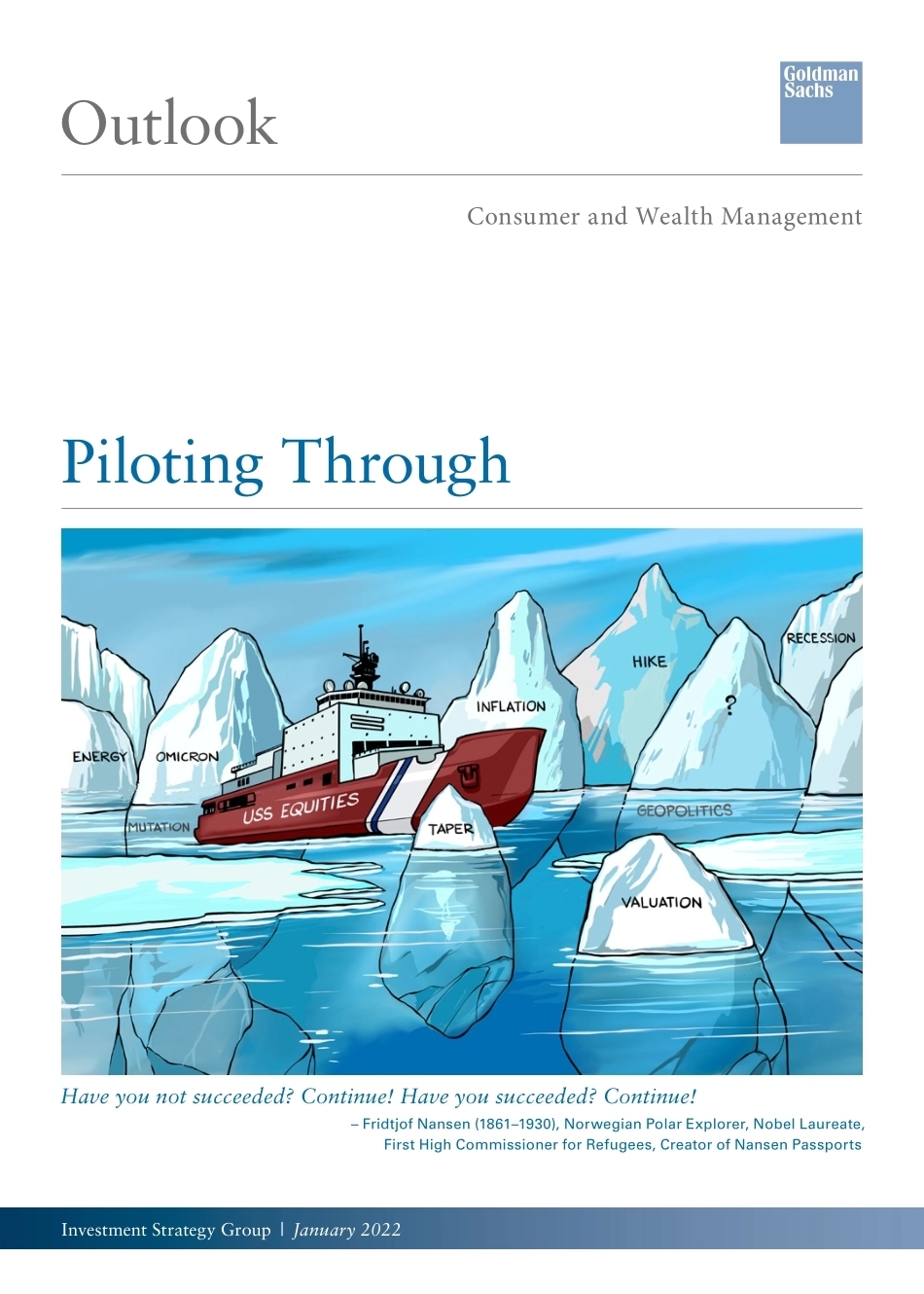
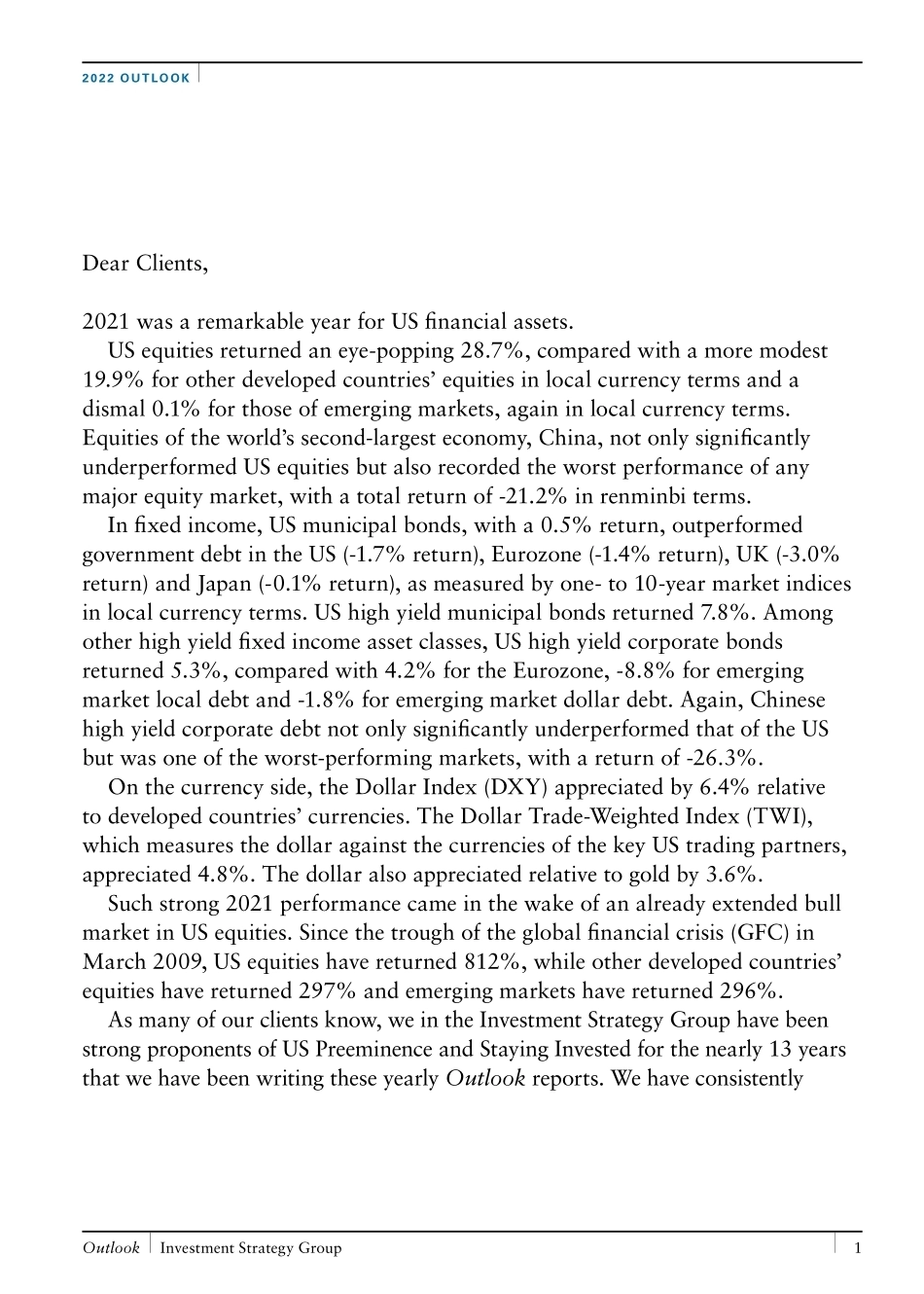
OutlookPiloting ThroughInvestment Strategy Group | January 2022Consumer and Wealth ManagementHave you not succeeded? Continue! Have you succeeded? Continue! – Fridtjof Nansen (1861–1930), Norwegian Polar Explorer, Nobel Laureate, First High Commissioner for Refugees, Creator of Nansen PassportsThis material represents the views of the Investment Strategy Group in the Consumer and Wealth Management Division of Goldman Sachs. It is not a product of Goldman Sachs Global Investment Research. The views and opinions expressed herein may differ from those expressed by other groups of Goldman Sachs.Sharmin Mossavar-Rahmani Chief Investment Officer Investment Strategy Group Goldman Sachs Brett Nelson Head of Tactical Asset Allocation Investment Strategy Group Goldman Sachs The co-authors give special thanks to key contributors from the Investment Strategy Group: Matheus Dibo Vice PresidentKelly Han Vice PresidentHarm Zebregs Vice PresidentYousra Zerouali AnalystAdditional contributors from the Investment Strategy Group:Matthew Weir Managing DirectorVenkatesh Balasubramanian Managing DirectorOussama Fatri Managing DirectorAnna Tokar Vice PresidentYlber Bajraktari Vice PresidentMichael Murdoch Vice PresidentDaniel Toro Vice President1OutlookInvestment Strategy Group2022 OUTLOOKDear Clients, 2021 was a remarkable year for US financial assets. US equities returned an eye-popping 28.7%, compared with a more modest 19.9% for other developed countries’ equities in local currency terms and a dismal 0.1% for those of emerging markets, again in local currency terms. Equities of the world’s second-largest economy, China, not only significantly underperformed US equities but also recorded the worst performance of any major equity market, with a total return of -21.2% in renminbi terms. In fixed income, US municipal bonds, with a 0.5% return, outperformed government debt in the US (-1.7% return), Eurozone (-1.4% return), UK (-3.0% return) and Japan (-0.1% return), as measured by one- to 10-year market indices in local currency terms. US high yield municipal bonds returned 7.8%. Among other high yield fixed income asset classes, US high yield corporate bonds returned 5.3%, compared with 4.2% for the Eurozone, -8.8% for emerging market local debt and -1.8% for emerging market dollar debt. Again, Chinese high yield corporate debt not only significantly underperformed that of the US but was one of the worst-performing markets, with a return of -26.3%. On the currency side, the Dollar Index (DXY) appreciated by 6.4% relative to developed countries’ currencies. The Dollar Trade-Weighted Index (TWI), which measures the dollar against the currencies of the key US trading partners, appreciated 4.8%. The dollar also appreciated relative to gold by 3.6%. Such strong 2021 performance came in the wake of an already extended bull market in US equities. Since the trough of the global financial crisis (GFC) in March 2009, US equities have returned 812%, while other developed countries’ equities have returned 297% and emerging markets have returned 296%. As many of our clients know, we in the Investment Strategy Group have been strong proponents of US Preeminence and Staying Invested for the nearly 13 years that we have been writing these yearly Outlook reports. We have consistently 2Goldman Sachsjanuary 2022recommended clients stay invested in equities and strategically allocate a greater portion of their equity portfolios to US stocks, with the higher allocation funded by a lower allocation to non-US developed and emerging market countries. We have not once recommended clients underweight US equities. Frankly, the magnitude of the returns and the outperformance of US equities relative to non-US equities have far exceeded our expectations. Inevitably, such outsized returns in US financial assets have prompted clients, and even colleagues, to ask, as they regularly have over the last several years, whether we are finally at a tipping point where the stay invested recommendation has reached the end of its shelf life and the time has arrived to underweight US equities. They have cited a litany of concerns, including high equity valuations, a shift in the US Federal Reserve toward tightening of monetary policy, risks of higher inflation, rising geopolitical risks with Russia and China, a virulent strain of domestic politics in the US (which some posit is an existential threat to US democracy), and, importantly, the incertitude about the impact of known and new mutations of SARS-CoV-2, including the highly contagious Omicron variant. Notwithstanding, we believe that the two investment themes of US Preeminence and Staying Invested remain valid. US Preeminence2021 showed the resilience of the US economy, and of its households and businesses, with a strong recovery in growth, employment and profitability. The factors that account for US preeminence are intact: • Higher labor productivity • Higher quality of corporate management 3OutlookInvestment Strat...





发表评论取消回复