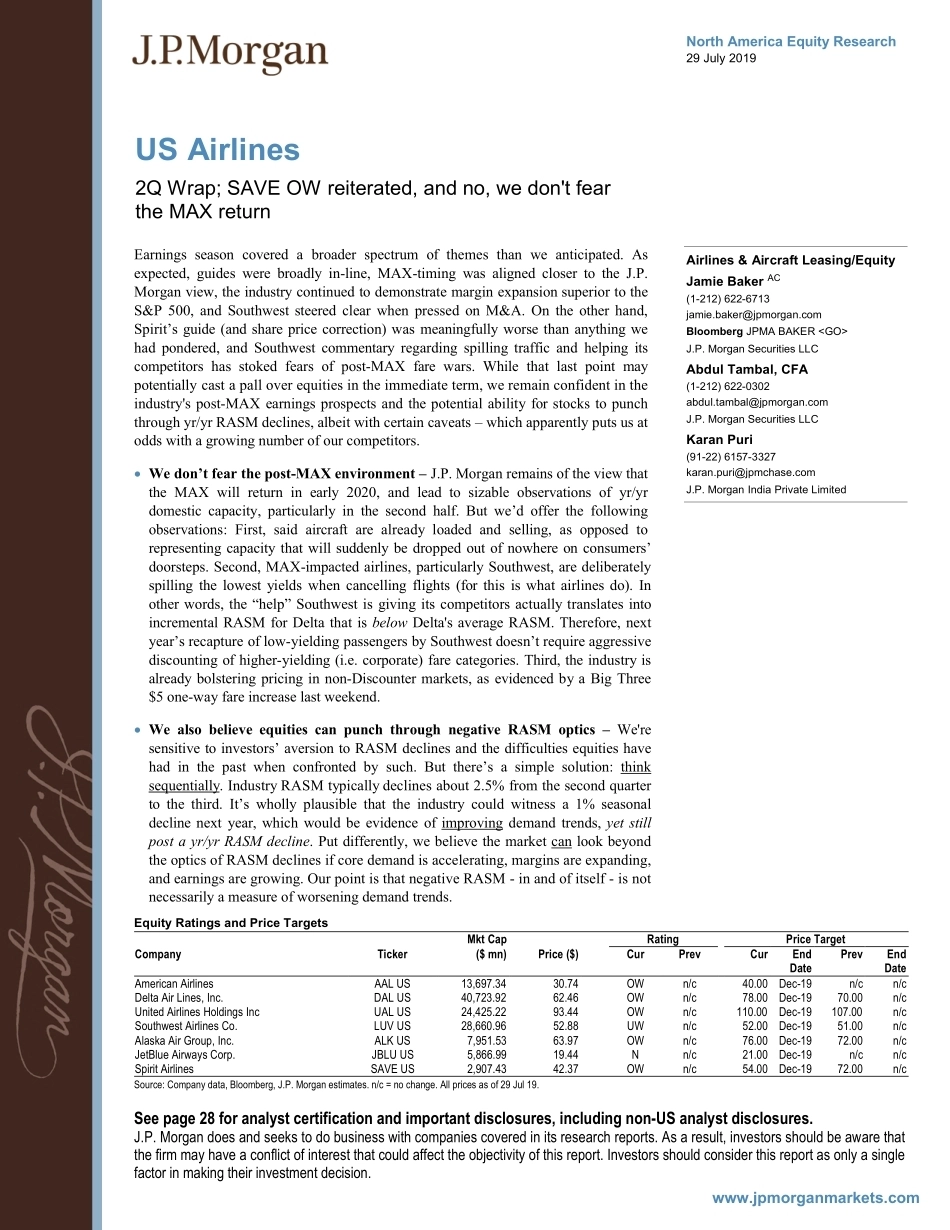
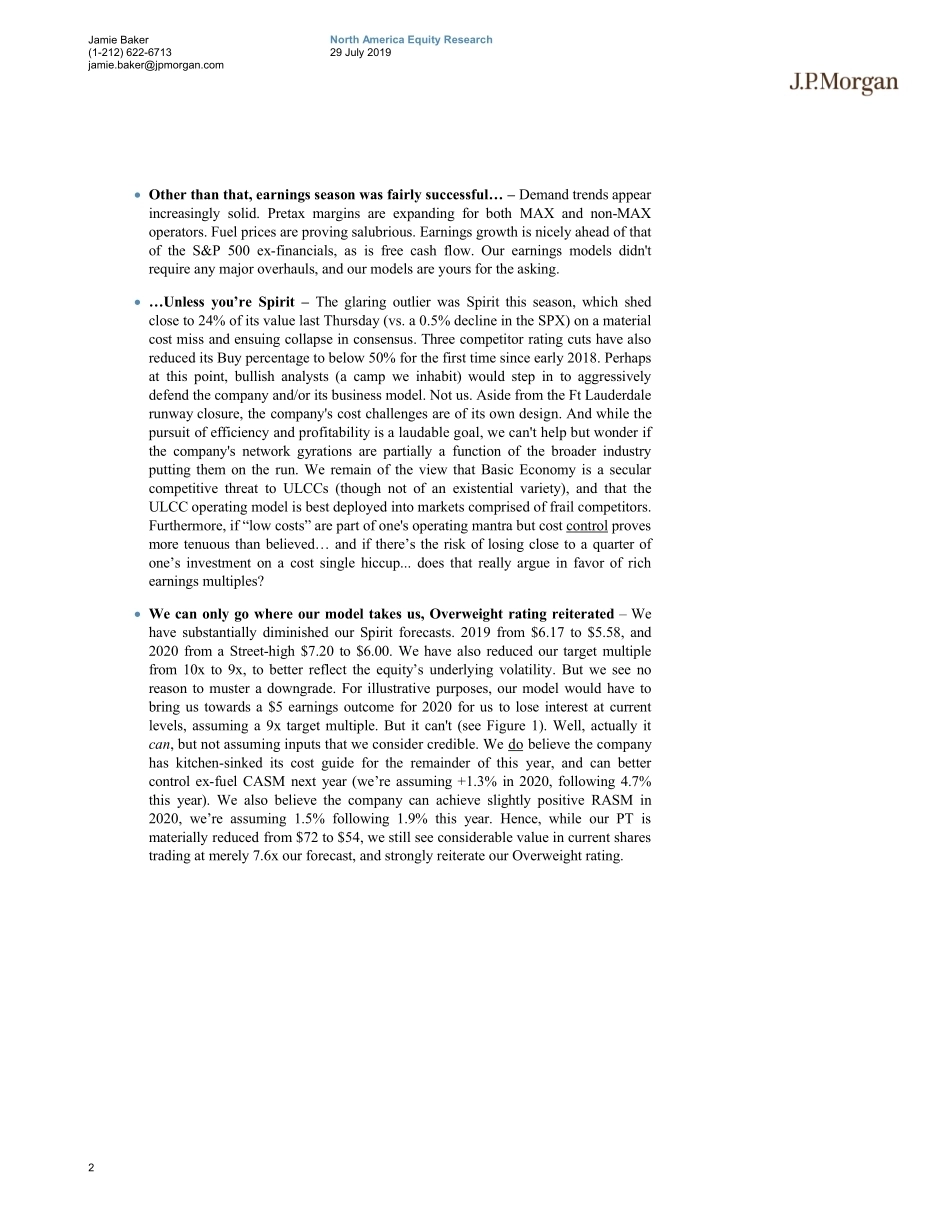
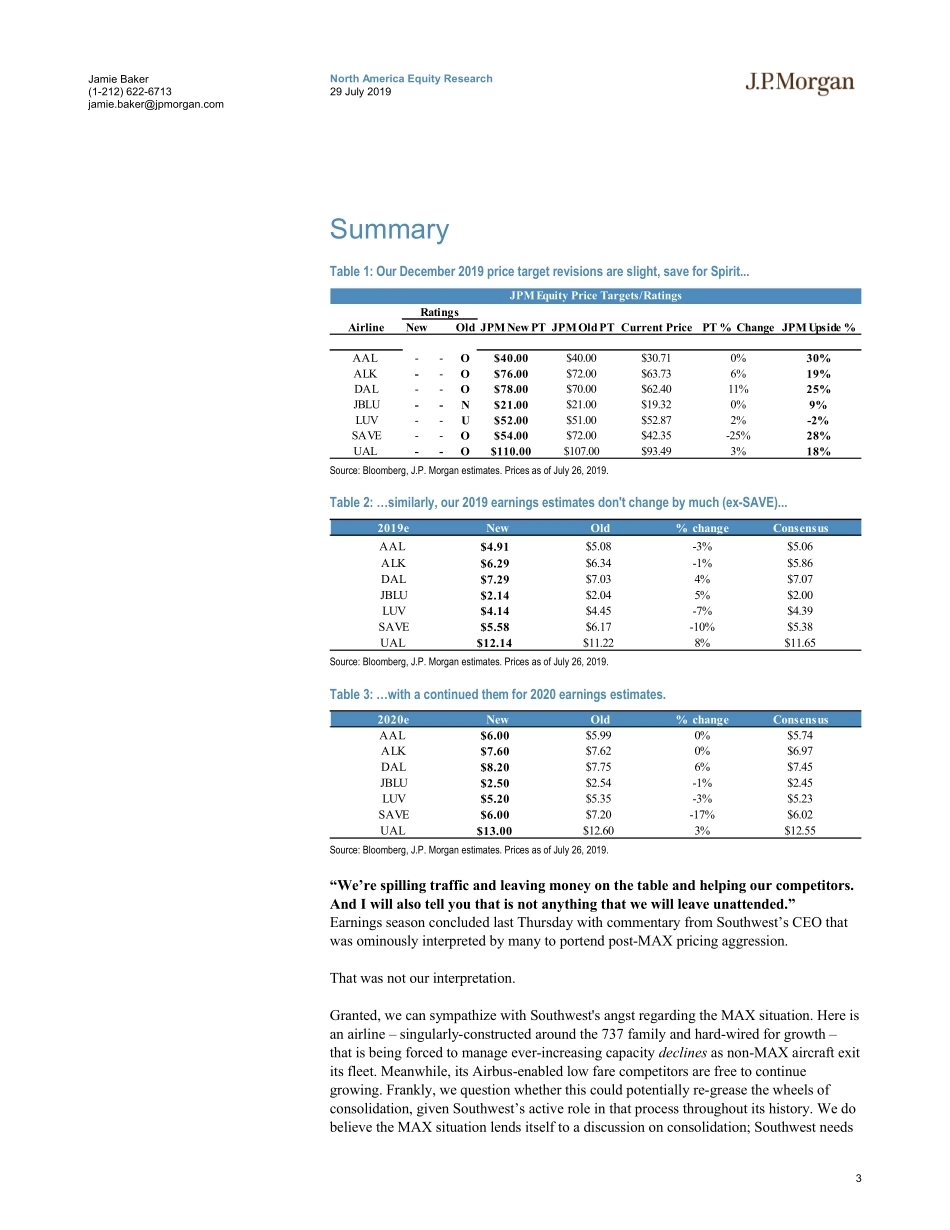
www.jpmorganmarkets.comNorth America Equity Research29 July 2019Equity Ratings and Price TargetsMkt CapRatingPrice TargetCompanyTicker($ mn)Price ($)CurPrevCurEnd DatePrevEnd DateAmerican AirlinesAAL US13,697.3430.74OWn/c40.00Dec-19n/cn/cDelta Air Lines, Inc.DAL US40,723.9262.46OWn/c78.00Dec-1970.00n/cUnited Airlines Holdings IncUAL US24,425.2293.44OWn/c110.00Dec-19107.00n/cSouthwest Airlines Co.LUV US28,660.9652.88UWn/c52.00Dec-1951.00n/cAlaska Air Group, Inc.ALK US7,951.5363.97OWn/c76.00Dec-1972.00n/cJetBlue Airways Corp.JBLU US5,866.9919.44Nn/c21.00Dec-19n/cn/cSpirit AirlinesSAVE US2,907.4342.37OWn/c54.00Dec-1972.00n/cSource: Company data, Bloomberg, J.P. Morgan estimates. n/c = no change. All prices as of 29 Jul 19.US Airlines2Q Wrap; SAVE OW reiterated, and no, we don't fear the MAX returnAirlines & Aircraft Leasing/EquityJamie Baker AC(1-212) 622-6713jamie.baker@jpmorgan.comBloomberg JPMA BAKER J.P. Morgan Securities LLCAbdul Tambal, CFA(1-212) 622-0302abdul.tambal@jpmorgan.comJ.P. Morgan Securities LLCKaran Puri(91-22) 6157-3327karan.puri@jpmchase.comJ.P. Morgan India Private LimitedSee page 28 for analyst certification and important disclosures, including non-US analyst disclosures.J.P. Morgan does and seeks to do business with companies covered in its research reports. As a result, investors should be aware that the firm may have a conflict of interest that could affect the objectivity of this report. Investors should consider this report as only a single factor in making their investment decision.Earnings season covered a broader spectrum of themes than we anticipated. As expected, guides were broadly in-line, MAX-timing was aligned closer to the J.P.Morgan view, the industry continued to demonstrate margin expansion superior to theS&P 500, and Southwest steered clear when pressed on M&A. On the other hand, Spirit’s guide (and share price correction) was meaningfully worse than anything we had pondered, and Southwest commentary regarding spilling traffic and helping its competitors has stoked fears of post-MAX fare wars. While that last point may potentially cast a pall over equities in the immediate term, we remain confident in the industry's post-MAX earnings prospects and the potential ability for stocks to punch through yr/yr RASM declines, albeit with certain caveats – which apparently puts us at odds with a growing number of our competitors. We don’t fear the post-MAX environment – J.P. Morgan remains of the view that the MAX will return in early 2020, and lead to sizable observations of yr/yr domestic capacity, particularly in the second half. But we’d offer the following observations: First, said aircraft are already loaded and selling, as opposed to representing capacity that will suddenly be dropped out of nowhere on consumers’ doorsteps. Second, MAX-impacted airlines, particularly Southwest, are deliberately spilling the lowest yields when cancelling flights (for this is what airlines do). Inother words, the “help” Southwest is giving its competitors actually translates into incremental RASM for Delta that is below Delta's average RASM. Therefore, next year’s recapture of low-yielding passengers by Southwest doesn’t require aggressive discounting of higher-yielding (i.e. corporate) fare categories. Third, the industry is already bolstering pricing in non-Discounter markets, as evidenced by a Big Three$5 one-way fare increase last weekend. We also believe equities can punch through negative RASM optics – We're sensitive to investors’ aversion to RASM declines and the difficulties equities have had in the past when confronted by such. But there’s a simple solution: think sequentially. Industry RASM typically declines about 2.5% from the second quarter to the third. It’s wholly plausible that the industry could witness a 1% seasonal decline next year, which would be evidence of improving demand trends, yet still post a yr/yr RASM decline. Put differently, we believe the market can look beyond the optics of RASM declines if core demand is accelerating, margins are expanding, and earnings are growing. Our point is that negative RASM - in and of itself - is not necessarily a measure of worsening demand trends. 2North America Equity Research29 July 2019Jamie Baker(1-212) 622-6713jamie.baker@jpmorgan.com Other than that, earnings season was fairly successful… – Demand trends appear increasingly solid. Pretax margins are expanding for both MAX and non-MAX operators. Fuel prices are proving salubrious. Earnings growth is nicely ahead of that of the S&P 500 ex-financials, as is free cash flow. Our earnings models didn't require any major overhauls, and our models are yours for the asking. …Unless you’re Spirit – The glaring outlier was Spirit this season, which shed close to 24% of its value last Thursday (vs. a 0.5% decline in the SPX) on a material cost miss and ensuing collapse in consensus. Three competitor rating cuts have also reduced its Buy percentage to below 50% for the first ti...




发表评论取消回复