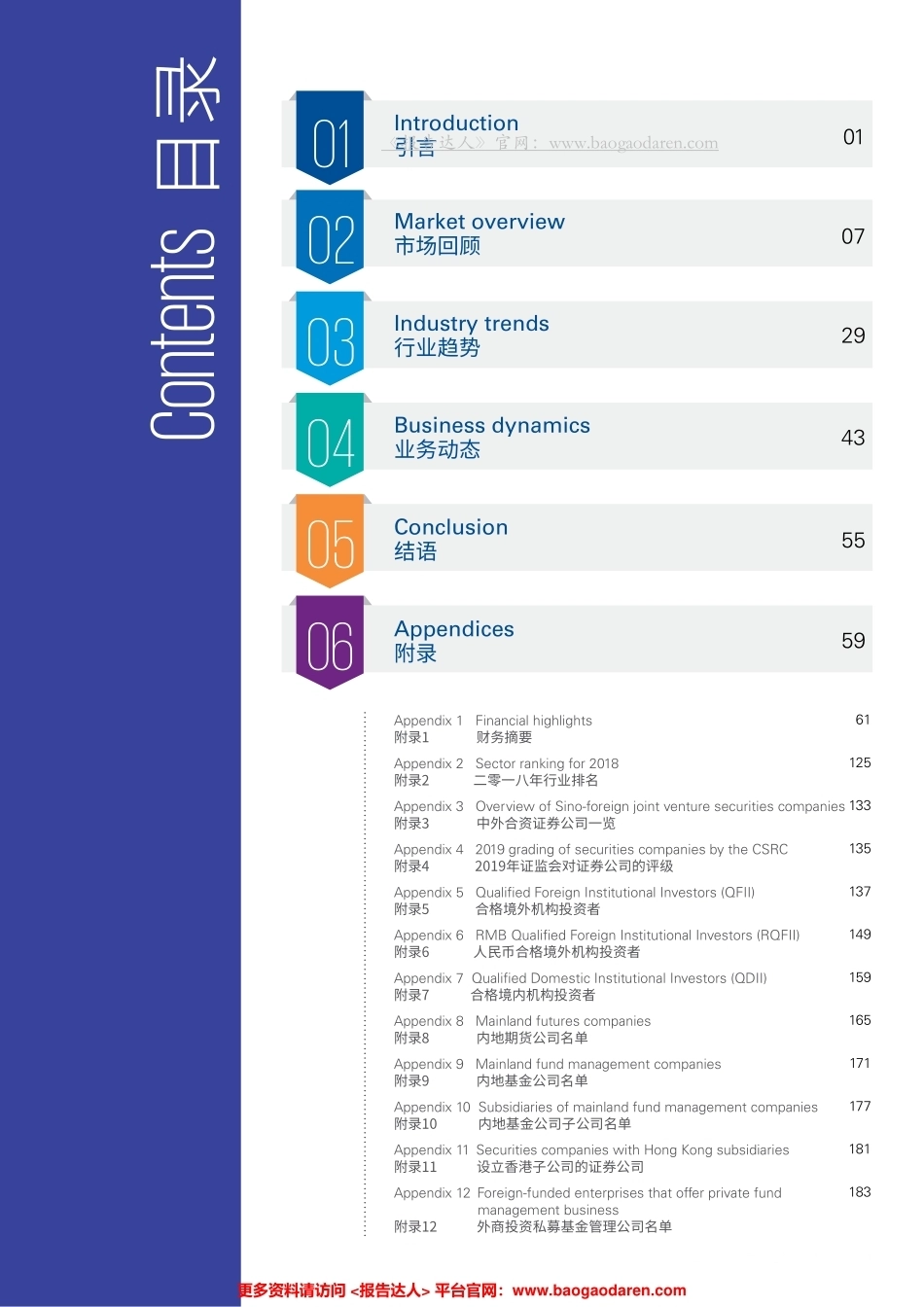
Financial services金融服务kpmg.com/cnMainland China Securities Survey 2019二零一九年 中国证券业 调查报告更多资料请访问 <报告达人> 平台官网:www.baogaodaren.com《报告达人》官网:www.baogaodaren.com0 10 20 30 40 506Contents 目录Introduction 引言Market overview市场回顾Industry trends行业趋势Business dynamics业务动态Conclusion结语Appendices附录Appendix 1 Financial highlights 附录1 财务摘要Appendix 2 Sector ranking for 2018 附录2 二零一八年行业排名Appendix 3 Overview of Sino-foreign joint venture securities companies 附录3 中外合资证券公司一览Appendix 4 2019 grading of securities companies by the CSRC 附录4 2019年证监会对证券公司的评级Appendix 5 Qualified Foreign Institutional Investors (QFII) 附录5 合格境外机构投资者Appendix 6 RMB Qualified Foreign Institutional Investors (RQFII) 附录6 人民币合格境外机构投资者Appendix 7 Qualified Domestic Institutional Investors (QDII) 附录7 合格境内机构投资者Appendix 8 Mainland futures companies 附录8 内地期货公司名单Appendix 9 Mainland fund management companies 附录9 内地基金公司名单Appendix 10 Subsidiaries of mainland fund management companies 附录10 内地基金公司子公司名单Appendix 11 Securities companies with Hong Kong subsidiaries 附录11 设立香港子公司的证券公司Appendix 12 Foreign-funded enterprises that offer private fund management business 附录12 外商投资私募基金管理公司名单010729555961 125 133 135 137 149159 165 171 177 181 18343二零一七年中国证券业调查报告 | 3 更多资料请访问 <报告达人> 平台官网:www.baogaodaren.com《报告达人》官网:www.baogaodaren.comIntroduction 引言011 | Mainland China Securities Survey 2019更多资料请访问 <报告达人> 平台官网:www.baogaodaren.com《报告达人》官网:www.baogaodaren.com二零一九年中国证券业调查报告 | 2 更多资料请访问 <报告达人> 平台官网:www.baogaodaren.com《报告达人》官网:www.baogaodaren.comIntroductionAgainst a backdrop of geopolitical uncertainty, slowing domestic economic growth and a weak A-share market, mainland China's securities industry, reflected a cyclical nature through 2018 to the first half of 2019 and demonstrated the “Matthew effect,” which can be observed by the industry’s increasing market concentration. Despite the slowing growth, securities companies are actively trying to evolve in terms of organisational structure, risk management, business innovation, incentive systems and human resources in order to create new business models and drive growth.According to the audited annual reports of securities companies in China released by the Securities Association of China (SAC), the securities industry realised operating income of RMB 263.3 billion and net profits of RMB 62.4 billion (based on financial statements at the parent company level) in 2018, which represented year-on-year declines of 16 percent and 44 percent, respectively. The total assets of the 131 securities companies that were counted stood at RMB 6.3 trillion, representing a year-on-year increase of 2 percent; net assets amounted to RMB 1.9 trillion, which constituted a year-on-year increase of 2 percent.In 2018, income composition remained in line with the previous year, although the income level from various segments declined in varying degrees. During the year, the proprietary trading segment remained the most significant source of income. This segment realised RMB 86.7 billion in income (including profits or losses arising from changes in fair values and investment income), down 15 percent from 2017. The brokerage segment’s operating income decreased by 22 percent compared with the previous year, and was the result of declining transaction volumes and lower commission rates. The investment banking segment’s income also declined 28 percent year-on-year. This decrease was primarily caused by reduced equity financing. As a result of new asset management regulations that reduced funding channel operations, implemented deleveraging measures and enhanced active management capabilities, the share of the industry’s total operating income increased slightly in 2018, yet the amount was down by 11percent.Regulatory authorities are increasingly balancing the strictness of regulations with the need to promote economic development. On one hand, guidelines and measures related to information technology (IT) management, risk management of stock-pledged repo transactions, internal control over investment banking and asset management are strengthening the regulation of securities companies’ risk and compliance management with regard to IT, credit, investment banking and asset management business. On the other hand, the launch of the Sci-Tech Innovation Board (STAR Market); the deregulation of stock index futures; the relaxation of merger and acquisition (M&A) and restructuring policy, and the approved entry of several securities companies that are controlled by foreign shareholders have stimulated market dynamics and the potential for growth.Securities companies continued to explore ways to transform and set themselves apart from the competition. Supported by financial technology (fintech), retail business lines have gradually transformed their wealth management arms by revamping their organisational structures. At the same time, prime brokerage (PB) businesses have developed rapidly as institutional investors play a greater role, while proprietary trading business has graduall...




发表评论取消回复