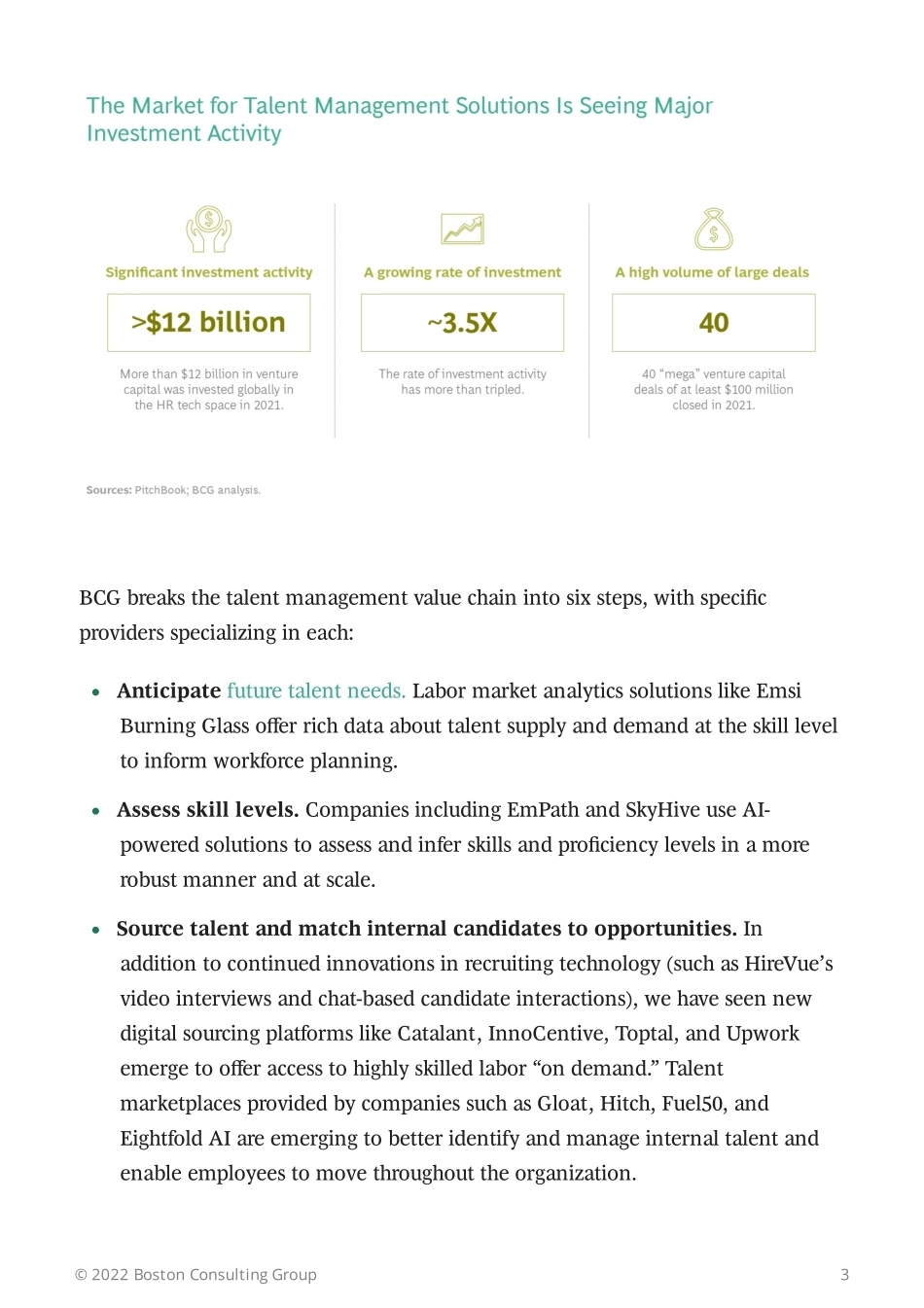
© 2022 Boston Consulting Group1The $12 Billion Opportunity in HR TechnologyMARCH 10, 2022 By Nithya Vaduganathan, Colleen McDonald, Allison Bailey, Renee Laverdiere, David Allred, and Sesh IyerA flood of new solutions is vying to help companies manage their workforce.In this crowded market, players can pursue three strategies to win share.Talent management is a large and growing challenge at many organizations, andtalent management providers are racing to roll out new offerings that can helpbusiness leaders and managers improve how they recruit, oversee, develop, andretain human capital. Many HR tech companies that formerly specialized in asingle aspect of the talent management value chain are building out morecomprehensive offerings, and others are growing through consolidation. Dozens of© 2022 Boston Consulting Group2companies are competing to expand their offerings, causing significant confusionin the market.To create clarity forsolution providers, werecently surveyed morethan 100 CHROs andother business leaders tounderstand their currentpain points and unmetneeds in human capitalmanagement (HCM)technology. Fortechnology providers and the investors that back them, the results offer realinsights into what businesses want. We have also identified several ways that HCMtechnology companies can create advantage by focusing on differentiated data, skilltaxonomies, and a position that connects or orchestrates multiple parts of thetalent value chain.The next 18 to 24 months will be a critical window for providers to stake out theirpositions in this crowded and highly active market. Those that understand theneeds of the market and design smarter solutions to meet those needs will find theodds in their favor.An Explosion in ActivityThe past few years have seen an explosion in activity for talent managementtechnologies. Companies are wrestling with the growing challenge of managingtalent amid changes in work norms due to COVID, the gig economy, and otherfactors. But this challenge brings opportunity, too. In 2021, more than $12 billionin venture capital poured into the HR technology market, with the rate ofinvestment more than tripling from 2020 to 2021, as investors back companieswhose ideas are promising. (See the exhibit.)HCM tech companies canfocus on data, taxonomies,and connecting ororchestrating the value chain.© 2022 Boston Consulting Group3BCG breaks the talent management value chain into six steps, with specificproviders specializing in each:• Anticipate future talent needs. Labor market analytics solutions like EmsiBurning Glass offer rich data about talent supply and demand at the skill levelto inform workforce planning.• Assess skill levels. Companies including EmPath and SkyHive use AI-powered solutions to assess and infer skills and proficiency levels in a morerobust manner and at scale.• Source talent and match internal candidates to opportunities. Inaddition to continued innovations in recruiting technology (such as HireVue’svideo interviews and chat-based candidate interactions), we have seen newdigital sourcing platforms like Catalant, InnoCentive, Toptal, and Upworkemerge to offer access to highly skilled labor “on demand.” Talentmarketplaces provided by companies such as Gloat, Hitch, Fuel50, andEightfold AI are emerging to better identify and manage internal talent andenable employees to move throughout the organization.© 2022 Boston Consulting Group4Enterprise Customers Want an Integrated SolutionDespite all the activity, in many ways the field is still evolving and maturing. Forexample, skill taxonomies are of mixed quality and do not always align with eachother, requiring significant adaptation to specific industries and individualcompanies. Solutions still have only a limited ability to accurately infer employeeskill levels, and even sophisticated matching platforms rely almost exclusively onskills to create matches; they don’t consider factors like personalities or workpreferences that we know are important in building teams. And applications thatrely on analytics need to build controls to identify and dismantle bias—rather thanamplifying it as some early-stage use cases have done.More broadly, companies struggle to keep up with the variety of disconnectedsolutions for individual aspects of the value chain. That has led to a kind of armsrace in the industry, as providers that are strong in one area of the value chain seekto address other areas. For example, Microso announced a partnership in early2020 with Oracle to track job applicants more effectively by integrating LinkedInemployee profile data with the Microso Viva platform. Similarly, staffing agency• Develop the skills and capabilities of the current workforce. A growingsuite of learning and development companies like Degreed, EdCast, andBetterUp enable reskilling and upskilling and help managers identify internalcandidates for specific roles.• Embed workers in the organization. Solutions like Starmind and MicrosoViva Topics pro...




发表评论取消回复