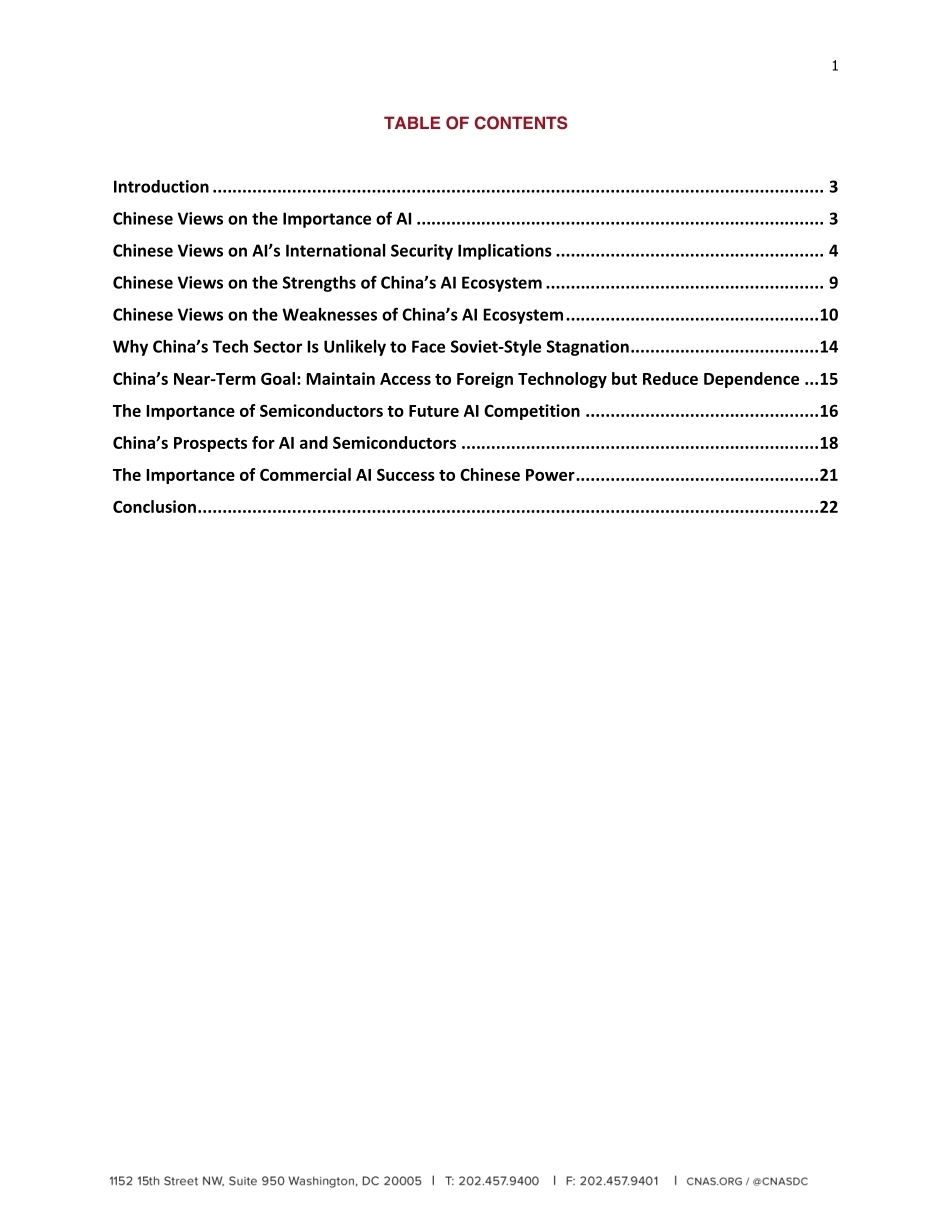
UNCLASSIFIED // FOR OFFICIAL USE ONLY Understanding China’s AI Strategy: Clues to Chinese Strategic Thinking on Artificial Intelligence and National Security February 2019 By Gregory C. Allen 每日免费阅读行业报告1、每日星球内分享10+精品报告;2、不定时分享国际投行报告,脱水研报等;3、行业报告均为公开内容,版权归原作者所有,星球仅分享内部学习。扫描右侧二维码即刻加入【行业报告(免费) 】星球(此页只为更多需要行业报告的朋友提供便利,希望不会影响您的阅读,谢谢理解!) 1 1 TABLE OF CONTENTS Introduction ........................................................................................................................... 3 Chinese Views on the Importance of AI .................................................................................. 3 Chinese Views on AI’s International Security Implications ...................................................... 4 Chinese Views on the Strengths of China’s AI Ecosystem ........................................................ 9 Chinese Views on the Weaknesses of China’s AI Ecosystem ................................................... 10 Why China’s Tech Sector Is Unlikely to Face Soviet-Style Stagnation ...................................... 14 China’s Near-Term Goal: Maintain Access to Foreign Technology but Reduce Dependence ... 15 The Importance of Semiconductors to Future AI Competition ............................................... 16 China’s Prospects for AI and Semiconductors ........................................................................ 18 The Importance of Commercial AI Success to Chinese Power ................................................. 21 Conclusion ............................................................................................................................. 22 2 2 ABOUT THE AUTHOR Gregory C. Allen is an adjunct senior fellow with the Technology and National Security Program at the Center for a New American Security (CNAS). For more information, contact: Principal Investigator Gregory Allen Adjunct Senior Fellow Technology and National Security Center for a New American Security Email: gallen@cnas.org / info@cnas.org ACKNOWLEDGMENTS I would like to thank Graham Allison, Jason Matheny, Paul Scharre, Richard Danzig, Matt Daniels, Joseph Nye, Helen Toner, Carrick Flynn, Lora Saalman, Elsa Kania, Ben Chang, and Tim Hwang for for their valuable input, feedback, and suggestions for this report. I would like to thank Jeffrey Ding, Elsa Kania, Rogier Creemers, Graham Webster, Lorand Laskai, Mingli Shi, Dahlia Peterson, Samm Sacks, Cameron Hickert, Paul Triolo, and others for the extremely valuable work they do translating Chinese government and corporate publications on Artificial Intelligence into English. I would like to thank the following institutions for their invitations to participate in conferences and meetings in China and Hong Kong on Artificial Intelligence: • Tsinghua University and the Chinese People’s Institute of Foreign Affairs: World Peace Forum, Beijing, July 13-15, 2018 • China Academy of Military Science and the China Institute of International Strategic Studies: 8th Beijing Xiangshan Forum, Beijing, October 24-26, 2018 • JP Morgan: Global Technology, Media, and Telecom Conference in Asia, Hong Kong, November 14-15, 2018 • Atlantic Council Scowcroft Center and The Swedish Ministry of Foreign Affairs: Fact Finding Trip on Chinese Technological Innovation, Shenzhen, December 3-7, 2018. Finally, I would like to thank the dozens of individuals with whom I met on trips to China. Their willingness to engage was critical to this report. Where they engaged with an expectation of anonymity or non-public disclosure, I have made sure to respect that here. Views expressed in this report are the author’s alone. CNAS does not take institutional positions. 3 3 INTRODUCTION In the second half of 2018, I traveled to China on four separate trips to attend major diplomatic, military, and private-sector conferences focusing on Artificial Intelligence (AI). During these trips, I participated in a series of meetings with high-ranking Chinese officials in China’s Ministry of Foreign Affairs, leaders of China’s military AI research organizations, government think tank experts, and corporate executives at Chinese AI companies. From these discussions – as well as my ongoing work analyzing China’s AI industry, policies, reports, and programs – I have arrived at a number of key judgments about Chinese leadership’s views, strategies, and prospects for AI as it applies to China’s economy and national security. Of course, China’s leadership in this area is a large population with diversity in its views, and any effort to generalize is inherently presumptuous and essentially guaranteed to oversimplify. However, the distance is large between prevailing views in American commentary on China’s AI efforts and what I have come to believe are the facts. I hope by stating my takeaways directly, this report will advance the assessment of this issue and be of benefit to the wider U.S. policymaking community. CHINESE VIEWS ON THE IMPORTANCE OF AI 1. China’s leadership – including Preside...




发表评论取消回复