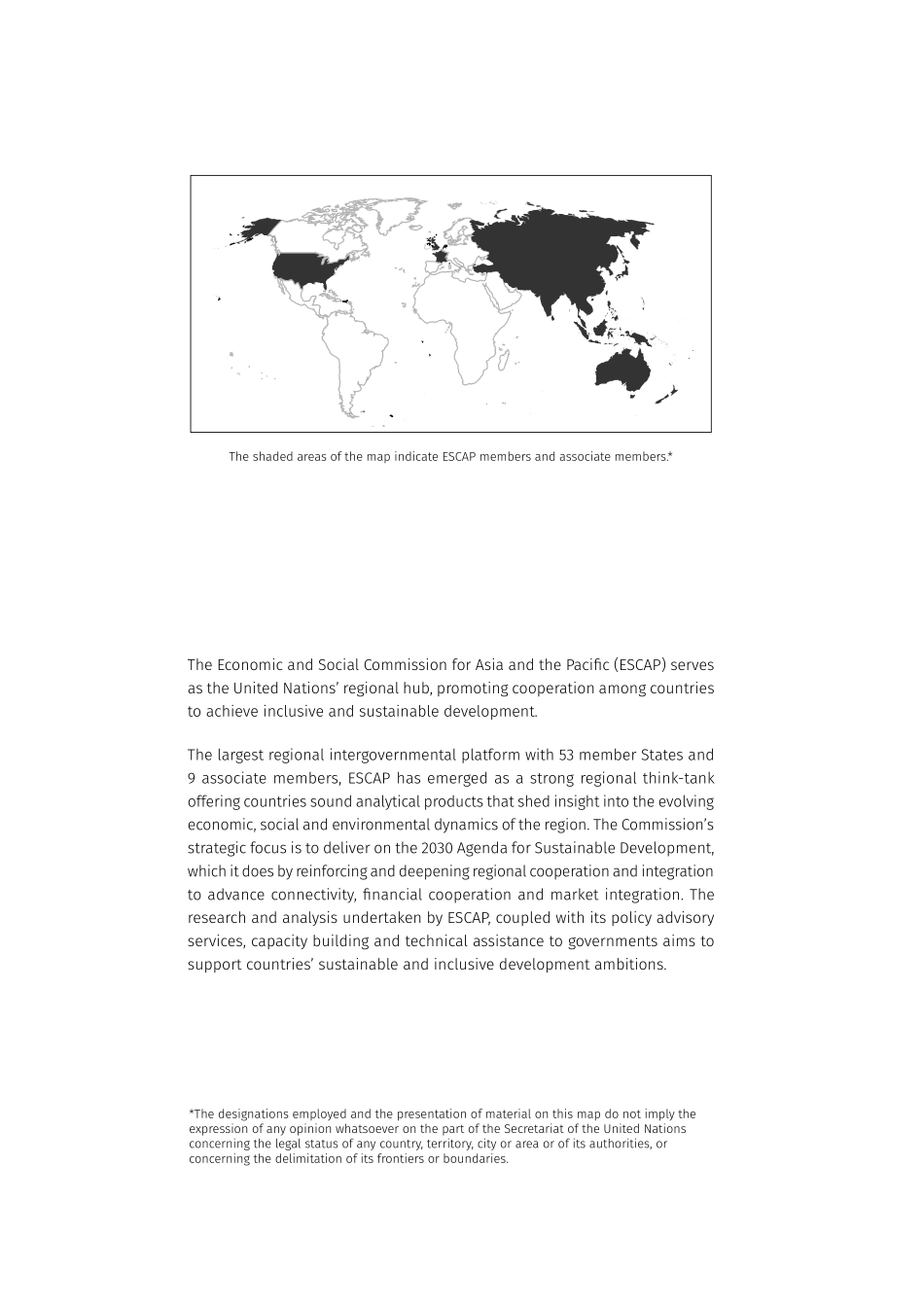
AND ENERGY TRANSITION PATHWAYS FOR ASIA AND THE PACIFICCOAL PHASE OUT *The designations employed and the presentation of material on this map do not imply the expression of any opinion whatsoever on the part of the Secretariat of the United Nations concerning the legal status of any country, territory, city or area or of its authorities, or concerning the delimitation of its frontiers or boundaries.The shaded areas of the map indicate ESCAP members and associate members.*The Economic and Social Commission for Asia and the Pacific (ESCAP) serves as the United Nations’ regional hub, promoting cooperation among countries to achieve inclusive and sustainable development.The largest regional intergovernmental platform with 53 member States and 9 associate members, ESCAP has emerged as a strong regional think-tank offering countries sound analytical products that shed insight into the evolving economic, social and environmental dynamics of the region. The Commission’s strategic focus is to deliver on the 2030 Agenda for Sustainable Development, which it does by reinforcing and deepening regional cooperation and integration to advance connectivity, financial cooperation and market integration. The research and analysis undertaken by ESCAP, coupled with its policy advisory services, capacity building and technical assistance to governments aims to support countries’ sustainable and inclusive development ambitions.AND ENERGY TRANSITION PATHWAYS FOR ASIA AND THE PACIFICCOAL PHASE OUT United Nations publication Copyright @ United Nations 2021 All rights reserved ST/ESCAP/2936This publication may be reproduced in whole or in part for educational or non-profit purposes without special permission from the copyright holder, provided that the source is acknowledged. The ESCAP Publications Office would appreciate receiving a copy of any publication that uses this publication as a source. Use may not be made of this publication for resale or any other commercial purpose whatsoever without prior permission. Applications for such permission, with a statement of the purpose and extent of reproduction, should be addressed to the Secretary of the Publications Board, United Nations, New York. The designations employed and the presentation of the material in this publication do not imply the expression of any opinion on the part of the United Nations concerning the legal status of any country, territory, city or area, or of its authorities, or concerning the delimitation of its frontier or boundaries.References to dollars ($) are to United States dollars unless otherwise stated.Photo creditsCover Neuwieser/Flickr.com Istock.com photo #586163548page 16 Istock.com photo #1192528175page 26 Istock.com photo # 586073426COAL PHASE OUT AND ENERGY TRANSITION PATHWAYS FOR ASIA AND THE PACIFICContentsAcknowledgement vExecutive summary viIntroduction 1Chapter 1 Current situation, trends and expansion plans 31.1 Current role of coal for power generation in the Asia-Pacific region 31.2 Planned coal fired power generation 61.3 Emissions from coal power generation not consistent with the Paris Agreement 141.4 Impact of COVID-19 crisis on policies for phasing out of coal in the South-East Asia subregion 19Chapter 2 Drivers of coal expansion in the region 212.1 Asian countries are joining the global trend away from coal 212.2 Drivers of coal expansion in Asia and the Pacific 22Chapter 3 How can trends be reversed – pathways for a transition to clean energy 273.1 Paris Agreement compatible energy transition 273.2 Renewable energy potential 353.3 Comparison of costs for renewable energy and storage vs. fossil fuel technologies 373.4 Integration to maximise benefits from renewable energy potential 40Chapter 4 Benefits of a transition from coal towards renewable-based efficient energy system 414.1 Access to clean and affordable energy 414.2 Employment 424.3 Health, reduced air and water pollution, and impact on water scarcity 424.4 Avoided risk of stranded investments 434.5 Energy security and independence 434.6 Environmental degradation 434.7 Land use 444.8 Shifting investment – opportunities for a green COVID-19 recovery 454.9 Economic impacts of climate change 46Chapter 5 Conclusion and recommendations 51References 59Annexes 64Annex 1 Asia-Pacific coal fleet pipeline 64Annex 2 Climate change impacts 65ii List of boxesBox 1 \ The additional burden of COVID-19 44List of figuresFigure 1 \ CO2 emissions from coal by sector 3Figure 2 \ Coal generation as percentage of national electricity generation in 2019 4Figure 3 \ Current coal fleet and pipeline in Asia-Pacific region by status and technology 8Figure 4 \ Current coal fleet and pipeline (left) and age distribution (right) in the North and Central Asia (NCA) subregion by status and technology 10Figure 5 \ Current coal fleet and pipeline in countries in the East and North-East subregion (ENEA) with stable or contracting coal capacity, by status and combustion technology 11Figure 6 \ Current coal fleet ...




发表评论取消回复