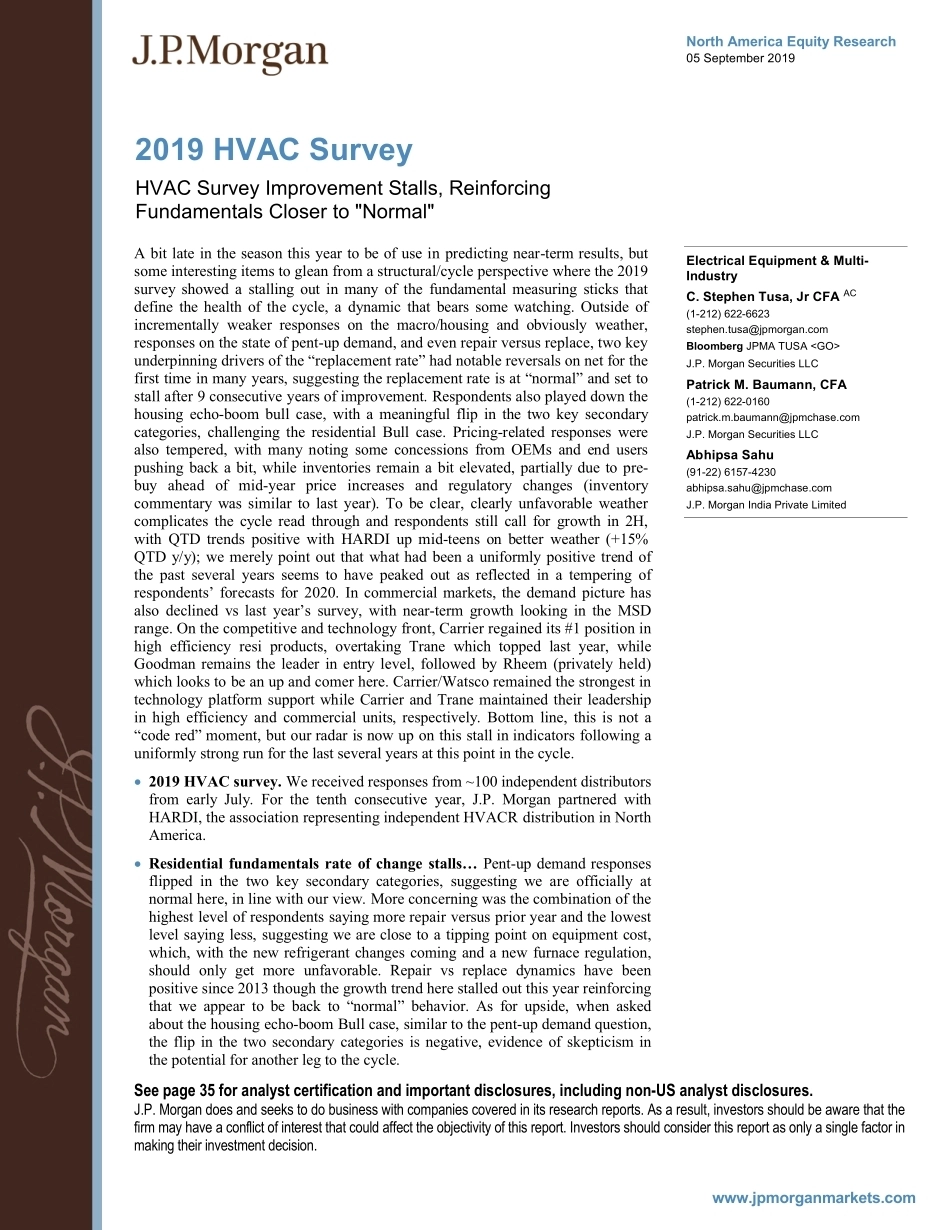
www.jpmorganmarkets.comNorth America Equity Research05 September 20192019 HVAC SurveyHVAC Survey Improvement Stalls, Reinforcing Fundamentals Closer to "Normal"Electrical Equipment & Multi-IndustryC. Stephen Tusa, Jr CFA AC(1-212) 622-6623stephen.tusa@jpmorgan.comBloomberg JPMA TUSA J.P. Morgan Securities LLCPatrick M. Baumann, CFA(1-212) 622-0160patrick.m.baumann@jpmchase.comJ.P. Morgan Securities LLCAbhipsa Sahu(91-22) 6157-4230abhipsa.sahu@jpmchase.comJ.P. Morgan India Private LimitedSee page 35 for analyst certification and important disclosures, including non-US analyst disclosures.J.P. Morgan does and seeks to do business with companies covered in its research reports. As a result, investors should be aware that the firm may have a conflict of interest that could affect the objectivity of this report. Investors should consider this report as only a single factor in making their investment decision.A bit late in the season this year to be of use in predicting near-term results, but some interesting items to glean from a structural/cycle perspective where the 2019 survey showed a stalling out in many of the fundamental measuring sticks that define the health of the cycle, a dynamic that bears some watching. Outside of incrementally weaker responses on the macro/housing and obviously weather, responses on the state of pent-up demand, and even repair versus replace, two key underpinning drivers of the “replacement rate” had notable reversals on net for the first time in many years, suggesting the replacement rate is at “normal” and set to stall after 9 consecutive years of improvement. Respondents also played down the housing echo-boom bull case, with a meaningful flip in the two key secondary categories, challenging the residential Bull case. Pricing-related responses were also tempered, with many noting some concessions from OEMs and end users pushing back a bit, while inventories remain a bit elevated, partially due to pre-buy ahead of mid-year price increases and regulatory changes (inventory commentary was similar to last year). To be clear, clearly unfavorable weather complicates the cycle read through and respondents still call for growth in 2H, with QTD trends positive with HARDI up mid-teens on better weather (+15% QTD y/y); we merely point out that what had been a uniformly positive trend of the past several years seems to have peaked out as reflected in a tempering of respondents’ forecasts for 2020. In commercial markets, the demand picture has also declined vs last year’s survey, with near-term growth looking in the MSD range. On the competitive and technology front, Carrier regained its #1 position in high efficiency resi products, overtaking Trane which topped last year, while Goodman remains the leader in entry level, followed by Rheem (privately held) which looks to be an up and comer here. Carrier/Watsco remained the strongest in technology platform support while Carrier and Trane maintained their leadership in high efficiency and commercial units, respectively. Bottom line, this is not a “code red” moment, but our radar is now up on this stall in indicators following a uniformly strong run for the last several years at this point in the cycle. 2019 HVAC survey. We received responses from ~100 independent distributors from early July. For the tenth consecutive year, J.P. Morgan partnered with HARDI, the association representing independent HVACR distribution in North America. Residential fundamentals rate of change stalls… Pent-up demand responses flipped in the two key secondary categories, suggesting we are officially at normal here, in line with our view. More concerning was the combination of the highest level of respondents saying more repair versus prior year and the lowest level saying less, suggesting we are close to a tipping point on equipment cost, which, with the new refrigerant changes coming and a new furnace regulation, should only get more unfavorable. Repair vs replace dynamics have been positive since 2013 though the growth trend here stalled out this year reinforcing that we appear to be back to “normal” behavior. As for upside, when asked about the housing echo-boom Bull case, similar to the pent-up demand question, the flip in the two secondary categories is negative, evidence of skepticism in the potential for another leg to the cycle.2North America Equity Research05 September 2019C. Stephen Tusa, Jr CFA(1-212) 622-6623stephen.tusa@jpmorgan.com …while distributors also see signs of slowing US economy, beyond theunfavorable weather. The survey reflected a less confident and rather neutral consumer including neutral to slightly negative residential construction trends.It’s tough to tell how respondents separated the weather impact from that of the macro, though the more HVAC-specific responses above reinforce a slowing in fundamentals that appears to be beyond the weather. Pricing dynamics moderate, some pre-buy. Industry pricing remains positive though at a s...




发表评论取消回复