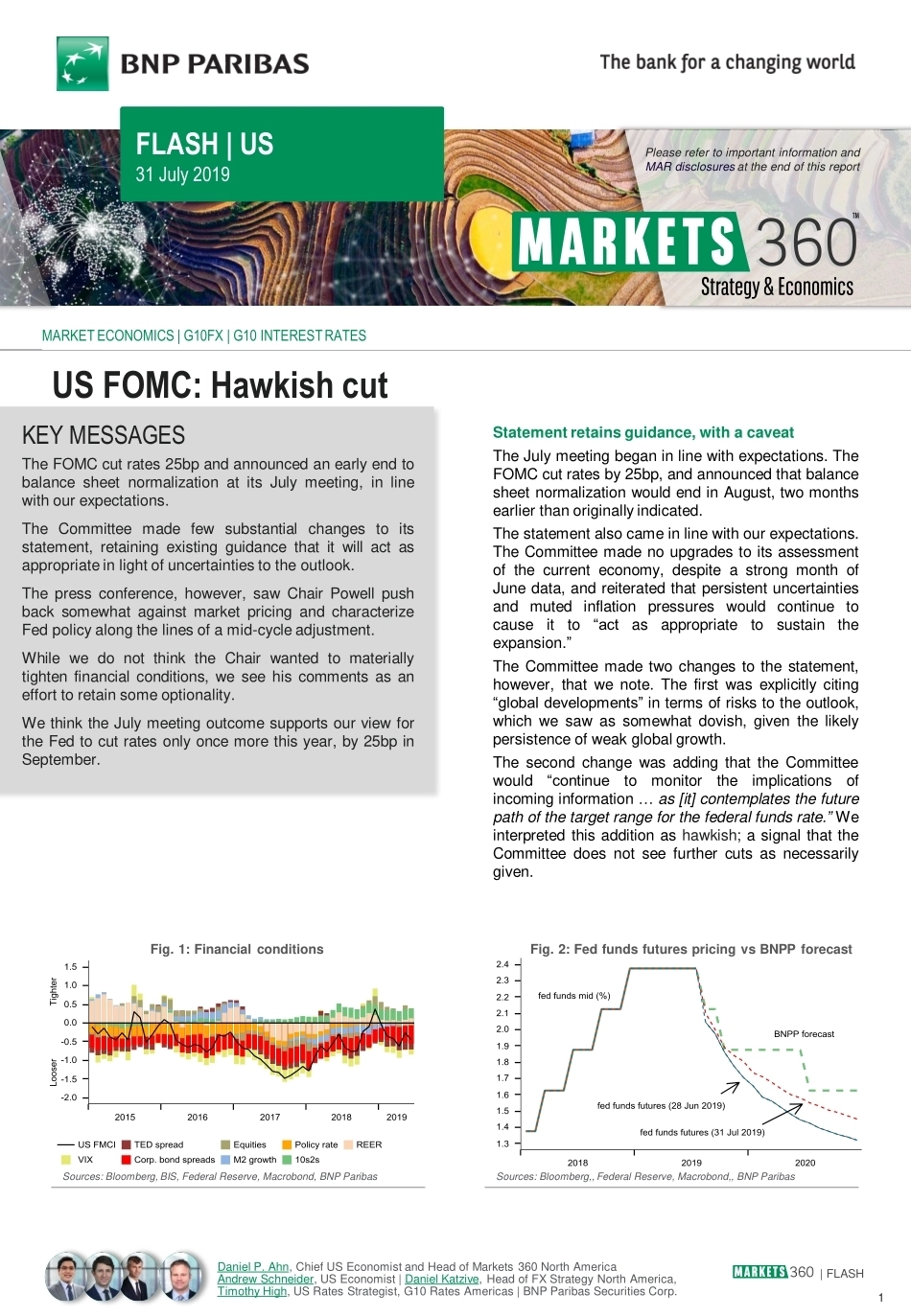
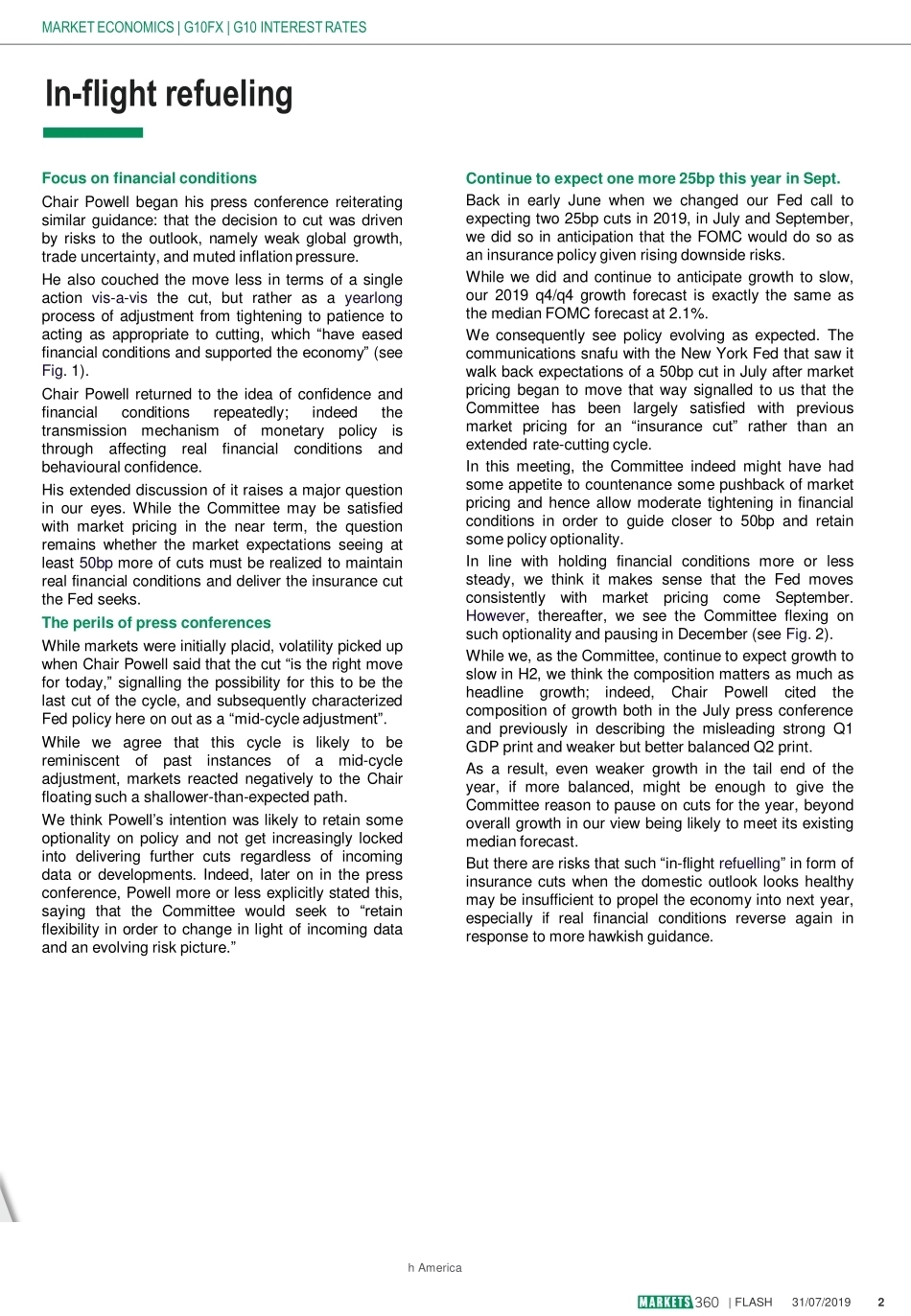
MARKET ECONOMICS | G10FX | G10 INTEREST RATES KEY MESSAGES The FOMC cut rates 25bp and announced an early end to balance sheet normalization at its July meeting, in line with our expectations. The Committee made few substantial changes to its statement, retaining existing guidance that it will act as appropriate in light of uncertainties to the outlook. The press conference, however, saw Chair Powell push back somewhat against market pricing and characterize Fed policy along the lines of a mid-cycle adjustment. While we do not think the Chair wanted to materially tighten financial conditions, we see his comments as an effort to retain some optionality. We think the July meeting outcome supports our view for the Fed to cut rates only once more this year, by 25bp in September. FLASH | US 31 July 2019 Statement retains guidance, with a caveat The July meeting began in line with expectations. The FOMC cut rates by 25bp, and announced that balance sheet normalization would end in August, two months earlier than originally indicated. The statement also came in line with our expectations. The Committee made no upgrades to its assessment of the current economy, despite a strong month of June data, and reiterated that persistent uncertainties and muted inflation pressures would continue to cause it to “act as appropriate to sustain the expansion.” The Committee made two changes to the statement, however, that we note. The first was explicitly citing “global developments” in terms of risks to the outlook, which we saw as somewhat dovish, given the likely persistence of weak global growth. The second change was adding that the Committee would “continue to monitor the implications of incoming information … as [it] contemplates the future path of the target range for the federal funds rate.” We interpreted this addition as hawkish; a signal that the Committee does not see further cuts as necessarily given. Daniel P. Ahn, Chief US Economist and Head of Markets 360 North America Andrew Schneider, US Economist | Daniel Katzive, Head of FX Strategy North America, Timothy High, US Rates Strategist, G10 Rates Americas | BNP Paribas Securities Corp. Please refer to important information and MAR disclosures at the end of this report US FOMC: Hawkish cut Fig. 1: Financial conditions Fig. 2: Fed funds futures pricing vs BNPP forecast Sources: Bloomberg,, Federal Reserve, Macrobond,, BNP Paribas Sources: Bloomberg, BIS, Federal Reserve, Macrobond, BNP Paribas 1 | FLASH | FLASH 31/07/2019 2 Continue to expect one more 25bp this year in Sept. Back in early June when we changed our Fed call to expecting two 25bp cuts in 2019, in July and September, we did so in anticipation that the FOMC would do so as an insurance policy given rising downside risks. While we did and continue to anticipate growth to slow, our 2019 q4/q4 growth forecast is exactly the same as the median FOMC forecast at 2.1%. We consequently see policy evolving as expected. The communications snafu with the New York Fed that saw it walk back expectations of a 50bp cut in July after market pricing began to move that way signalled to us that the Committee has been largely satisfied with previous market pricing for an “insurance cut” rather than an extended rate-cutting cycle. In this meeting, the Committee indeed might have had some appetite to countenance some pushback of market pricing and hence allow moderate tightening in financial conditions in order to guide closer to 50bp and retain some policy optionality. In line with holding financial conditions more or less steady, we think it makes sense that the Fed moves consistently with market pricing come September. However, thereafter, we see the Committee flexing on such optionality and pausing in December (see Fig. 2). While we, as the Committee, continue to expect growth to slow in H2, we think the composition matters as much as headline growth; indeed, Chair Powell cited the composition of growth both in the July press conference and previously in describing the misleading strong Q1 GDP print and weaker but better balanced Q2 print. As a result, even weaker growth in the tail end of the year, if more balanced, might be enough to give the Committee reason to pause on cuts for the year, beyond overall growth in our view being likely to meet its existing median forecast. But there are risks that such “in-flight refuelling” in form of insurance cuts when the domestic outlook looks healthy may be insufficient to propel the economy into next year, especially if real financial conditions reverse again in response to more hawkish guidance. Focus on financial conditions Chair Powell began his press conference reiterating similar guidance: that the decision to cut was driven by risks to the outlook, namely weak global growth, trade uncertainty, and muted inflation pressure. He also couched the move less in terms of a single action vis-a-vis the cut, but rather as a yearlong process of adjustment from tightening to patience t...




发表评论取消回复