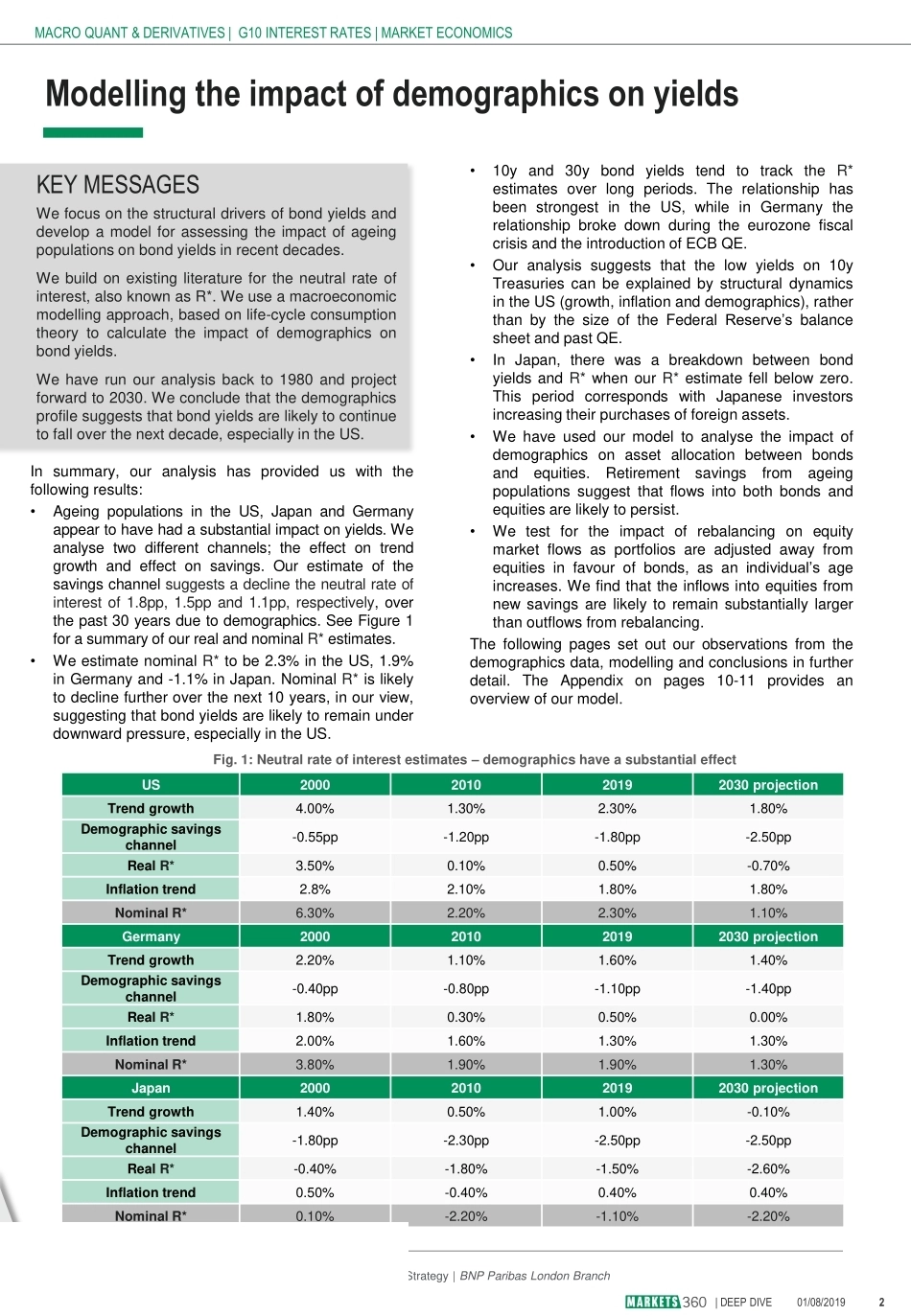
ASSESSING THE IMPACT OF AGEING POPULATIONS ON YIELDS LIFE-CYCLE MODELLING OF THE NEUTRAL RATE OF INTEREST Please refer to important information at the end of this report MACRO QUANT & DERIVATIVES | G10 INTEREST RATES | MARKET ECONOMICS 1 August 2019 | DEEP DIVE 01/08/2019 2 Modelling the impact of demographics on yields MACRO QUANT & DERIVATIVES | G10 INTEREST RATES | MARKET ECONOMICS •10y and 30y bond yields tend to track the R* estimates over long periods. The relationship has been strongest in the US, while in Germany the relationship broke down during the eurozone fiscal crisis and the introduction of ECB QE. •Our analysis suggests that the low yields on 10y Treasuries can be explained by structural dynamics in the US (growth, inflation and demographics), rather than by the size of the Federal Reserve’s balance sheet and past QE. •In Japan, there was a breakdown between bond yields and R* when our R* estimate fell below zero. This period corresponds with Japanese investors increasing their purchases of foreign assets. •We have used our model to analyse the impact of demographics on asset allocation between bonds and equities. Retirement savings from ageing populations suggest that flows into both bonds and equities are likely to persist. •We test for the impact of rebalancing on equity market flows as portfolios are adjusted away from equities in favour of bonds, as an individual’s age increases. We find that the inflows into equities from new savings are likely to remain substantially larger than outflows from rebalancing. The following pages set out our observations from the demographics data, modelling and conclusions in further detail. The Appendix on pages 10-11 provides an overview of our model. KEY MESSAGES We focus on the structural drivers of bond yields and develop a model for assessing the impact of ageing populations on bond yields in recent decades. We build on existing literature for the neutral rate of interest, also known as R*. We use a macroeconomic modelling approach, based on life-cycle consumption theory to calculate the impact of demographics on bond yields. We have run our analysis back to 1980 and project forward to 2030. We conclude that the demographics profile suggests that bond yields are likely to continue to fall over the next decade, especially in the US. In summary, our analysis has provided us with the following results: •Ageing populations in the US, Japan and Germany appear to have had a substantial impact on yields. We analyse two different channels; the effect on trend growth and effect on savings. Our estimate of the savings channel suggests a decline the neutral rate of interest of 1.8pp, 1.5pp and 1.1pp, respectively, over the past 30 years due to demographics. See Figure 1 for a summary of our real and nominal R* estimates. •We estimate nominal R* to be 2.3% in the US, 1.9% in Germany and -1.1% in Japan. Nominal R* is likely to decline further over the next 10 years, in our view, suggesting that bond yields are likely to remain under downward pressure, especially in the US. US 2000 2010 2019 2030 projection Trend growth 4.00% 1.30% 2.30% 1.80% Demographic savings channel -0.55pp -1.20pp -1.80pp -2.50pp Real R* 3.50% 0.10% 0.50% -0.70% Inflation trend 2.8% 2.10% 1.80% 1.80% Nominal R* 6.30% 2.20% 2.30% 1.10% Germany 2000 2010 2019 2030 projection Trend growth 2.20% 1.10% 1.60% 1.40% Demographic savings channel -0.40pp -0.80pp -1.10pp -1.40pp Real R* 1.80% 0.30% 0.50% 0.00% Inflation trend 2.00% 1.60% 1.30% 1.30% Nominal R* 3.80% 1.90% 1.90% 1.30% Japan 2000 2010 2019 2030 projection Trend growth 1.40% 0.50% 1.00% -0.10% Demographic savings channel -1.80pp -2.30pp -2.50pp -2.50pp Real R* -0.40% -1.80% -1.50% -2.60% Inflation trend 0.50% -0.40% 0.40% 0.40% Nominal R* 0.10% -2.20% -1.10% -2.20% Fig. 1: Neutral rate of interest estimates – demographics have a substantial effect Sources: BNP Paribas, CBO, Macrobond, IMF Michael Sneyd, Head of Macro Quantitative & Derivatives Strategy | BNP Paribas London Branch | DEEP DIVE 01/08/2019 3 The impact of demographics on the neutral rate of interest We focus on two channels by which demographics can impact R* and therefore nominal yields in the market: 1)The impact of demographic shifts on the growth of the working-age population, which has a direct impact on potential GDP growth: this demographic impact is reasonably easy to calculate. We call it the ‘potential growth channel’. 2)The impact of demographics on savings and therefore yields. Central-bank policy over the past 10 years has been focused on reducing interest rates to encourage savers to save less or move into higher yielding assets. However, when savings are for retirement, the impact of lower yields may not necessarily encourage higher consumption and lower savings. In this article we quantify the impact that retirement savings may be having on interest rates. We call this the ‘savings channel’. We identify three important moves in demographics in developed econo...





发表评论取消回复