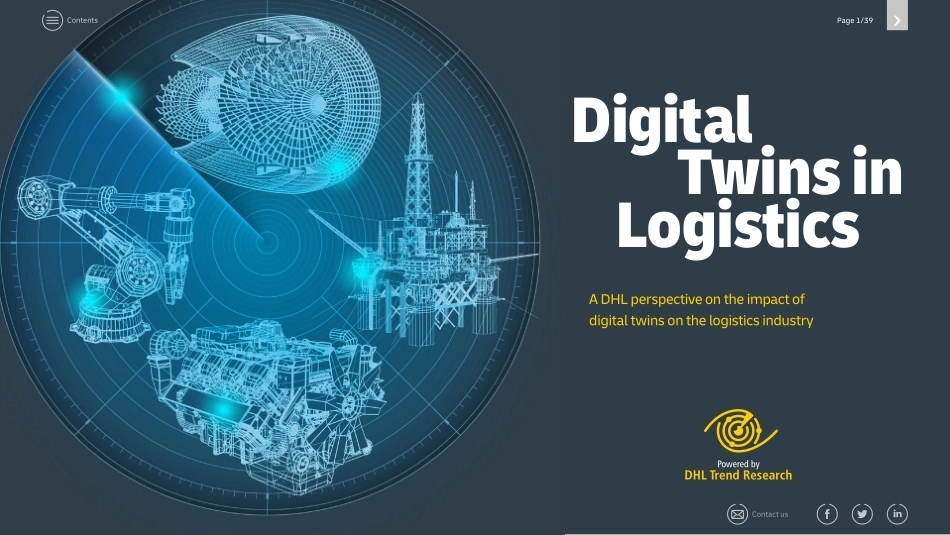
A DHL perspective on the impact of digital twins on the logistics industry DHL Trend ResearchPowered byPage 1/39Digital Twins in LogisticsContentsContact us ContentsPage 2/39Preface1 Understanding Digital Twins 41.1 The Digital Twin Comes of Age 41.2 What Makes a Digital Twin? 61.3 Underlying Technologies Enabling Digital Twins 71.4 How Digital Twins Create Value 81.5 The Digital Twin Through the Product Lifecycle 91.6 Challenges in Applying Digital Twins 102 Digital Twins Across Industries 122.1 Digital Twins in Manufacturing 132.2 Digital Twins in Materials Science 142.3 Digital Twins in Industrial Products 152.4 Digital Twins in Life Sciences and Healthcare 162.5 Digital Twins in Infrastructure and Urban Planning 172.6 Digital Twins in the Energy Sector 192.7 Digital Twins in Consumer, Retail and E-commerce 203 Digital Twins in Logistics 213.1 Packaging & Container Digital Twins 223.2 Digital Twins of Shipments 233.3 Digital Twins of Warehouses and Distribution Centers 233.4 Digital Twins of Logistics Infrastructure 263.5 Digital Twins of Global Logistics Networks 274 Logistics Implications of Implementing Digital Twins 284.1 Inbound to Manufacturing 294.2 In-plant Logistics 304.3 Aftermarket Logistics 324.4 Orchestrating the Supply Chain 32Conclusion & Outlook 34Sources 36Pictorial Sources 37Further Information 38Recommended Reading 39Contact usFor centuries, people have used pictures and models to help them tackle complex problems. Great buildings first took shape on the architect’s drawing board. Classic cars were shaped in wood and clay. Over time, our modeling capabilities have become more sophisticated. Computers have replaced pencils. 3D computer models have replaced 2D drawings. Advanced modeling systems can simulate the operation and behavior of a product as well as its geometry.Until recently, however, there remained an unbridged divide between model and reality. No two manufactured objects are ever truly identical, even if they have been built from the same set of drawings. Computer models of machines don’t evolve as parts wear out and are replaced, as fatigue accumulates in structures, or as owners make modifications to suit their changing needs. That gap is now starting to close. Fueled by developments in the internet of things (IoT), big data, artificial intelligence, cloud computing, and digital reality technologies, the recent arrival of digital twins heralds a tipping point where the physical and digital worlds can be managed as one, and we can interact with the digital counterpart of physical things much like we would the things themselves, even in 3D space around us. Led by the engineering, manufacturing, automotive, and energy industries in particular, digital twins are already creating new value. They are helping companies to design, visualize, monitor, manage, and maintain their assets more effectively. And they are unlocking new business opportunities like the provision of advanced services and the generation of valuable insight from operational data. As logistics professionals, we have been thinking about how digital twins will change traditional supply chains, and how the logistics sector might embrace digital twins to improve its own processes. Our objective in writing this report is to share our findings and to help you answer the following key questions:■ What is a digital twin and what does it mean for my organization?■ What best-practice examples from other industries can be applied to logistics?■ How will my supply chain change because of digital twins? Looking ahead, we believe that the adoption of digital twins across industries will drive better decision making in the physical world. That, in turn, will drive significant changes in the operation of supply chains and logistics processes.In the logistics industry itself, digital twins will extend the benefits of IoT already being applied today. They will bring deeper insight into the planning, design, operation, and optimization of supply chains, from individual assets and shipments to entire global supply networks.We think there has never been a more exciting time for industries and logisticians to work together to leverage the full potential of digital twins. On behalf of us all at DHL, we look forward to collaborating with you in this exciting and potentially transformative field. PrefaceMatthias HeutgerSenior Vice PresidentGlobal Head of Innovation & Commercial Development, DHLMarkus Kueckelhaus Vice President Innovation & Trend Research, DHLPage 3/39ContentsContact us Chapter 1 Understanding Digital Twins1.1 THE DIGITAL TWIN COMES OF AGEFor many years, scientists and engineers have created mathematical models of real-world objects and over time these models have become increasingly sophisticated. Today the evolution of sensors and network technologies enables us to link previously offline physical assets to digital models. In this way, changes experienced by the physical object are reflected in the digital model, and ...




发表评论取消回复