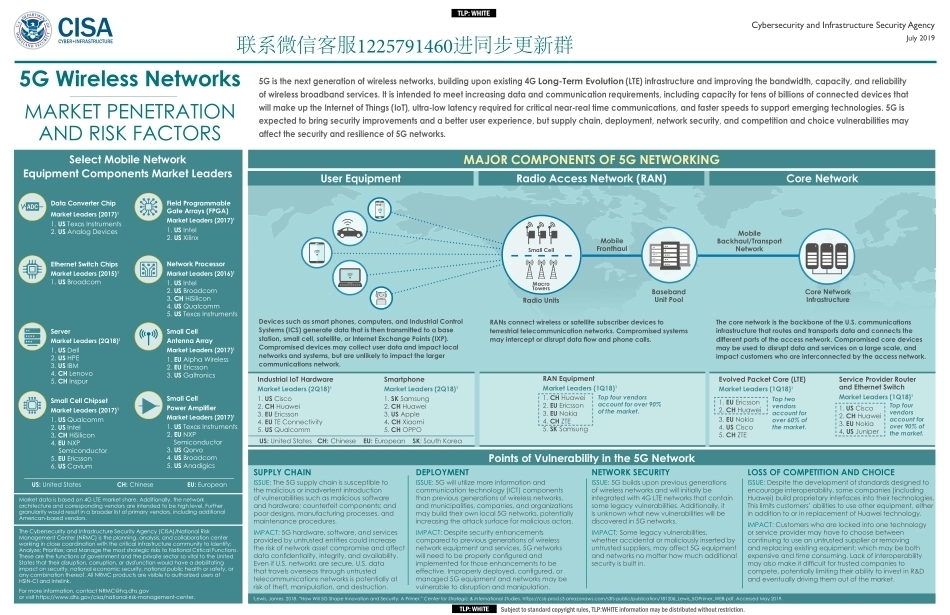
MAJOR COMPONENTS OF 5G NETWORKINGField Programmable Gate Arrays (FPGA) Market Leaders (2017)11. US Intel2. US XilinxSmall Cell ChipsetMarket Leaders (2017)11. US Qualcomm2. US Intel3. CH HiSilicon4. EU NXPSemiconductor5. EU Ericsson6. US CaviumSmall Cell Power AmplifierMarket Leaders (2017)11. US Texas Instruments2. EU NXPSemiconductor3. US Qorvo4. US Broadcom5. US AnadigicsNetwork ProcessorMarket Leaders (2016)11. US Intel2. US Broadcom3. CH HiSilicon4. US Qualcomm5. US Texas InstrumentsServerMarket Leaders (2Q18)11. US Dell2. US HPE3. US IBM4. CH Lenovo5. CH InspurData Converter ChipMarket Leaders (2017)11. US Texas Instruments2. US Analog DevicesEthernet Switch Chips Market Leaders (2015)11. US BroadcomSmall Cell Antenna ArrayMarket Leaders (2017)11. EU Alpha Wireless2. EU Ericsson3. US Galtronics 1Lewis, James. 2018. “How Will 5G Shape Innovation and Security: A Primer.” Center for Strategic & International Studies. https://csis-prod.s3.amazonaws.com/s3fs-public/publication/181206_Lewis_5GPrimer_WEB.pdf. Accessed May 2019.ADCThe Cybersecurity and Infrastructure Security Agency (CISA)/National Risk Management Center (NRMC) is the planning, analysis, and collaboration center working in close coordination with the critical infrastructure community to Identify; Analyze; Prioritize; and Manage the most strategic risks to National Critical Functions. These are the functions of government and the private sector so vital to the United States that their disruption, corruption, or dysfunction would have a debilitating impact on security, national economic security, national public health or safety, or any combination thereof. All NRMC products are visible to authorized users at HSIN-CI and Intelink. For more information, contact NRMC@hq.dhs.gov or visit https://www.dhs.gov/cisa/national-risk-management-center.Market data is based on 4G LTE market share. Additionally, the network architecture and corresponding vendors are intended to be high level. Further granularity would result in a broader list of primary vendors, including additional American-based vendors.5G is the next generation of wireless networks, building upon existing 4G Long-Term Evolution (LTE) infrastructure and improving the bandwidth, capacity, and reliability of wireless broadband services. It is intended to meet increasing data and communication requirements, including capacity for tens of billions of connected devices that will make up the Internet of Things (IoT), ultra-low latency required for critical near-real time communications, and faster speeds to support emerging technologies. 5G is expected to bring security improvements and a better user experience, but supply chain, deployment, network security, and competition and choice vulnerabilities may affect the security and resilience of 5G networks.5G Wireless Networks MARKET PENETRATION AND RISK FACTORSSelect Mobile Network Equipment Components Market LeadersCybersecurity and Infrastructure Security AgencyJuly 2019TLP: WHITETLP: WHITESubject to standard copyright rules, TLP:WHITE information may be distributed without restriction.Points of Vulnerability in the 5G NetworkSUPPLY CHAINISSUE: The 5G supply chain is susceptible to the malicious or inadvertent introduction of vulnerabilities such as malicious software and hardware; counterfeit components; and poor designs, manufacturing processes, and maintenance procedures. IMPACT: 5G hardware, software, and services provided by untrusted entities could increase the risk of network asset compromise and affect data confidentiality, integrity, and availability. Even if U.S. networks are secure, U.S. data that travels overseas through untrusted telecommunications networks is potentially at risk of theft, manipulation, and destruction.DEPLOYMENTISSUE: 5G will utilize more information and communication technology (ICT) components than previous generations of wireless networks, and municipalities, companies, and organizations may build their own local 5G networks, potentially increasing the attack surface for malicious actors.IMPACT: Despite security enhancements compared to previous generations of wireless network equipment and services, 5G networks will need to be properly configured and implemented for those enhancements to be effective. Improperly deployed, configured, or managed 5G equipment and networks may be vulnerable to disruption and manipulation.NETWORK SECURITYISSUE: 5G builds upon previous generations of wireless networks and will initially be integrated with 4G LTE networks that contain some legacy vulnerabilities. Additionally, it is unknown what new vulnerabilities will be discovered in 5G networks.IMPACT: Some legacy vulnerabilities, whether accidental or maliciously inserted by untrusted suppliers, may affect 5G equipment and networks no matter how much additional security is built in.LOSS OF COMPETITION AND CHOICEISSUE: Despite the development of standards designed to encourage interoperability, some companies (including Huawei) ...




发表评论取消回复