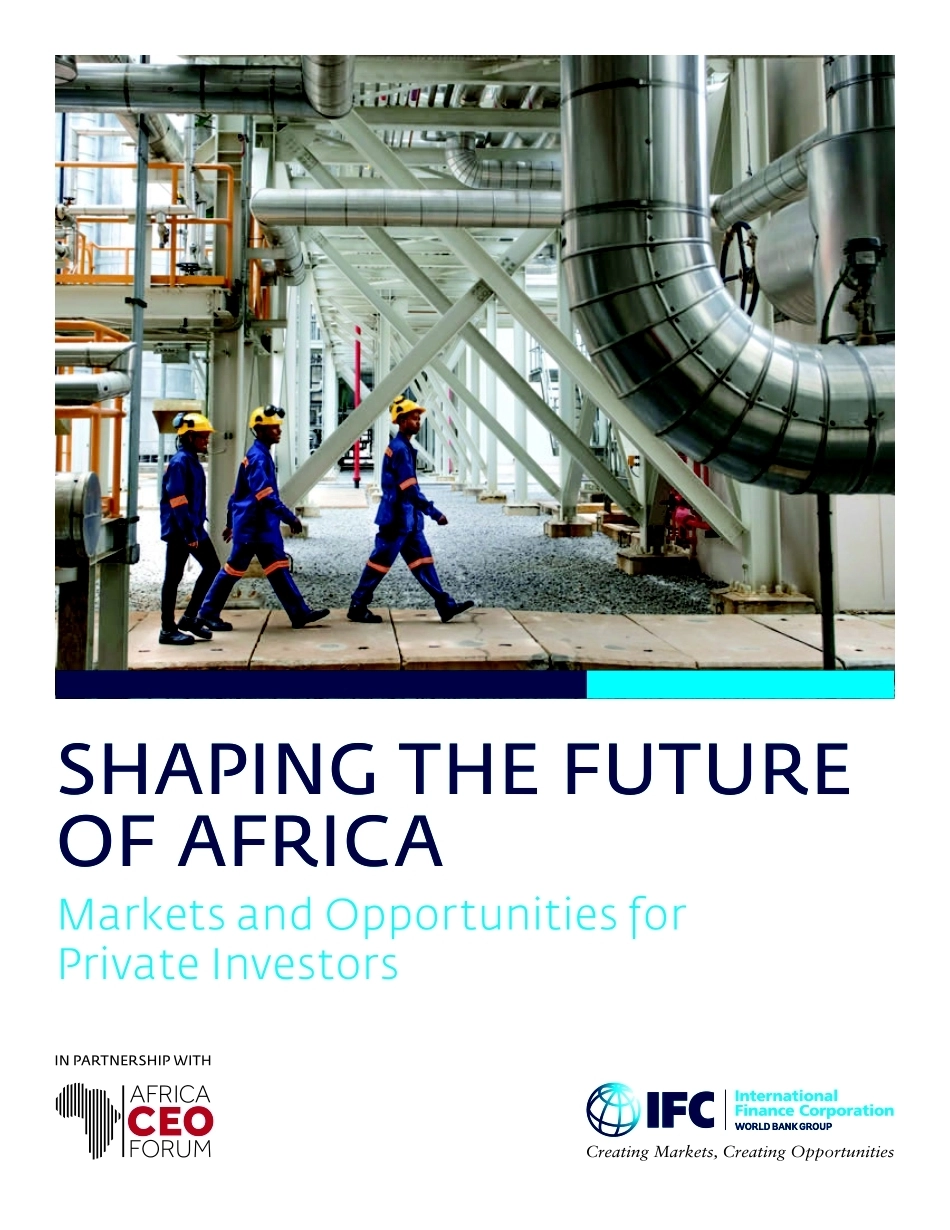
SHAPING THE FUTURE OF AFRICAMarkets and Opportunities for Private InvestorsIN PARTNERSHIP WITH每日免费阅读行业报告1、每日星球内分享10+精品报告;2、不定时分享国际投行报告,脱水研报等;3、行业报告均为公开内容,版权归原作者所有,星球仅分享内部学习。扫描右侧二维码即刻加入【行业报告(免费) 】星球(此页只为更多需要行业报告的朋友提供便利,希望不会影响您的阅读,谢谢理解!)IFC2121 Pennsylvania Avenue, N.W. Washington, D.C. 20433 U.S.A.ifc.org/thoughtleadershipIFC—a sister organization of the World Bank and member of the World Bank Group—is the largest global development institution focused on the private sector in emerging markets. We work with more than 2,000 businesses worldwide, using our capital, expertise, and influence to create markets and opportunities in the toughest areas of the world. In FY17, we delivered a record $19.3 billion in long-term financing for developing countries, leveraging the power of the private sector to help end poverty and boost shared prosperity. For more information, visit www.ifc.org.All rights reservedFirst printing, March 2018The findings, interpretations, views, and conclusions expressed herein are those of the authors and do not necessarily reflect the views of the Executive Directors of the International Finance Corporation or of the International Bank for Reconstruction and Development (the World Bank) or the governments they represent.Rights and PermissionsThe material in this publication is copyrighted. IFC encourages use and distribution of its publications. Content from this document may be used freely and copied into other formats without prior permission provided that clear attribution is given to the original source and that content is not used for commercial purposes.Photo CreditsCover: Dominic Chavez, IFC; Page 4: Stephan Gladieu, World Bank; Page 8: Dana Smillie, World Bank; Page 22: Arne Hoel, World Bank; Page 23: Azito; Page 24: Vitol; Page 25: Dominic Chavez, IFC; Page 26: Mobisol; Page 27: John Hogg, World Bank; Page 28: IFC; Page 29: Afriflora; Page 30: Mohamad Al-Arief, World Bank; Page 31: Dana Smillie, World BankSHAPING THE FUTURE OF AFRICAMarkets and Opportunities for Private InvestorsAUTHORSDILEK AYKUT, Senior Economist, Global Macro, Market and Portfolio Research, Economics and Private Sector Development, IFCMONIKA BLASZKIEWICZ-SCHWARTZMAN, Economist, Global Macro, Market and Portfolio Research, Economics and Private Sector Development, IFCCONTRIBUTORSOmar Chaudry, Desmond Dodd, Vincent Arthur Floreani, Jean Pierre Lacombe, Liane Lohde, Florian Mölders, Thomas Rehermann, Friedemann RoyCONTENT ADVISORSEconomics and Private Sector Development | Neil Gregory, Thomas Rehermann Sub-Saharan Africa | Frank Douamba, Cheikh Oumar Seydi Partnerships, Communications & Outreach | Desmond Dodd, Nadine S. GhannamPROJECT AND CONTENT TEAMProject Manager | Thomas Rehermann Editors | Matt Benjamin, Ofeoritse Daibo Research Assistant | Sulayman J. K. Cham Composition and Design | Rikki Campbell Ogden 5 | EXECUTIVE SUMMARY 9 | MARKETS AND OPPORTUNITIES FOR PRIVATE INVESTORS IN AFRICA 23 | CASE STUDIES Azito and CIPREL Expansions Invigorate Côte d’Ivoire’s Power Sector Ghana’s Sankofa Gas Project—An Opportunity to Correct an Ailing Power Sector Dakar Toll Road Dramatically Reduces Traffic Congestion to Capital City Mobisol Connects a Continent to Change Francophone Africa Seeks Opportunities in the Housing Finance Market Zambia’s Metalco Recycles Kabwe’s Toxic Lead Waste Ethiopian Rose Producer Afriflora is Boosting Exports… and Jobs Madagascar Seeks to Create a Market in Beef Exports Solar Energy Brings Affordable Electricity to Egypt 32 | REFERENCESCONTENTS45AFRICA IS ON THE REBOUNDThe end of the commodity super cycle in 2014 hit Sub-Saharan economies hard, sending economic growth to a two-decade low by 2016 as prices of crude oil, commodities, and other African exports fell dramatically. In addition, global financial factors reduced the interest of international investors in the region.But after a few years of sluggish growth, most of the region’s economies are returning to previous levels of expansion.Capital flows into the region, in the form of bank lending and equity and bond offerings, have strengthened considerably, reflecting improved global sentiment toward emerging markets in general and in Africa in particular. Remittances, an important source of capital and foreign exchange for all developing countries and no less so for Africa, are also improving.Progress is uneven across the continent, as resource intensive economies—especially oil exporters such as Angola and Nigeria—continue to lag, while agricultural exporters enjoy stable growth. And several large economies—Ethiopia, Côte d’Ivoire, Senegal, Tanzania, and Ghana in particular—have posted growth rates of over 6 percent over the last few years.Overall, the economic outlook for the region is positive, with economic growth expected to rise to 3.2 percent this year and 3.6 percent in 2020, according to World Bank Group data.AN OPPORTUNITY FOR THE PRIVATE SECTORDespite the recent economic drag, Africa is a rapidly expanding market that represen...




发表评论取消回复