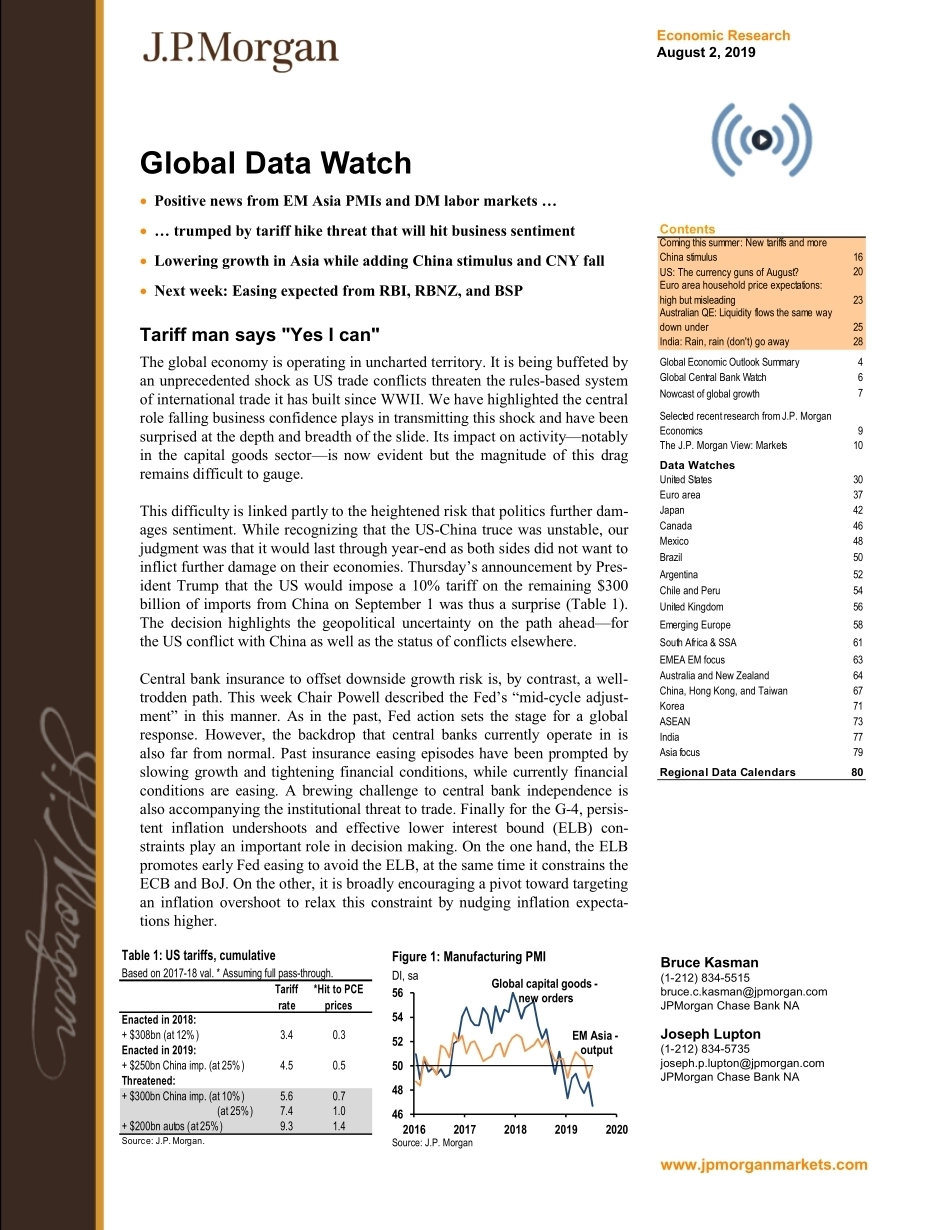
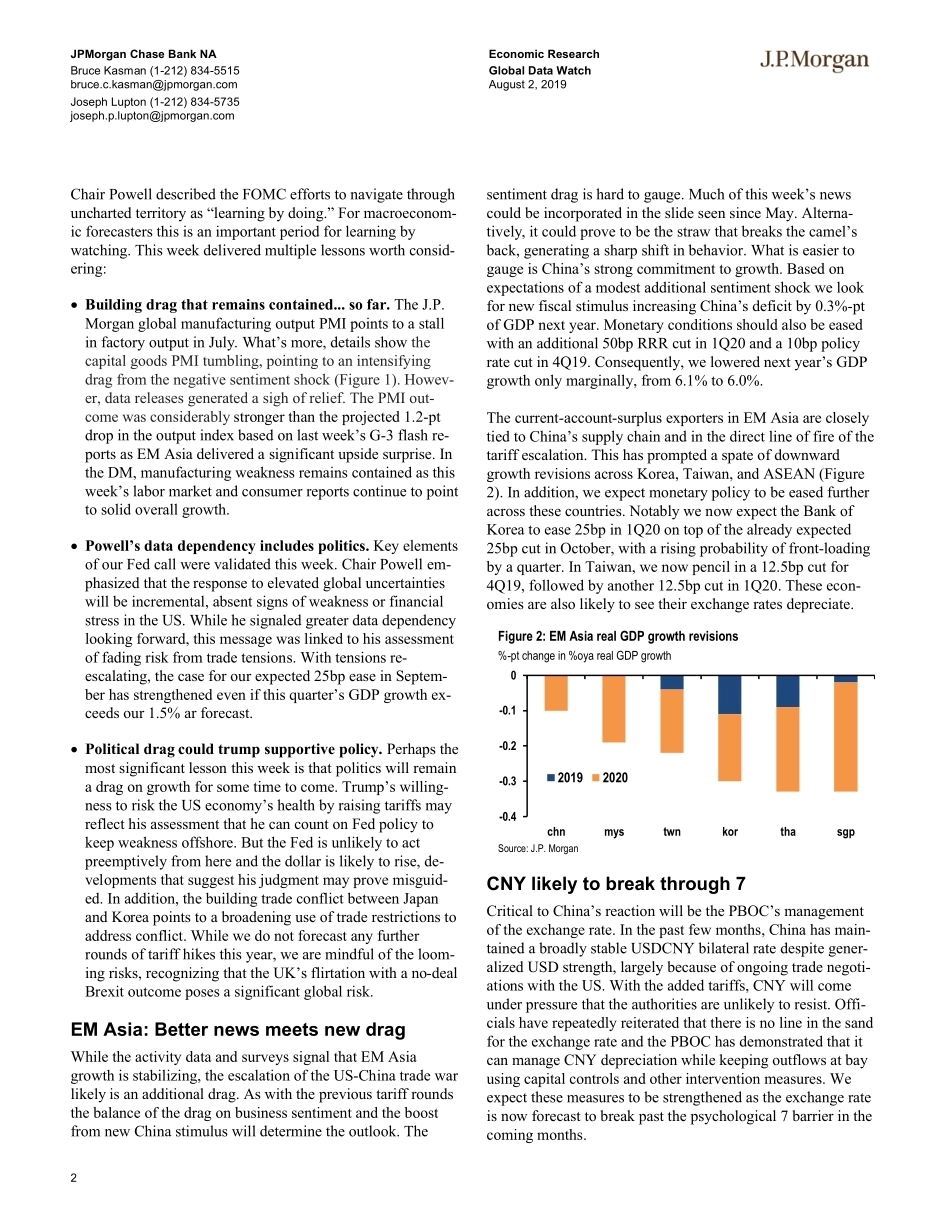
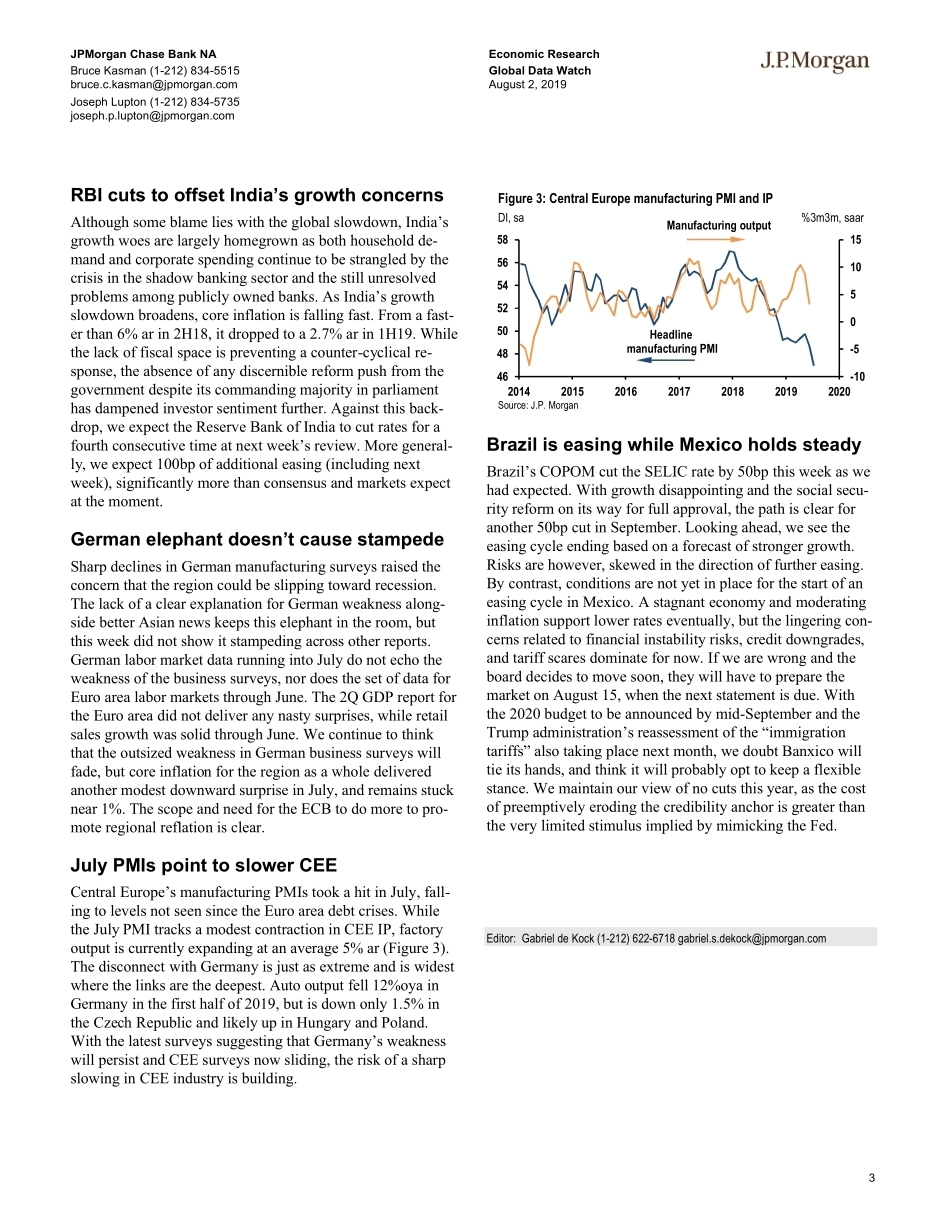
Economic ResearchAugust 2, 2019Global Data Watch Positive news from EM Asia PMIs and DM labor markets … … trumped by tariff hike threat that will hit business sentiment Lowering growth in Asia while adding China stimulus and CNY fall Next week: Easing expected from RBI, RBNZ, and BSPTariff man says "Yes I can"The global economy is operating in uncharted territory. It is being buffeted by an unprecedented shock as US trade conflicts threaten the rules-based system of international trade it has built since WWII. We have highlighted the central role falling business confidence plays in transmitting this shock and have been surprised at the depth and breadth of the slide. Its impact on activity—notably in the capital goods sector—is now evident but the magnitude of this drag remains difficult to gauge. This difficulty is linked partly to the heightened risk that politics further dam-ages sentiment. While recognizing that the US-China truce was unstable, our judgment was that it would last through year-end as both sides did not want to inflict further damage on their economies. Thursday’s announcement by Pres-ident Trump that the US would impose a 10% tariff on the remaining $300 billion of imports from China on September 1 was thus a surprise (Table 1). The decision highlights the geopolitical uncertainty on the path ahead—for the US conflict with China as well as the status of conflicts elsewhere. Central bank insurance to offset downside growth risk is, by contrast, a well-trodden path. This week Chair Powell described the Fed’s “mid-cycle adjust-ment” in this manner. As in the past, Fed action sets the stage for a global response. However, the backdrop that central banks currently operate in is also far from normal. Past insurance easing episodes have been prompted by slowing growth and tightening financial conditions, while currently financial conditions are easing. A brewing challenge to central bank independence is also accompanying the institutional threat to trade. Finally for the G-4, persis-tent inflation undershoots and effective lower interest bound (ELB) con-straints play an important role in decision making. On the one hand, the ELB promotes early Fed easing to avoid the ELB, at the same time it constrains the ECB and BoJ. On the other, it is broadly encouraging a pivot toward targeting an inflation overshoot to relax this constraint by nudging inflation expecta-tions higher.Table 1: US tariffs, cumulativeBased on 2017-18 val. * Assuming full pass-through.Tariff rate *Hit to PCE prices+ $308bn (at 12%)3.40.3+ $250bn China imp. (at 25%)4.50.5+ $300bn China imp. (at 10%)5.60.7 (at 25%)7.41.0+ $200bn autos (at 25%)9.31.4Threatened:Source: J.P. Morgan. Enacted in 2018:Enacted in 2019:46485052545620162017201820192020DI, saFigure 1: Manufacturing PMISource: J.P. MorganEM Asia -outputGlobal capital goods -new ordersContentsComing this summer: New tariffs and more China stimulus16US: The currency guns of August?20Euro area household price expectations: high but misleading23Australian QE: Liquidity flows the same way down under 25India: Rain, rain (don't) go away28Global Economic Outlook Summary4Global Central Bank Watch6Nowcast of global growth7Selected recent research from J.P. Morgan Economics9The J.P. Morgan View: Markets10Data WatchesUnited States30Euro area37Japan42Canada46Mexico48Brazil50Argentina52Chile and Peru54United Kingdom56Emerging Europe58South Africa & SSA61EMEA EM focus63Australia and New Zealand64China, Hong Kong, and Taiwan67Korea71ASEAN73India77Asia focus79Regional Data Calendars80Bruce Kasman(1-212) 834-5515bruce.c.kasman@jpmorgan.comJPMorgan Chase Bank NAJoseph Lupton(1-212) 834-5735joseph.p.lupton@jpmorgan.comJPMorgan Chase Bank NAwww.jpmorganmarkets.com2Economic ResearchGlobal Data WatchAugust 2, 2019JPMorgan Chase Bank NABruce Kasman (1-212) 834-5515bruce.c.kasman@jpmorgan.comJoseph Lupton (1-212) 834-5735joseph.p.lupton@jpmorgan.comChair Powell described the FOMC efforts to navigate through uncharted territory as “learning by doing.” For macroeconom-ic forecasters this is an important period for learning by watching. This week delivered multiple lessons worth consid-ering: Building drag that remains contained... so far. The J.P. Morgan global manufacturing output PMI points to a stall in factory output in July. What’s more, details show the capital goods PMI tumbling, pointing to an intensifying drag from the negative sentiment shock (Figure 1). Howev-er, data releases generated a sigh of relief. The PMI out-come was considerably stronger than the projected 1.2-pt drop in the output index based on last week’s G-3 flash re-ports as EM Asia delivered a significant upside surprise. In the DM, manufacturing weakness remains contained as this week’s labor market and consumer reports continue to point to solid overall growth. Powell’s data dependency includes politics. Key elements of our Fed call were validated this week. Chair Powell em-phasized that the response to elevated ...




发表评论取消回复