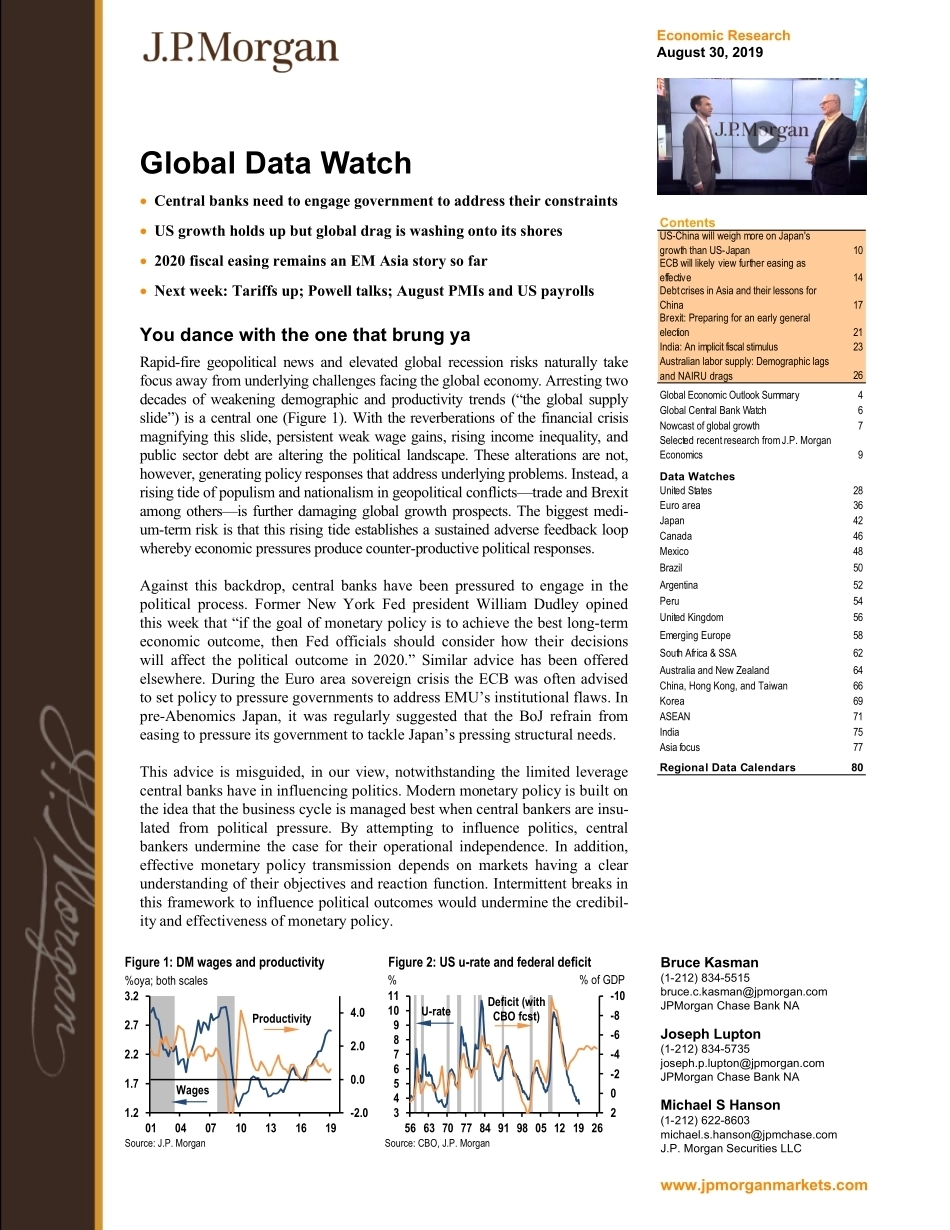
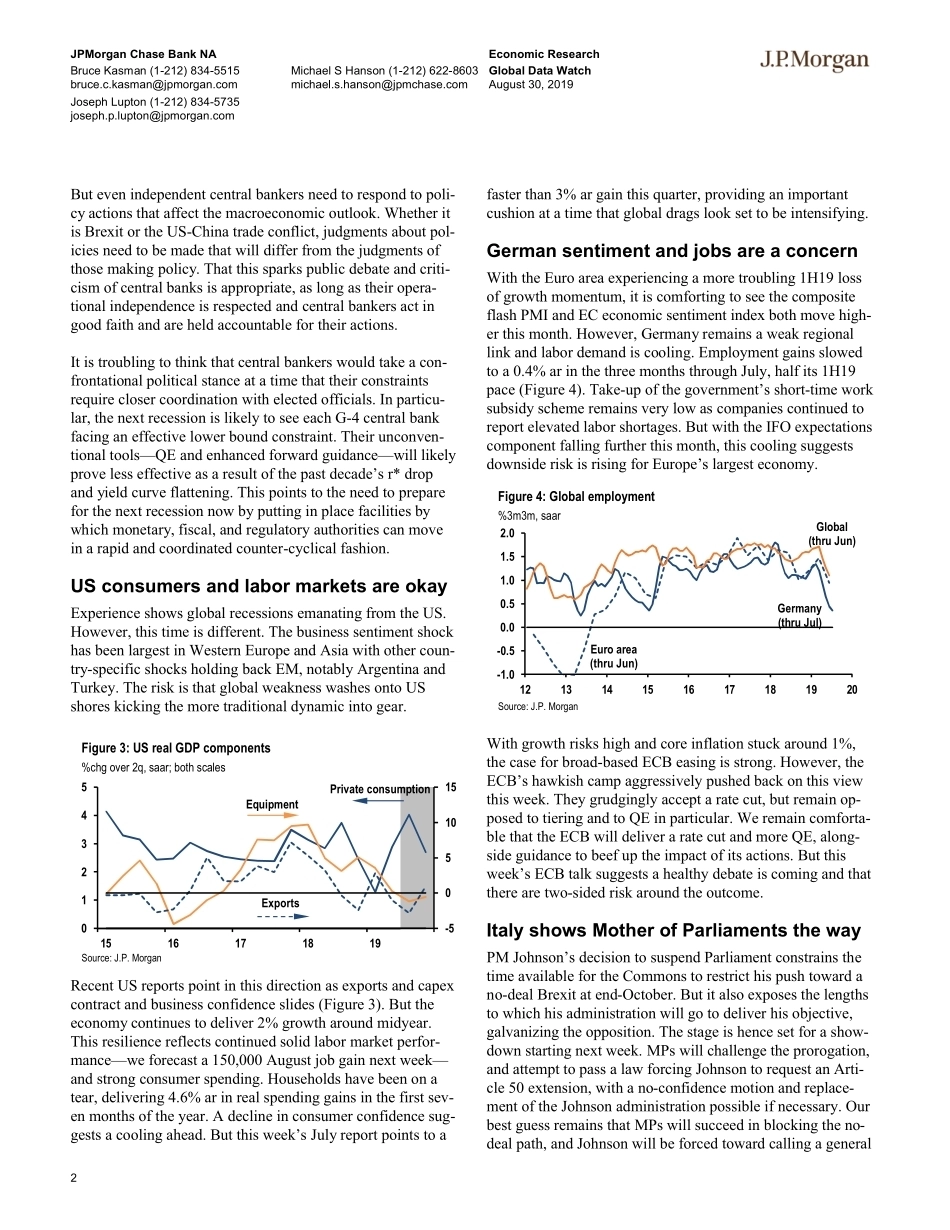
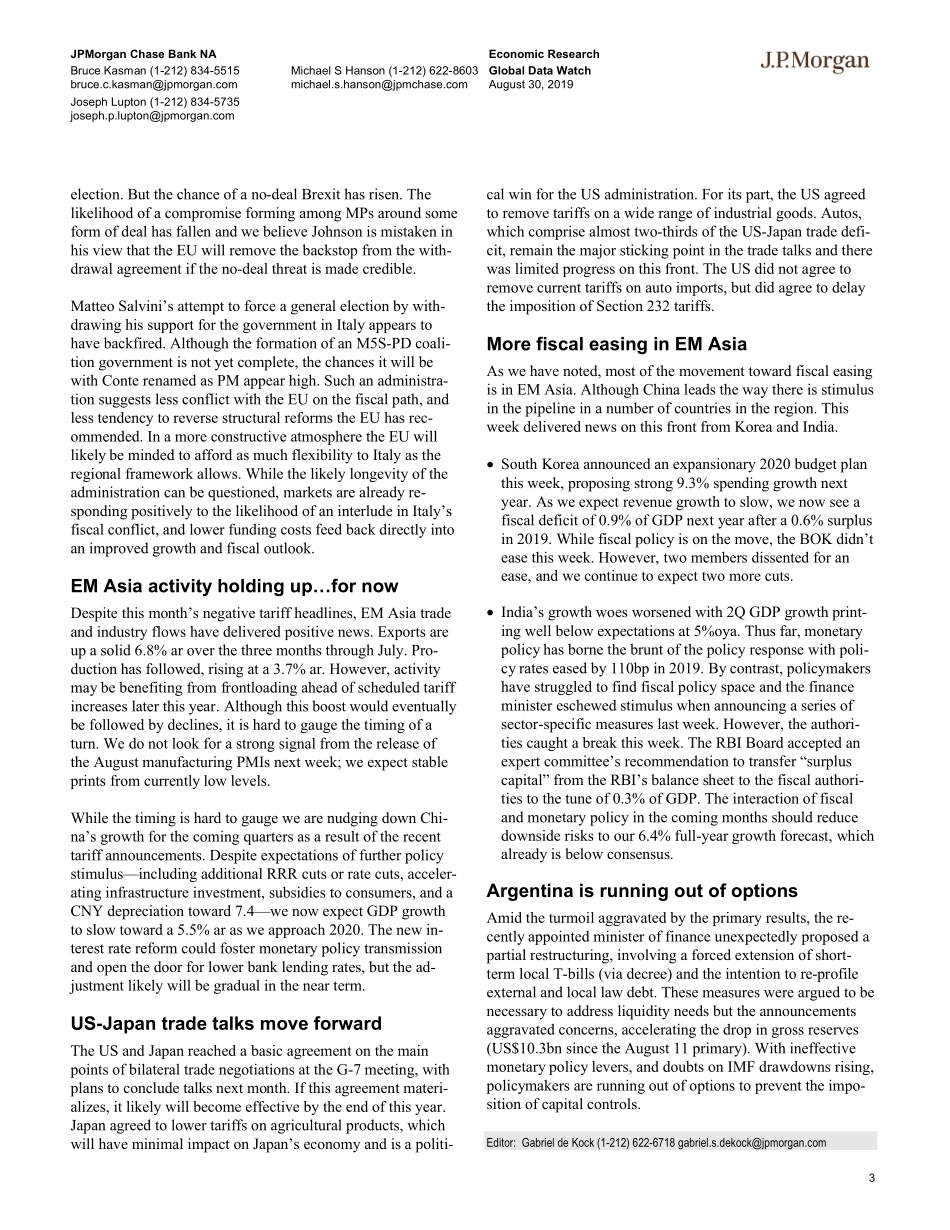
Economic ResearchAugust 30, 2019Global Data Watch Central banks need to engage government to address their constraints US growth holds up but global drag is washing onto its shores 2020 fiscal easing remains an EM Asia story so far Next week: Tariffs up; Powell talks; August PMIs and US payrollsYou dance with the one that brung yaRapid-fire geopolitical news and elevated global recession risks naturally take focus away from underlying challenges facing the global economy. Arresting two decades of weakening demographic and productivity trends (“the global supply slide”) is a central one (Figure 1). With the reverberations of the financial crisis magnifying this slide, persistent weak wage gains, rising income inequality, and public sector debt are altering the political landscape. These alterations are not, however, generating policy responses that address underlying problems. Instead, a rising tide of populism and nationalism in geopolitical conflicts—trade and Brexit among others—is further damaging global growth prospects. The biggest medi-um-term risk is that this rising tide establishes a sustained adverse feedback loop whereby economic pressures produce counter-productive political responses. Against this backdrop, central banks have been pressured to engage in the political process. Former New York Fed president William Dudley opined this week that “if the goal of monetary policy is to achieve the best long-term economic outcome, then Fed officials should consider how their decisions will affect the political outcome in 2020.” Similar advice has been offered elsewhere. During the Euro area sovereign crisis the ECB was often advised to set policy to pressure governments to address EMU’s institutional flaws. In pre-Abenomics Japan, it was regularly suggested that the BoJ refrain from easing to pressure its government to tackle Japan’s pressing structural needs. This advice is misguided, in our view, notwithstanding the limited leverage central banks have in influencing politics. Modern monetary policy is built on the idea that the business cycle is managed best when central bankers are insu-lated from political pressure. By attempting to influence politics, central bankers undermine the case for their operational independence. In addition, effective monetary policy transmission depends on markets having a clear understanding of their objectives and reaction function. Intermittent breaks in this framework to influence political outcomes would undermine the credibil-ity and effectiveness of monetary policy. -2.00.02.04.01.21.72.22.73.201040710131619%oya; both scalesFigure 1: DM wages and productivitySource: J.P. MorganWagesProductivity-10-8-6-4-2023456789101156 63 70 77 84 91 98 05 12 19 26%Figure 2: US u-rate and federal deficit% of GDPSource: CBO, J.P. MorganDeficit (with CBO fcst)U-rateContentsUS-China will weigh more on Japan's growth than US-Japan10ECB will likely view further easing as effective14Debt crises in Asia and their lessons for China17Brexit: Preparing for an early general election21India: An implicit fiscal stimulus23Australian labor supply: Demographic lags and NAIRU drags26Global Economic Outlook Summary4Global Central Bank Watch6Nowcast of global growth7Selected recent research from J.P. Morgan Economics9Data WatchesUnited States28Euro area36Japan42Canada46Mexico48Brazil50Argentina52Peru54United Kingdom56Emerging Europe58South Africa & SSA62Australia and New Zealand64China, Hong Kong, and Taiwan66Korea69ASEAN71India75Asia focus77Regional Data Calendars80Bruce Kasman(1-212) 834-5515bruce.c.kasman@jpmorgan.comJPMorgan Chase Bank NAJoseph Lupton(1-212) 834-5735joseph.p.lupton@jpmorgan.comJPMorgan Chase Bank NAMichael S Hanson(1-212) 622-8603michael.s.hanson@jpmchase.comJ.P. Morgan Securities LLCwww.jpmorganmarkets.com2Economic ResearchGlobal Data WatchAugust 30, 2019JPMorgan Chase Bank NABruce Kasman (1-212) 834-5515bruce.c.kasman@jpmorgan.comJoseph Lupton (1-212) 834-5735joseph.p.lupton@jpmorgan.comMichael S Hanson (1-212) 622-8603michael.s.hanson@jpmchase.comBut even independent central bankers need to respond to poli-cy actions that affect the macroeconomic outlook. Whether it is Brexit or the US-China trade conflict, judgments about pol-icies need to be made that will differ from the judgments of those making policy. That this sparks public debate and criti-cism of central banks is appropriate, as long as their opera-tional independence is respected and central bankers act in good faith and are held accountable for their actions. It is troubling to think that central bankers would take a con-frontational political stance at a time that their constraints require closer coordination with elected officials. In particu-lar, the next recession is likely to see each G-4 central bank facing an effective lower bound constraint. Their unconven-tional tools—QE and enhanced forward guidance—will likely prove less effective as a result of the past decade’s r* drop and yield curve flattening. ...




发表评论取消回复