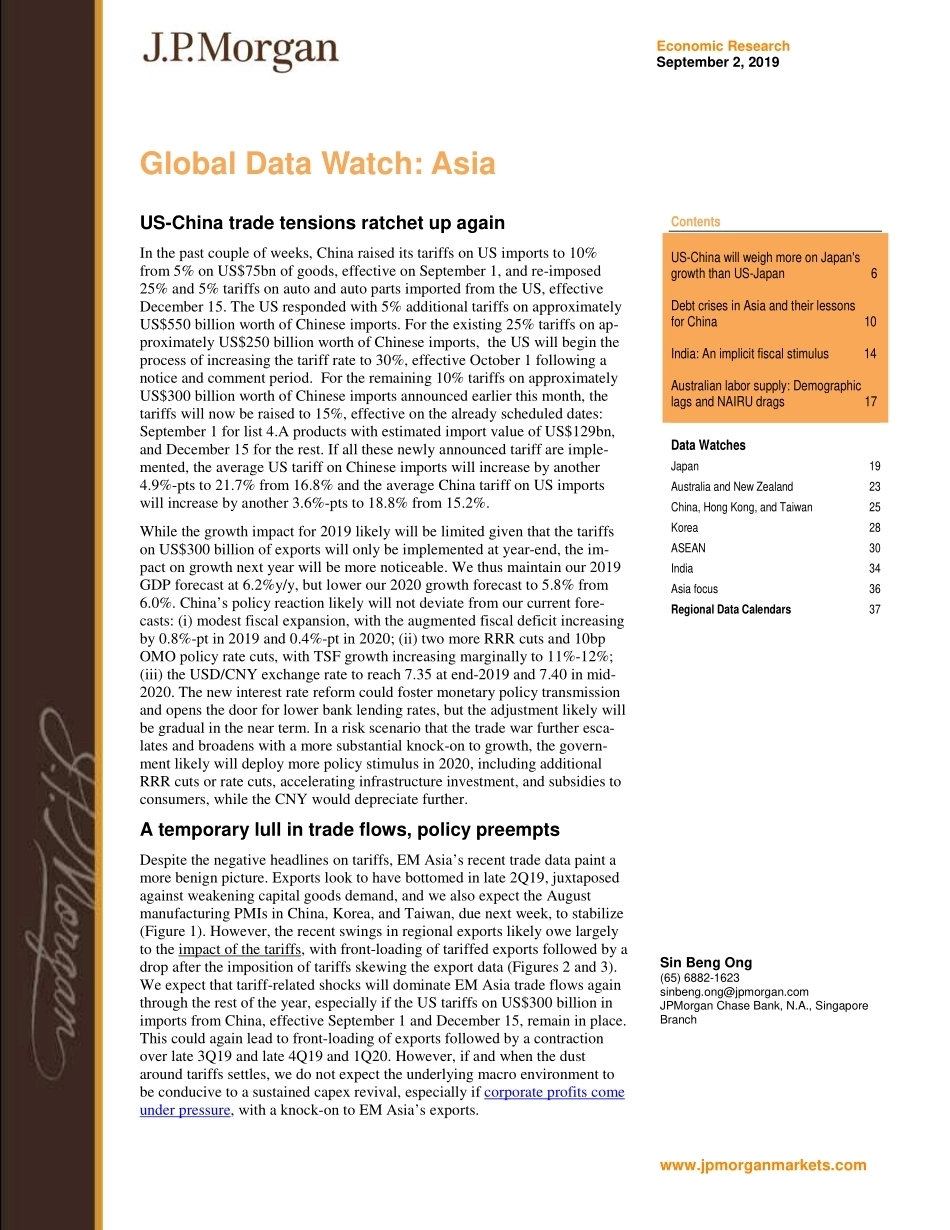
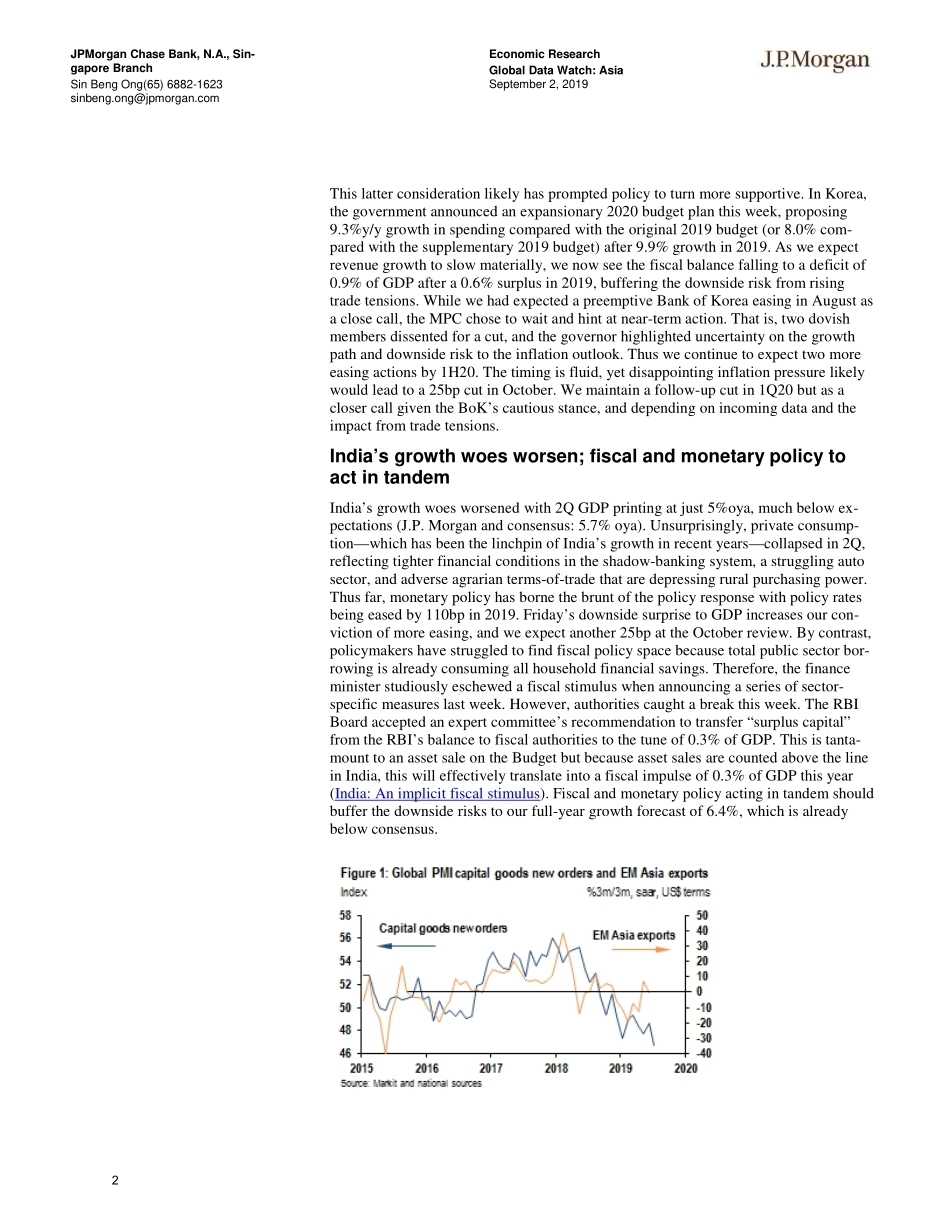
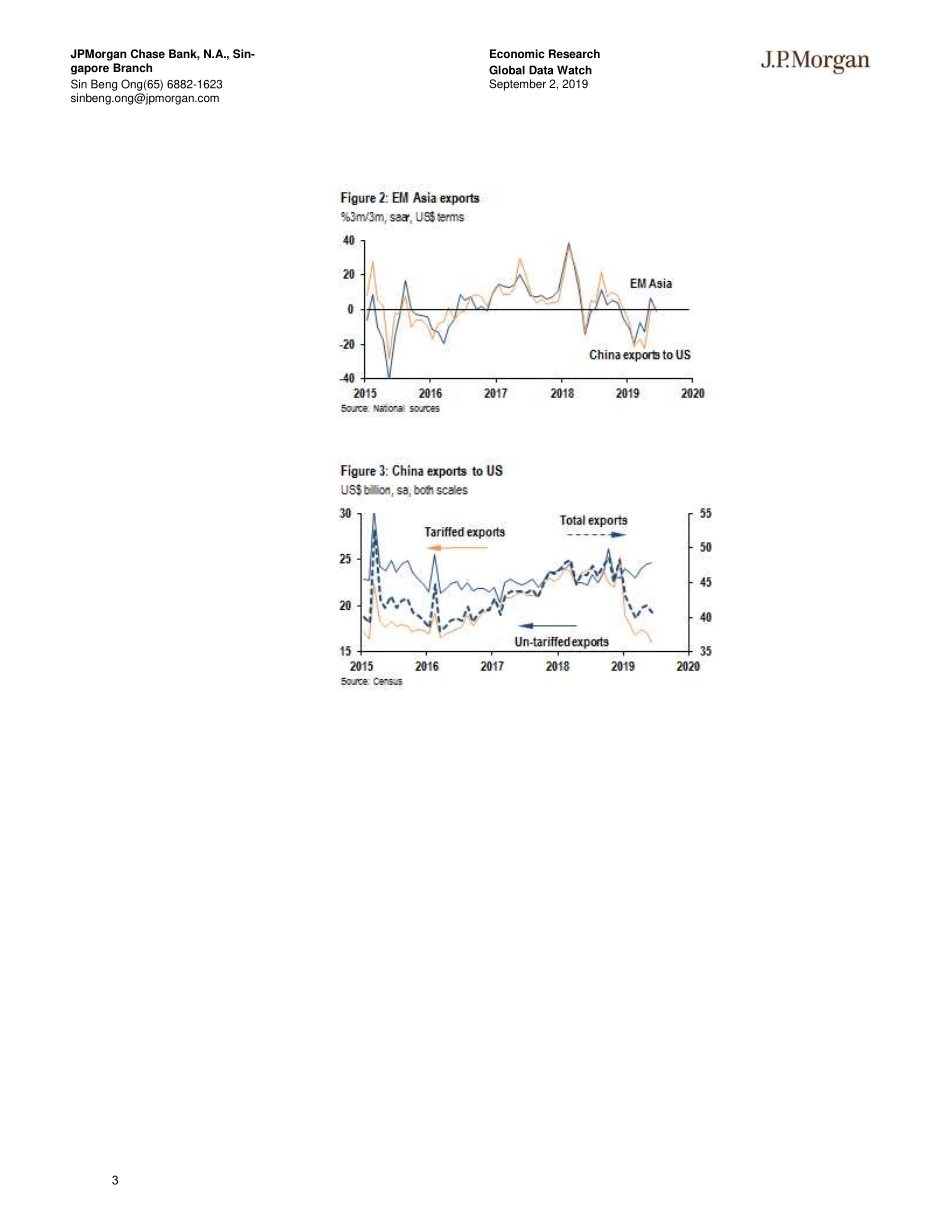
Economic Research September 2, 2019 Global Data Watch: Asia US-China trade tensions ratchet up again In the past couple of weeks, China raised its tariffs on US imports to 10% from 5% on US$75bn of goods, effective on September 1, and re-imposed 25% and 5% tariffs on auto and auto parts imported from the US, effective December 15. The US responded with 5% additional tariffs on approximately US$550 billion worth of Chinese imports. For the existing 25% tariffs on ap-proximately US$250 billion worth of Chinese imports, the US will begin the process of increasing the tariff rate to 30%, effective October 1 following a notice and comment period. For the remaining 10% tariffs on approximately US$300 billion worth of Chinese imports announced earlier this month, the tariffs will now be raised to 15%, effective on the already scheduled dates: September 1 for list 4.A products with estimated import value of US$129bn, and December 15 for the rest. If all these newly announced tariff are imple-mented, the average US tariff on Chinese imports will increase by another 4.9%-pts to 21.7% from 16.8% and the average China tariff on US imports will increase by another 3.6%-pts to 18.8% from 15.2%. While the growth impact for 2019 likely will be limited given that the tariffs on US$300 billion of exports will only be implemented at year-end, the im-pact on growth next year will be more noticeable. We thus maintain our 2019 GDP forecast at 6.2%y/y, but lower our 2020 growth forecast to 5.8% from 6.0%. China’s policy reaction likely will not deviate from our current fore-casts: (i) modest fiscal expansion, with the augmented fiscal deficit increasing by 0.8%-pt in 2019 and 0.4%-pt in 2020; (ii) two more RRR cuts and 10bp OMO policy rate cuts, with TSF growth increasing marginally to 11%-12%; (iii) the USD/CNY exchange rate to reach 7.35 at end-2019 and 7.40 in mid-2020. The new interest rate reform could foster monetary policy transmission and opens the door for lower bank lending rates, but the adjustment likely will be gradual in the near term. In a risk scenario that the trade war further esca-lates and broadens with a more substantial knock-on to growth, the govern-ment likely will deploy more policy stimulus in 2020, including additional RRR cuts or rate cuts, accelerating infrastructure investment, and subsidies to consumers, while the CNY would depreciate further. A temporary lull in trade flows, policy preempts Despite the negative headlines on tariffs, EM Asia’s recent trade data paint a more benign picture. Exports look to have bottomed in late 2Q19, juxtaposed against weakening capital goods demand, and we also expect the August manufacturing PMIs in China, Korea, and Taiwan, due next week, to stabilize (Figure 1). However, the recent swings in regional exports likely owe largely to the impact of the tariffs, with front-loading of tariffed exports followed by a drop after the imposition of tariffs skewing the export data (Figures 2 and 3). We expect that tariff-related shocks will dominate EM Asia trade flows again through the rest of the year, especially if the US tariffs on US$300 billion in imports from China, effective September 1 and December 15, remain in place. This could again lead to front-loading of exports followed by a contraction over late 3Q19 and late 4Q19 and 1Q20. However, if and when the dust around tariffs settles, we do not expect the underlying macro environment to be conducive to a sustained capex revival, especially if corporate profits come under pressure, with a knock-on to EM Asia’s exports. Sin Beng Ong (65) 6882-1623 sinbeng.ong@jpmorgan.com JPMorgan Chase Bank, N.A., Singapore Branch www.jpmorganmarkets.com Contents US-China will weigh more on Japan's growth than US-Japan 6 Debt crises in Asia and their lessons for China 10 India: An implicit fiscal stimulus 14 Australian labor supply: Demographic lags and NAIRU drags 17 Data Watches Japan 19 Australia and New Zealand 23 China, Hong Kong, and Taiwan 25 Korea 28 ASEAN 30 India 34 Asia focus 36 Regional Data Calendars 37 Economic Research Global Data Watch: Asia September 2, 2019 JPMorgan Chase Bank, N.A., Sin-gapore Branch Sin Beng Ong(65) 6882-1623 sinbeng.ong@jpmorgan.com This latter consideration likely has prompted policy to turn more supportive. In Korea, the government announced an expansionary 2020 budget plan this week, proposing 9.3%y/y growth in spending compared with the original 2019 budget (or 8.0% com-pared with the supplementary 2019 budget) after 9.9% growth in 2019. As we expect revenue growth to slow materially, we now see the fiscal balance falling to a deficit of 0.9% of GDP after a 0.6% surplus in 2019, buffering the downside risk from rising trade tensions. While we had expected a preemptive Bank of Korea easing in August as a close call, the MPC chose to wait and hint at near-term action. That is, two dovish members dissented for a cut, and the governor highlighted uncertainty on the growth path and downside risk to...




发表评论取消回复