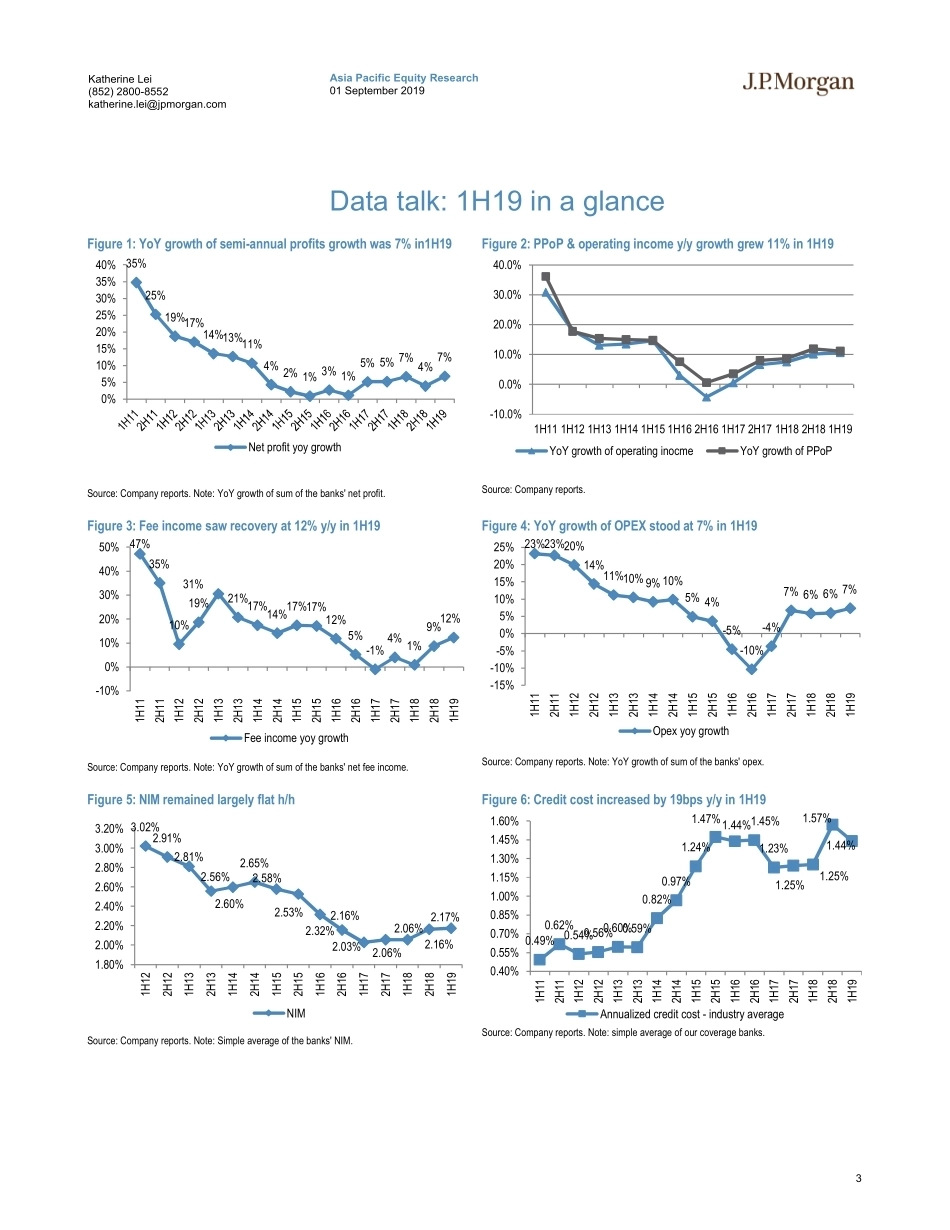
Asia Pacific Equity Research01 September 2019 China banks1H19 results review: Profit growth beat expectations but growth momentum started to weaken; prefer JSBs over large banksBanks & Financial ServicesKatherine Lei AC(852) 2800-8552katherine.lei@jpmorgan.comBloomberg JPMA LEI George Cai(852) 2800-8557george.cai@jpmorgan.comDaqi Jiao(852) 2800-8595daqi.jiao@jpmorgan.comJ.P. Morgan Securities (Asia Pacific) LimitedSee page 59 for analyst certification and important disclosures, including non-US analyst disclosures.J.P. Morgan does and seeks to do business with companies covered in its research reports. As a result, investors should be aware that the firm may have a conflict of interest that could affect the objectivity of this report. Investors should consider this report as only a single factor in making their investment decision.www.jpmorganmarkets.comChina banks’ 1H19 bottom-line results beat expectations; however, we noted weakening sequential trends on PPoP growth in 2Q19. JSBs continued to outperform large banks, particularly on NIM expansion, fee and deposits growth. Key positives are that asset quality remains stable and negative impacts from LPR transformation may be lower than expected as per management comments. Key concerns are weakening revenue growth momentum and that credit supply may decelerate in 2H19 if there are no revisions on loan quota. We prefer JSBs (i.e. PAB, CMB) over large banks and regional banks (CRCB, Huishang). Growth momentum trending down; diverging trends between large banks and JSBs: 1H19 PPoP growth remained strong (+11% y/y), but quarterly data shows weakening growth momentum with 2Q19 PPoP growth of 8% y/y, slowing from 16% y/y in 1Q19, though profits growth remained largely stable (+7% y/y). JSBs’ results are notably better than large banks: a) revenue and profits y/y growth of 17% and 10% in 1H19 was ahead of large banks at 8% and 5%, respectively; b) this was driven by NIM expansion (JSBs +6bps h/h vs large banks -7bps h/h); c) JSBs’ deposits growth was +11% h/h vs large banks of +7% h/h; and d) JSBs also tightened NPL recognition (Figure 46). Asset quality remains largely stable and beat our expectation: NPL ratio remained broadly stable (-3bps q/q, -5bps h/h). Leading indicators, such as SML % (-12bps h/h) and newly-overdue loan % (-1bps h/h), all showed that asset quality remains stable. NPL coverage went up 5ppt q/q to 214% on average, and loan loss reserve ratio, adding back shadow assets on balance sheet, stood at 3.08%. Our take on financial deleveraging and loan growth – credit supply could be tight if no loosening: there is no unwinding of financial deleveraging: a) non-standardized assets (NSA) stayed flat h/h, accounting for ~6% of assets on average; b) banks increased NAV products in WMP mix from 25% at end 2018 to 36% in 1H19); and c) decline in reliance on wholesale funding, particularly for JSBs. However, the worrying trend is that 1H19 new loans account for ~77% of FY19 loan quota for large banks, ~70% for JSBs, meaning that if there are no revisions to loan quota or sequential expansion of shadow lending, credit supply could decelerate in 2H19. Key management takeaways on loan growth, LPR & NIM and asset quality: a) CCB and CMB management commented that there is no plan to revise up loan quota, but they will focus on mix optimization in 2H19. b) On LPR, 30%, 50% and 80% of new loans extended in 3Q19, 4Q19 and 1Q20 will be based on LPR, and CCB management commented that 2H19 NIM could be down 1-2bps h/h due to LPR implementation. Management in general guided stable or weakening NIM trends going forward. c) On inclusive finance and POE loans, banks are on track to meet regulatory guidance (Table 10 - Table 11). d) Asset quality is generally stable, with CMB expecting credit costs to trend down. See pages 21-24 for detailed management comments by topics.2Asia Pacific Equity Research01 September 2019Katherine Lei(852) 2800-8552katherine.lei@jpmorgan.com Table of ContentsData talk: 1H19 in a glance ......................................................3Key trends in 1H19: stable asset quality, declining topline growth and diverging performance ........................................6Diverging trends between large banks and JSBs.......................................................6Asset quality more stable than thought.....................................................................8Loan growth and allocation ...................................................................................13Financial deleveraging health check.......................................................................16Key takeaways from analyst briefings..................................211H19 Review ...........................................................................25P&L review ..........................................................................................................25Balance sheet review.................................................




发表评论取消回复