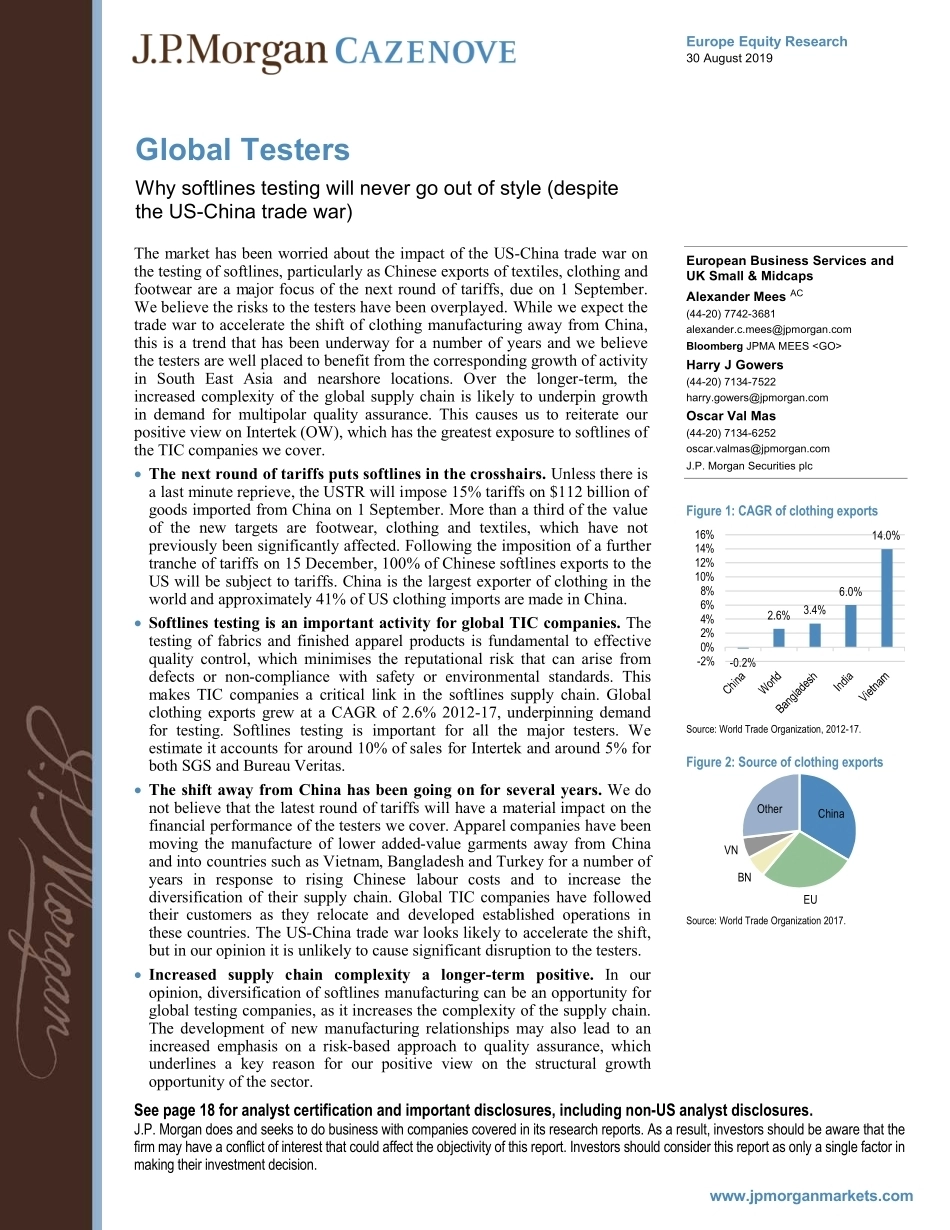
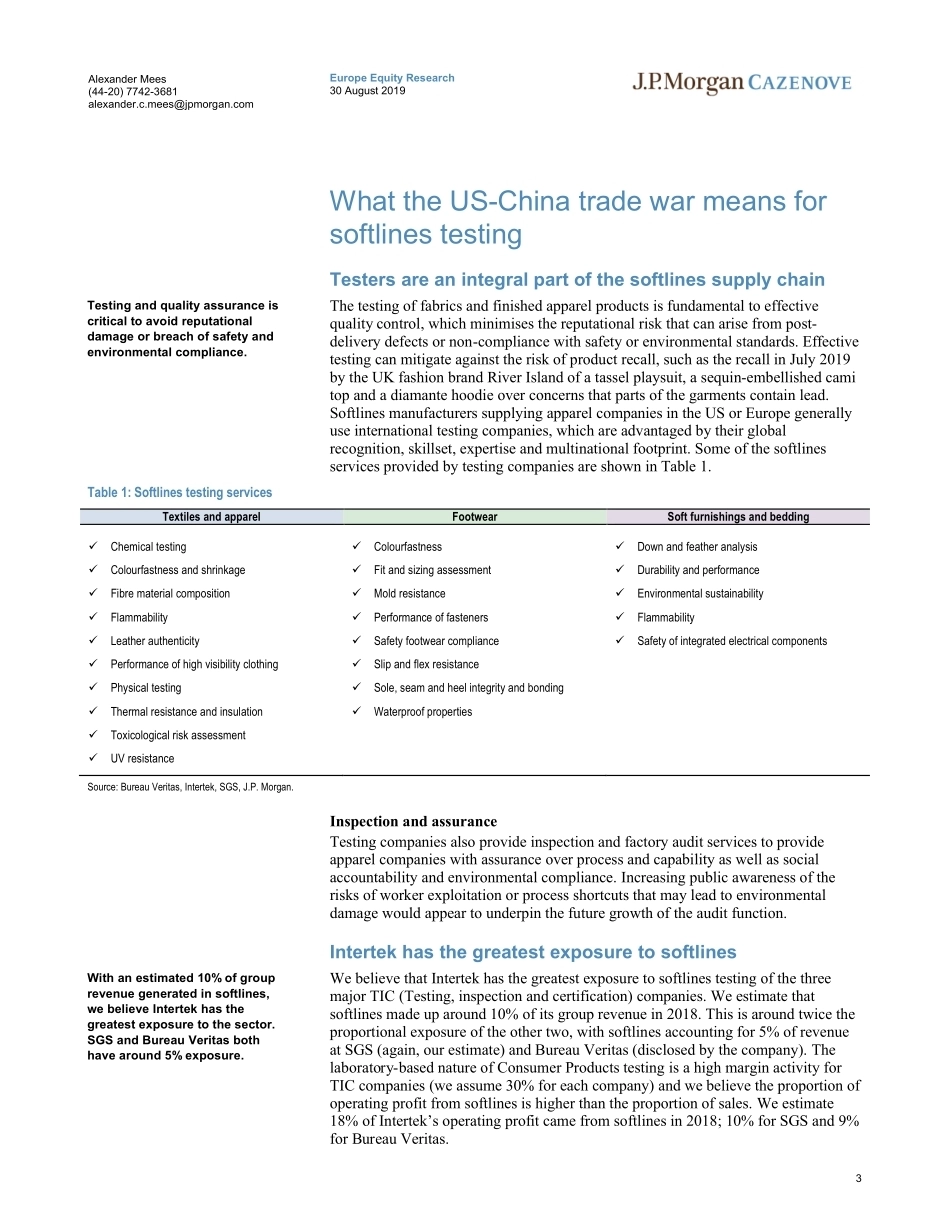
Europe Equity Research30 August 2019 Global TestersWhy softlines testing will never go out of style (despite the US-China trade war)European Business Services and UK Small & MidcapsAlexander Mees AC(44-20) 7742-3681alexander.c.mees@jpmorgan.comBloomberg JPMA MEES Harry J Gowers(44-20) 7134-7522harry.gowers@jpmorgan.comOscar Val Mas(44-20) 7134-6252oscar.valmas@jpmorgan.comJ.P. Morgan Securities plcSee page 18 for analyst certification and important disclosures, including non-US analyst disclosures.J.P. Morgan does and seeks to do business with companies covered in its research reports. As a result, investors should be aware that the firm may have a conflict of interest that could affect the objectivity of this report. Investors should consider this report as only a single factor in making their investment decision.www.jpmorganmarkets.comThe market has been worried about the impact of the US-China trade war onthe testing of softlines, particularly as Chinese exports of textiles, clothing and footwear are a major focus of the next round of tariffs, due on 1 September.We believe the risks to the testers have been overplayed. While we expect the trade war to accelerate the shift of clothing manufacturing away from China, this is a trend that has been underway for a number of years and we believe the testers are well placed to benefit from the corresponding growth of activity in South East Asia and nearshore locations. Over the longer-term, the increased complexity of the global supply chain is likely to underpin growth in demand for multipolar quality assurance. This causes us to reiterate our positive view on Intertek (OW), which has the greatest exposure to softlines of the TIC companies we cover. The next round of tariffs puts softlines in the crosshairs. Unless there is a last minute reprieve, the USTR will impose 15% tariffs on $112 billion of goods imported from China on 1 September. More than a third of the value of the new targets are footwear, clothing and textiles, which have not previously been significantly affected. Following the imposition of a further tranche of tariffs on 15 December, 100% of Chinese softlines exports to the US will be subject to tariffs. China is the largest exporter of clothing in the world and approximately 41% of US clothing imports are made in China. Softlines testing is an important activity for global TIC companies. The testing of fabrics and finished apparel products is fundamental to effective quality control, which minimises the reputational risk that can arise fromdefects or non-compliance with safety or environmental standards. This makes TIC companies a critical link in the softlines supply chain. Global clothing exports grew at a CAGR of 2.6% 2012-17, underpinning demand for testing. Softlines testing is important for all the major testers. We estimate it accounts for around 10% of sales for Intertek and around 5% for both SGS and Bureau Veritas. The shift away from China has been going on for several years. We do not believe that the latest round of tariffs will have a material impact on the financial performance of the testers we cover. Apparel companies have been moving the manufacture of lower added-value garments away from China and into countries such as Vietnam, Bangladesh and Turkey for a number of years in response to rising Chinese labour costs and to increase the diversification of their supply chain. Global TIC companies have followed their customers as they relocate and developed established operations in these countries. The US-China trade war looks likely to accelerate the shift, but in our opinion it is unlikely to cause significant disruption to the testers. Increased supply chain complexity a longer-term positive. In our opinion, diversification of softlines manufacturing can be an opportunity for global testing companies, as it increases the complexity of the supply chain.The development of new manufacturing relationships may also lead to an increased emphasis on a risk-based approach to quality assurance, which underlines a key reason for our positive view on the structural growth opportunity of the sector.Figure 1: CAGR of clothing exportsSource: World Trade Organization, 2012-17.Figure 2: Source of clothing exportsSource: World Trade Organization 2017.-0.2%2.6%3.4%6.0%14.0%-2%0%2%4%6%8%10%12%14%16%ChinaEUBNVNOther2Europe Equity Research30 August 2019Alexander Mees(44-20) 7742-3681alexander.c.mees@jpmorgan.com Table of ContentsWhat the US-China trade war means for softlines testing....3Testers are an integral part of the softlines supply chain...........................................3Intertek has the greatest exposure to softlines...........................................................3The impact of the trade war has so far been limited..................................................5The testers can follow manufacturing relocations.....................................................5Over the longer-term, complexity may lead to...




发表评论取消回复