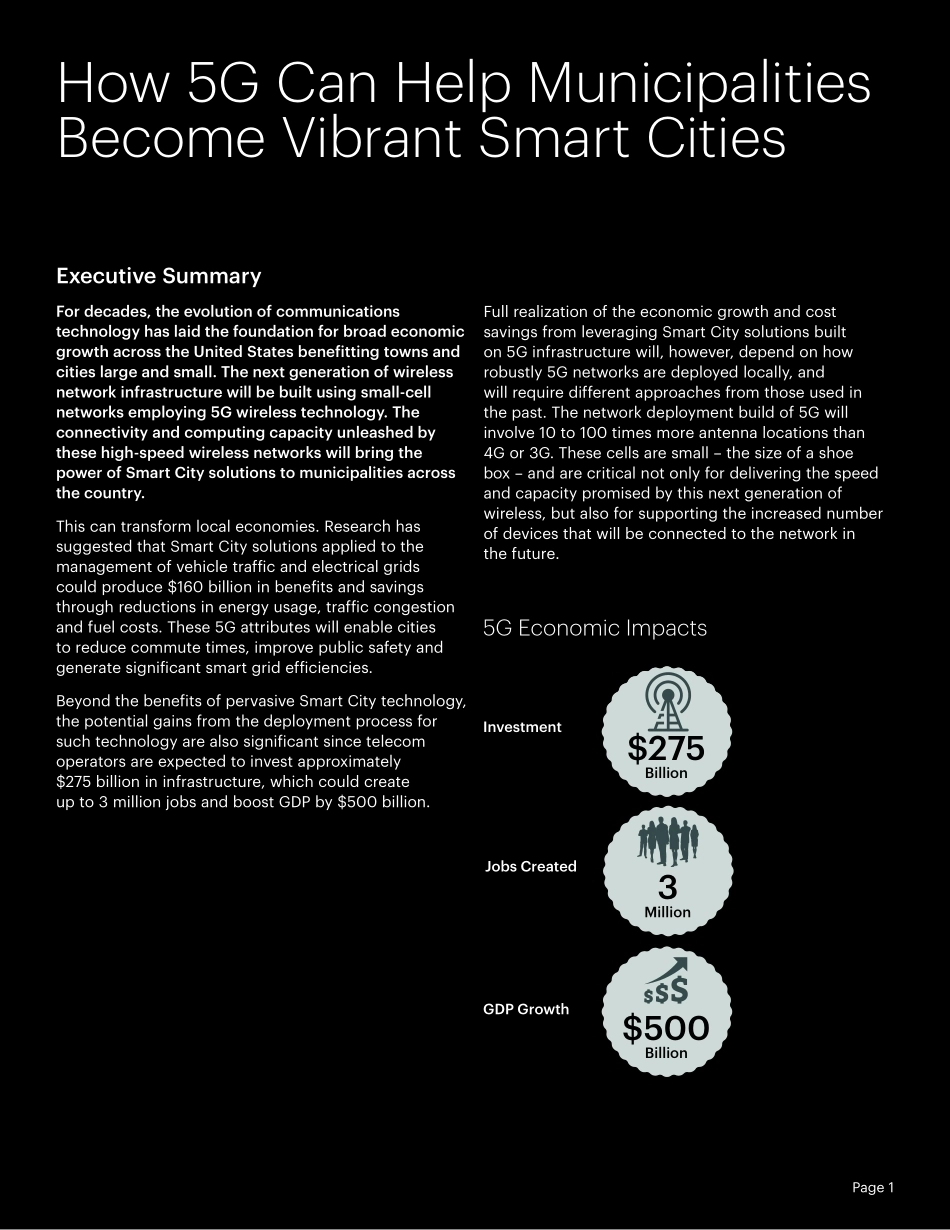
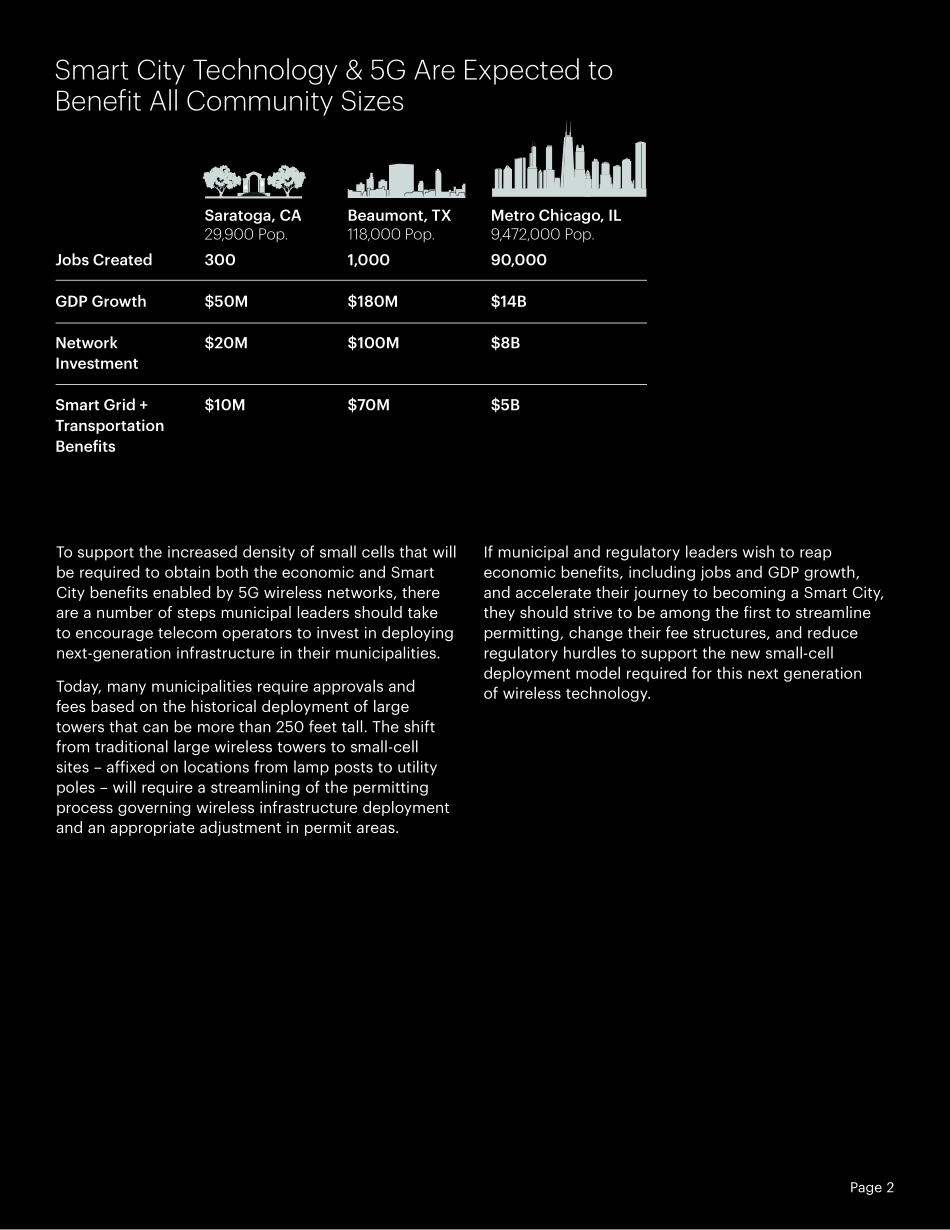
SMART CITIESHow 5G Can Help Municipalities Become Vibrant Smart CitiesHow 5G Can Help Municipalities Become Vibrant Smart CitiesExecutive Summary For decades, the evolution of communications technology has laid the foundation for broad economic growth across the United States benefitting towns and cities large and small. The next generation of wireless network infrastructure will be built using small-cell networks employing 5G wireless technology. The connectivity and computing capacity unleashed by these high-speed wireless networks will bring the power of Smart City solutions to municipalities across the country. This can transform local economies. Research has suggested that Smart City solutions applied to the management of vehicle traffic and electrical grids could produce $160 billion in benefits and savings through reductions in energy usage, traffic congestion and fuel costs. These 5G attributes will enable cities to reduce commute times, improve public safety and generate significant smart grid efficiencies. Beyond the benefits of pervasive Smart City technology, the potential gains from the deployment process for such technology are also significant since telecom operators are expected to invest approximately $275 billion in infrastructure, which could create up to 3 million jobs and boost GDP by $500 billion.5G Economic ImpactsJobs CreatedGDP GrowthInvestment3Million$500Billion$275BillionFull realization of the economic growth and cost savings from leveraging Smart City solutions built on 5G infrastructure will, however, depend on how robustly 5G networks are deployed locally, and will require different approaches from those used in the past. The network deployment build of 5G will involve 10 to 100 times more antenna locations than 4G or 3G. These cells are small – the size of a shoe box – and are critical not only for delivering the speed and capacity promised by this next generation of wireless, but also for supporting the increased number of devices that will be connected to the network in the future.Page 1To support the increased density of small cells that will be required to obtain both the economic and Smart City benefits enabled by 5G wireless networks, there are a number of steps municipal leaders should take to encourage telecom operators to invest in deploying next-generation infrastructure in their municipalities. Today, many municipalities require approvals and fees based on the historical deployment of large towers that can be more than 250 feet tall. The shift from traditional large wireless towers to small-cell sites – affixed on locations from lamp posts to utility poles – will require a streamlining of the permitting process governing wireless infrastructure deployment and an appropriate adjustment in permit areas. If municipal and regulatory leaders wish to reap economic benefits, including jobs and GDP growth, and accelerate their journey to becoming a Smart City, they should strive to be among the first to streamline permitting, change their fee structures, and reduce regulatory hurdles to support the new small-cell deployment model required for this next generation of wireless technology. Saratoga, CA 29,900 Pop.300$50M$20M$10M Jobs CreatedGDP GrowthNetwork InvestmentSmart Grid + Transportation BenefitsBeaumont, TX 118,000 Pop.1,000$180M$100M$70MMetro Chicago, IL 9,472,000 Pop.90,000$14B$8B$5BSmart City Technology & 5G Are Expected to Benefit All Community SizesPage 2The Next Generation of Wireless Technology Will Fuel Economic Growth The full potential of Smart Cities will be unlocked by 5G networks and small cells, creating jobs as well as entire new industries. Communities that support 5G wireless technology will see significant economic and community benefits. This next generation of wireless technology is expected to create 3 million new jobs and boost annual GDP by $500 billion, driven by a projected $275 billion investment from telecom operators. Direct Economic Benefits As telecom operators build out their networks, they are expected to invest across the country. Our analysis indicates that U.S. telecom operators could invest approximately $275 billion over seven years to deploy next-generation wireless technology, with trials beginning as early as 2017 in select cities.1 Of that $275 billion, $93 billion is expected to be spent on construction, with the remainder being allocated for network equipment, engineering, and planning. 5G Economic ImpactsJobs CreatedGDP GrowthInvestment3Million$500Billion$275BillionPage 3Deploying the infrastructure required for 5G will also create jobs. We estimate that approximately 50,000 new construction jobs will be created each year over the 7-year buildout period. When we consider the effects on suppliers and other partners, and their spending in the economy, the full impact from construction spending alone could be approximately 120,000 jobs created each year during the first seven years of deployment.2 Broader Economic BenefitsThou...





发表评论取消回复