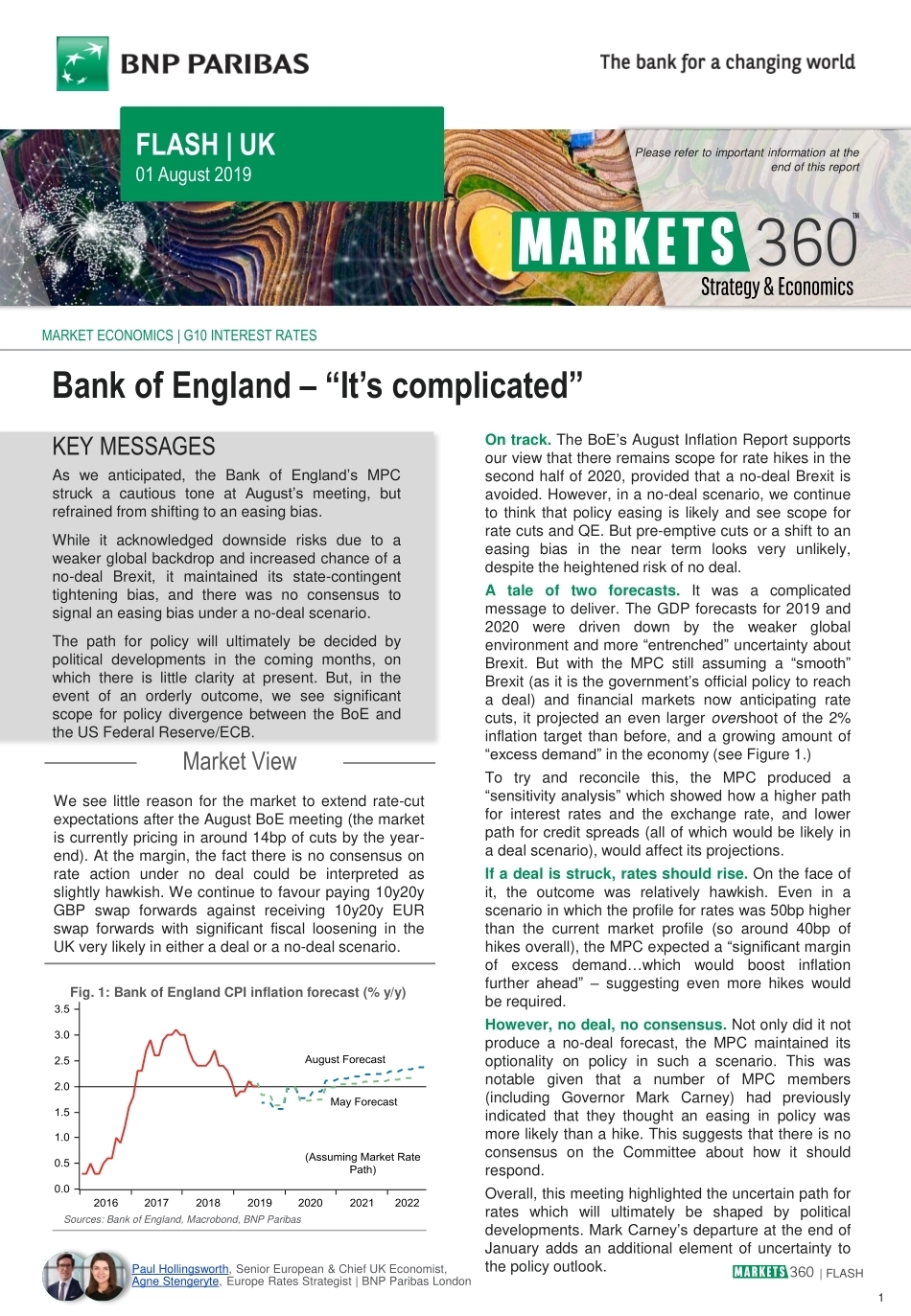
Market View We see little reason for the market to extend rate-cut expectations after the August BoE meeting (the market is currently pricing in around 14bp of cuts by the year-end). At the margin, the fact there is no consensus on rate action under no deal could be interpreted as slightly hawkish. We continue to favour paying 10y20y GBP swap forwards against receiving 10y20y EUR swap forwards with significant fiscal loosening in the UK very likely in either a deal or a no-deal scenario. MARKET ECONOMICS | G10 INTEREST RATES KEY MESSAGES As we anticipated, the Bank of England’s MPC struck a cautious tone at August’s meeting, but refrained from shifting to an easing bias. While it acknowledged downside risks due to a weaker global backdrop and increased chance of a no-deal Brexit, it maintained its state-contingent tightening bias, and there was no consensus to signal an easing bias under a no-deal scenario. The path for policy will ultimately be decided by political developments in the coming months, on which there is little clarity at present. But, in the event of an orderly outcome, we see significant scope for policy divergence between the BoE and the US Federal Reserve/ECB. FLASH | UK 01 August 2019 On track. The BoE’s August Inflation Report supports our view that there remains scope for rate hikes in the second half of 2020, provided that a no-deal Brexit is avoided. However, in a no-deal scenario, we continue to think that policy easing is likely and see scope for rate cuts and QE. But pre-emptive cuts or a shift to an easing bias in the near term looks very unlikely, despite the heightened risk of no deal. A tale of two forecasts. It was a complicated message to deliver. The GDP forecasts for 2019 and 2020 were driven down by the weaker global environment and more “entrenched” uncertainty about Brexit. But with the MPC still assuming a “smooth” Brexit (as it is the government’s official policy to reach a deal) and financial markets now anticipating rate cuts, it projected an even larger overshoot of the 2% inflation target than before, and a growing amount of “excess demand” in the economy (see Figure 1.) To try and reconcile this, the MPC produced a “sensitivity analysis” which showed how a higher path for interest rates and the exchange rate, and lower path for credit spreads (all of which would be likely in a deal scenario), would affect its projections. If a deal is struck, rates should rise. On the face of it, the outcome was relatively hawkish. Even in a scenario in which the profile for rates was 50bp higher than the current market profile (so around 40bp of hikes overall), the MPC expected a “significant margin of excess demand…which would boost inflation further ahead” – suggesting even more hikes would be required. However, no deal, no consensus. Not only did it not produce a no-deal forecast, the MPC maintained its optionality on policy in such a scenario. This was notable given that a number of MPC members (including Governor Mark Carney) had previously indicated that they thought an easing in policy was more likely than a hike. This suggests that there is no consensus on the Committee about how it should respond. Overall, this meeting highlighted the uncertain path for rates which will ultimately be shaped by political developments. Mark Carney’s departure at the end of January adds an additional element of uncertainty to the policy outlook. Paul Hollingsworth, Senior European & Chief UK Economist, Agne Stengeryte, Europe Rates Strategist | BNP Paribas London Please refer to important information at the end of this report Bank of England – “It’s complicated” Fig. 1: Bank of England CPI inflation forecast (% y/y) Sources: Bank of England, Macrobond, BNP Paribas 1 | FLASH Legal Notice This document has been written by our Strategist and Economist teams within the BNP Paribas group of companies (collectively “BNPP”); it does not purport to be an exhaustive analysis, and may be subject to conflicts of interest resulting from their interaction with sales and trading which could affect the objectivity of this report. This document is non-independent research for the purpose of the UK Financial Conduct Authority rules. For the purposes of the recast Markets in Financial Instruments Directive (2014/65/EU) (MiFID II), non-independent research constitutes a marketing communication. This document is not investment research for the purposes of MiFID II. It has not been prepared in accordance with legal requirements designed to provide the independence of investment research, and is not subject to any prohibition on dealing ahead of the dissemination of investment research. The content in this document/communication may also contain “Research” as defined under the MiFID II unbundling rules. If the document/communication contains Research, it is intended for those firms who are either in scope of the MiFID II unbundling rules and have signed up to one of the BNPP Global Markets Research packages, or ...




发表评论取消回复