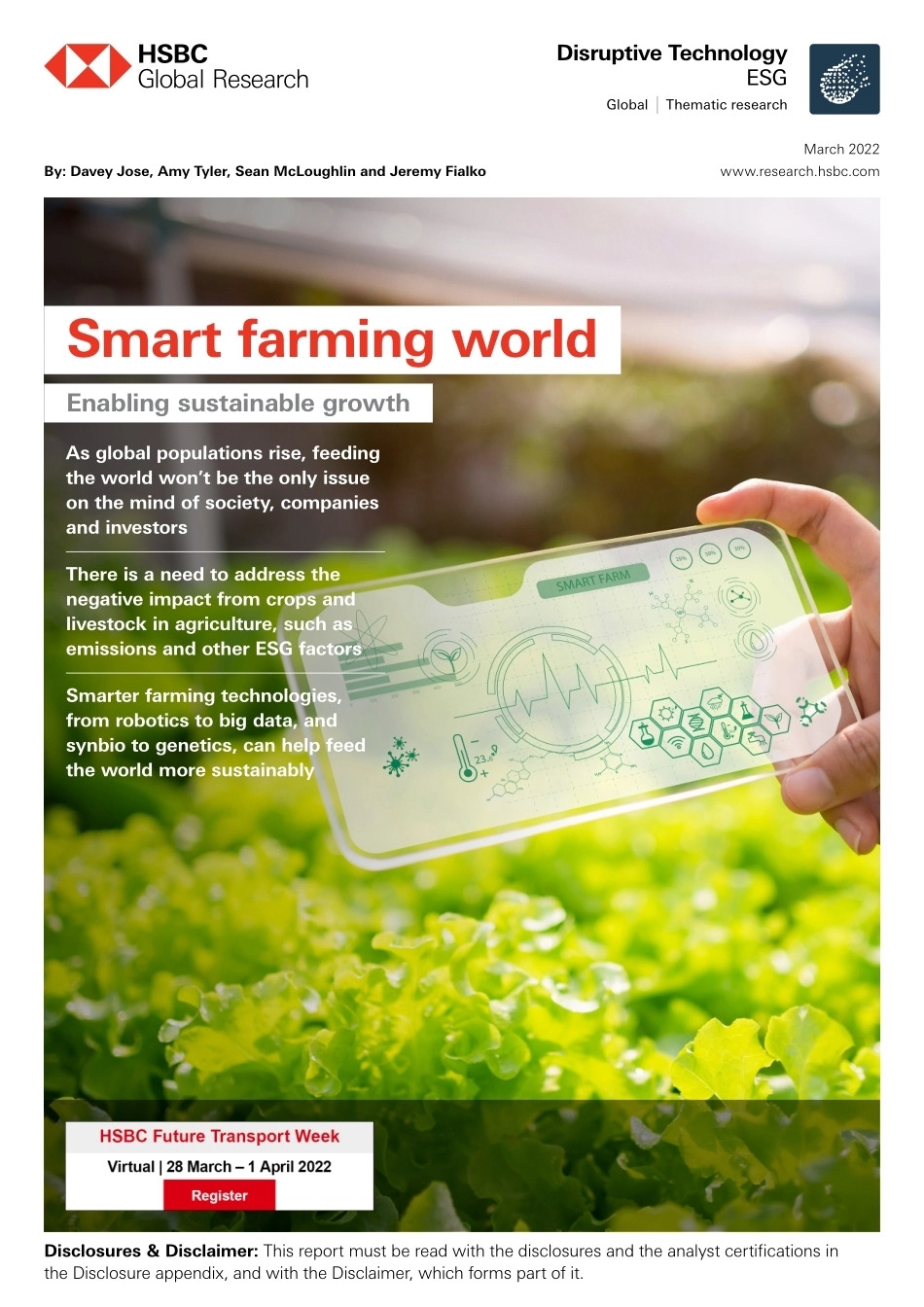
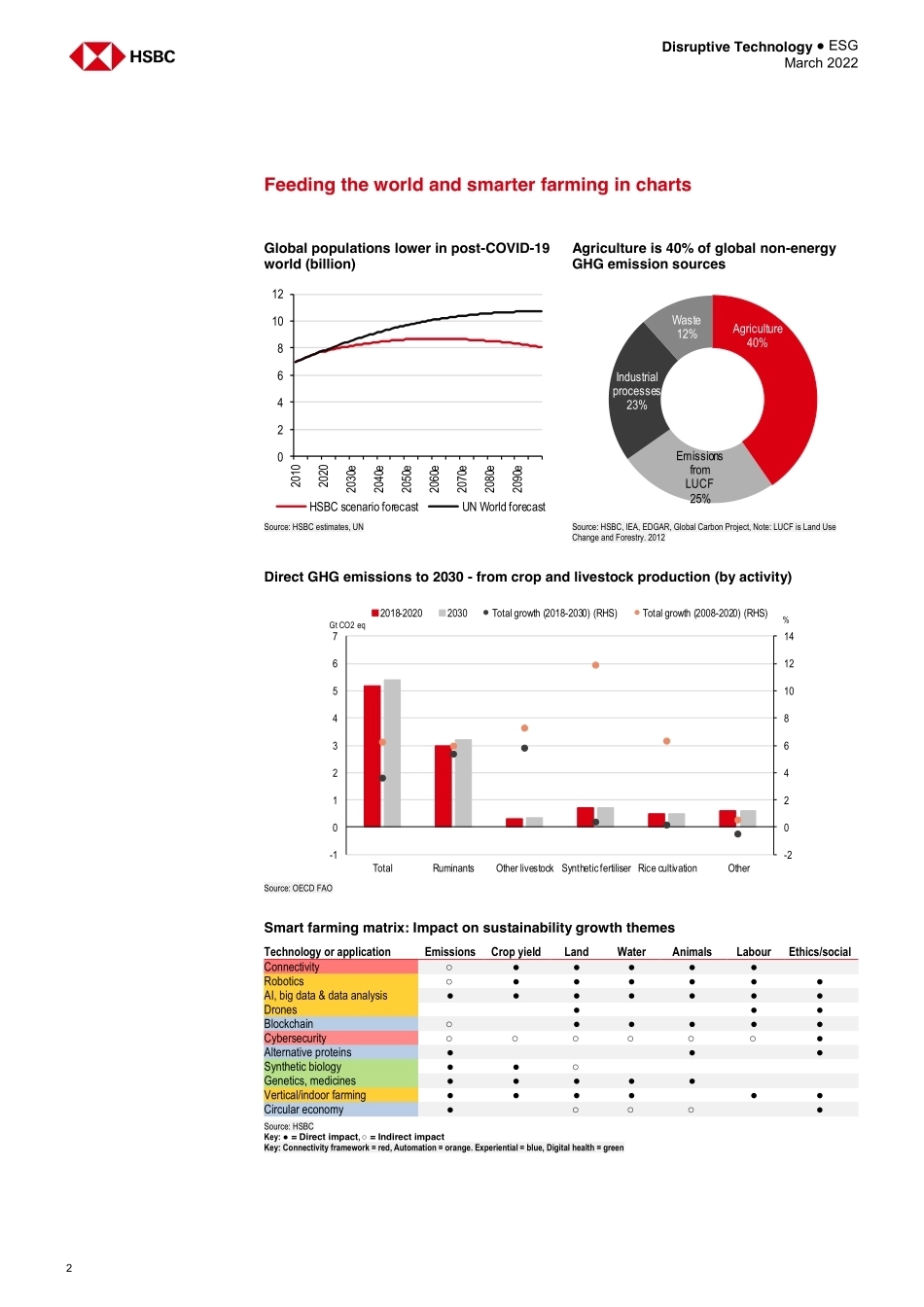
www.research.hsbc.comDisclosures & Disclaimer: This report must be read with the disclosures and the analyst certifications inthe Disclosure appendix, and with the Disclaimer, which forms part of it.March 2022By: Davey Jose, Amy Tyler, Sean McLoughlin and Jeremy FialkoSmart farming worldEnabling sustainable growthAs global populations rise, feeding the world won’t be the only issue on the mind of society, companies and investorsThere is a need to address the negative impact from crops and livestock in agriculture, such as emissions and other ESG factorsSmarter farming technologies, from robotics to big data, and synbio to genetics, can help feed the world more sustainablyDisruptive TechnologyESGGlobalThematic research 1 Disruptive Technology ● ESG March 2022 Smarter farming to feed the world sustainably Food, glorious food! Despite global population growth set to be lower in a post pandemic age, we believe that this factor alone may not be sufficient in alleviating the pressure to feed world sustainably. For example, the negative issues of climate change, environmental and labour factors from agriculture are increasingly at the top of the mind of society, companies and investors. By 2050, we expect the global population to hit 8.5bn. The UN expects each person to consume 12% more than they did at the turn of the century. We believe this implies that total food consumption may grow by 60% at the midpoint of the century. In this report, we outline key data point observations, issues and pressure points for feeding the world sustainably. This includes global population growth dynamics, food demand as well as environmental and labour issues. This sets up the thematic motivation for the report and then we move on to look at how various smart farming tools are being used today in making agriculture more sustainable in the longer run. What is smart farming? Smart farming naturally includes technologies such as robotics and connectivity, often using Internet-of-Things to track and automate activity on farms. But in the modern day, farms are also starting to use big data, artificial intelligence, drones and blockchains to process and make sense of activity in real-time. However, as the farm becomes smarter, allowing the production of crops, feeds and livestock to increase yields, reduce water use, energy and labour, this digitisation also brings issues of cybersecurity and hacking. We believe there is value in understanding smart farming beyond the traditional definitions of simply pure digitisation. So we look at how innovations such as vertical farming, hydroponics, alternative protein for human consumption, synthetic biology and animal protein/pain killers can help with reducing water use, emissions and improving ethics in the modern agriculture setting. We also look at the regulations landscape globally to support smarter and sustainable farming. Did you know? � Global population set to rise to 8.5bn and world set to consume 60% more food by 2050 � Food related GHG emissions are responsible for 26% of global emissions � Global AgTech to grow from about USD22bn today to nearly USD140bn by 2030 � Digital farming technology increased yields up to 30% recently in trials in India � Vertical (indoor) farming uses no soil and 95% less water than traditional methods We also publish an accompanying report in which we highlight companies exposed to smart farming technologies and applications, entitled “Powering smart farms: Ten thematic stocks” (3 March 2022). Why read this report? Population growth, environment and labour issues in food production… Understanding smarter farming applications today Disruptive Technology ● ESG March 2022 2 Feeding the world and smarter farming in charts Global populations lower in post-COVID-19 world (billion) Agriculture is 40% of global non-energy GHG emission sources Source: HSBC estimates, UN Source: HSBC, IEA, EDGAR, Global Carbon Project, Note: LUCF is Land Use Change and Forestry. 2012 Direct GHG emissions to 2030 - from crop and livestock production (by activity) Source: OECD FAO Smart farming matrix: Impact on sustainability growth themes Technology or application Emissions Crop yield Land Water Animals Labour Ethics/social Connectivity ○ ● ● ● ● ● Robotics ○ ● ● ● ● ● ● AI, big data & data analysis ● ● ● ● ● ● ● Drones ● ● ● Blockchain ○ ● ● ● ● ● Cybersecurity ○ ○ ○ ○ ○ ○ ● Alternative proteins ● ● ● Synthetic biology ● ● ○ Genetics, medicines ● ● ● ● ● Vertical/indoor farming ● ● ● ● ● ● Circular economy ● ○ ○ ○ ● Source: HSBC Key: ● = Direct impact, ○ = Indirect impact Key: Connectivity framework = red, Automation = orange. Experiential = blue, Digital health = green 024681012201020202030e2040e2050e2060e2070e2080e2090eHSBC scenario forecastUN World forecastAgriculture40%Emissions from LUCF25%Industrial processes23%Waste12%-202468101214-101234567TotalRuminantsOther livestock Synthetic fertiliser Rice cultivationOther%Gt CO2 eq2018-20202030Total growth (2018-2030) (RHS)Total grow...




发表评论取消回复