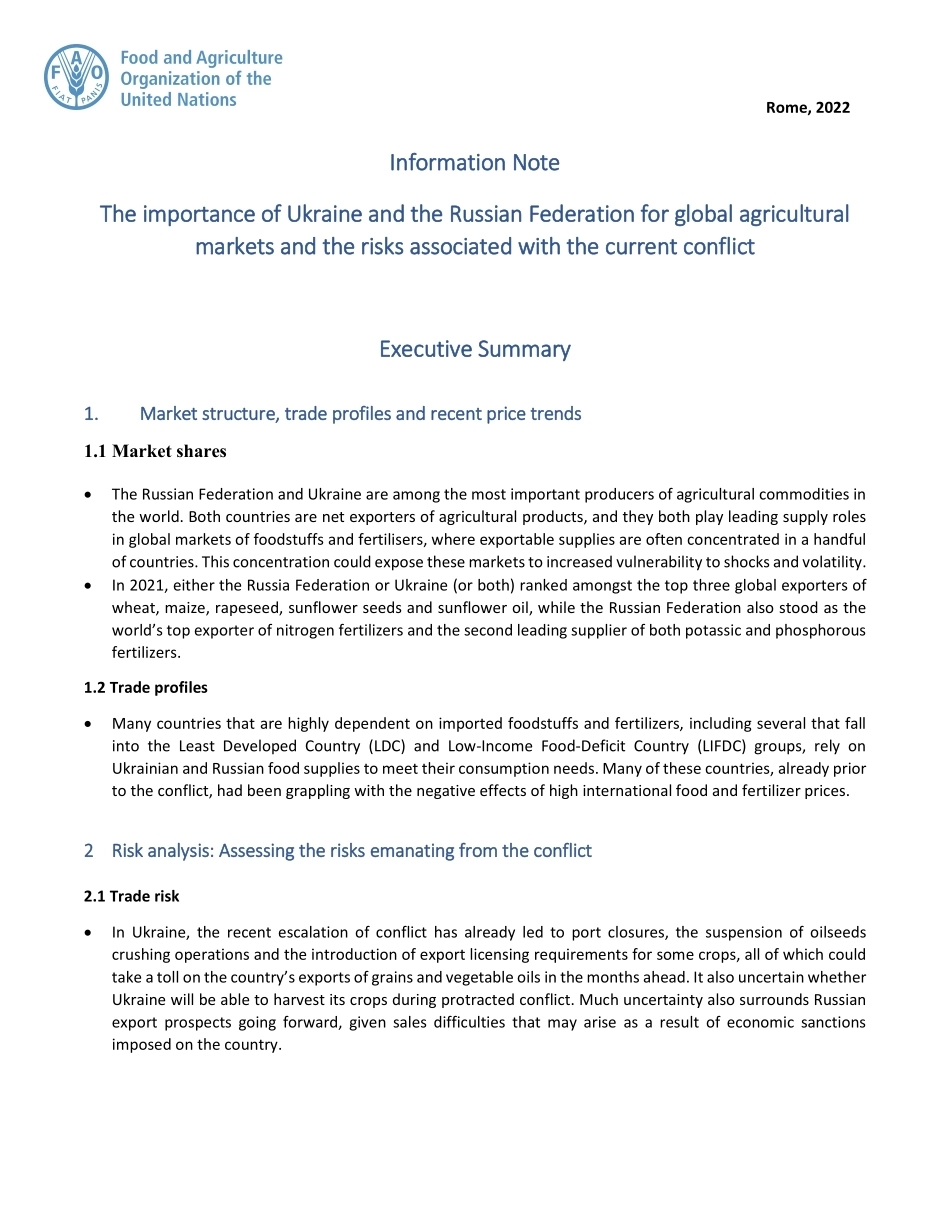
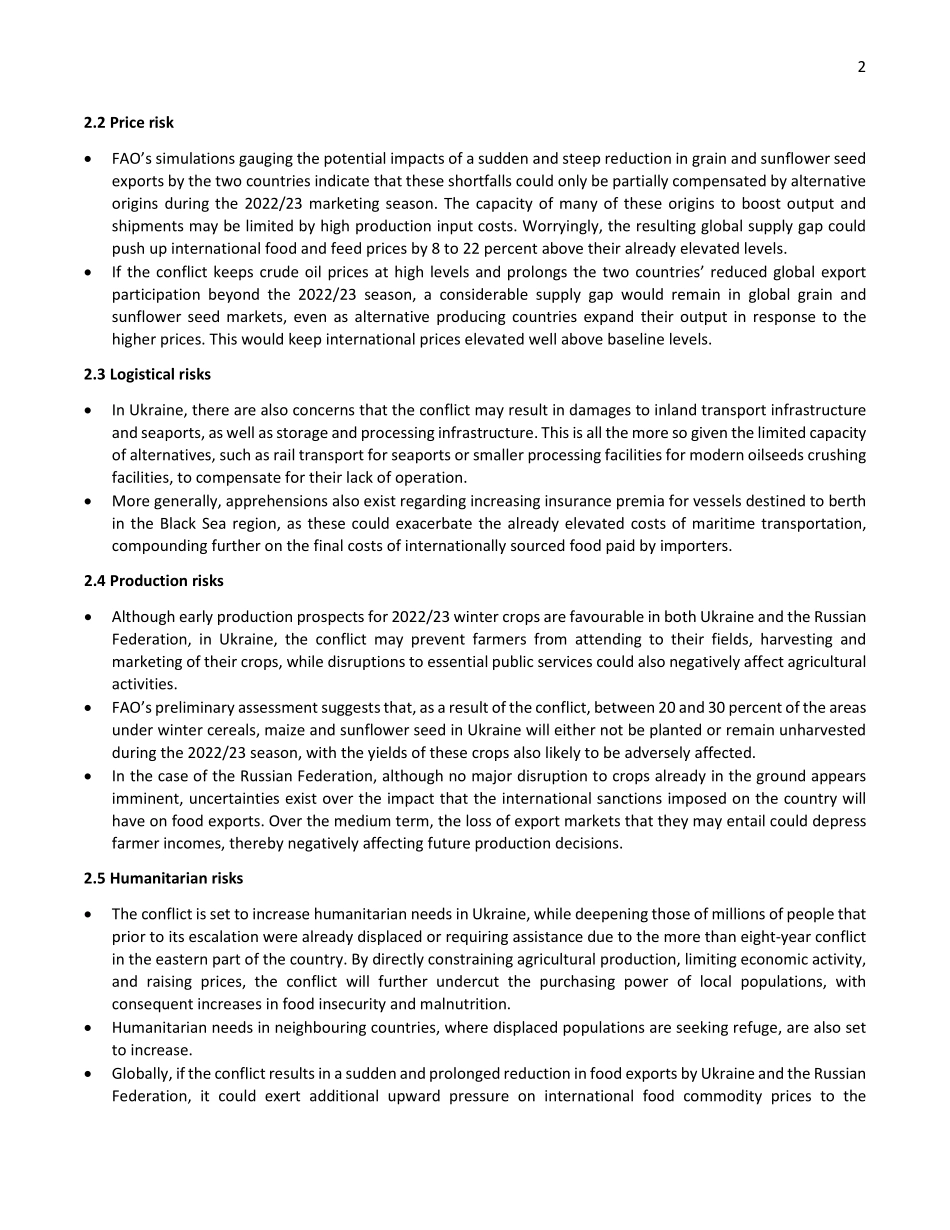
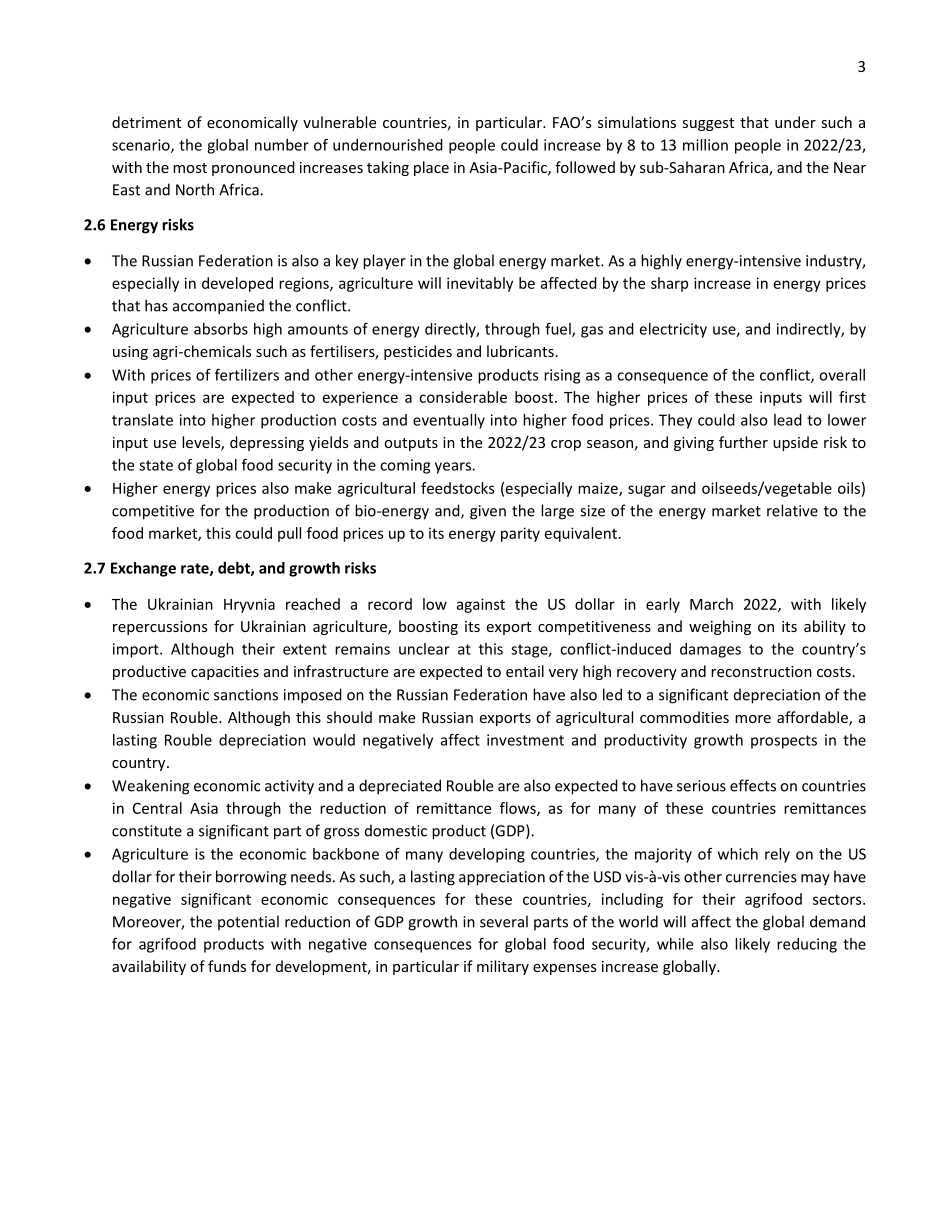
Information Note The importance of Ukraine and the Russian Federation for global agricultural markets and the risks associated with the current conflict Executive Summary 1.Market structure, trade profiles and recent price trends1.1 Market shares•The Russian Federation and Ukraine are among the most important producers of agricultural commodities inthe world. Both countries are net exporters of agricultural products, and they both play leading supply rolesin global markets of foodstuffs and fertilisers, where exportable supplies are often concentrated in a handfulof countries. This concentration could expose these markets to increased vulnerability to shocks and volatility.•In 2021, either the Russia Federation or Ukraine (or both) ranked amongst the top three global exporters ofwheat, maize, rapeseed, sunflower seeds and sunflower oil, while the Russian Federation also stood as theworld’s top exporter of nitrogen fertilizers and the second leading supplier of both potassic and phosphorousfertilizers.1.2 Trade profiles •Many countries that are highly dependent on imported foodstuffs and fertilizers, including several that fallinto the Least Developed Country (LDC) and Low-Income Food-Deficit Country (LIFDC) groups, rely onUkrainian and Russian food supplies to meet their consumption needs. Many of these countries, already priorto the conflict, had been grappling with the negative effects of high international food and fertilizer prices.2 Risk analysis: Assessing the risks emanating from the conflict 2.1 Trade risk •In Ukraine, the recent escalation of conflict has already led to port closures, the suspension of oilseedscrushing operations and the introduction of export licensing requirements for some crops, all of which couldtake a toll on the country’s exports of grains and vegetable oils in the months ahead. It also uncertain whetherUkraine will be able to harvest its crops during protracted conflict. Much uncertainty also surrounds Russianexport prospects going forward, given sales difficulties that may arise as a result of economic sanctionsimposed on the country.Rome, 20222 2.2 Price risk • FAO’s simulations gauging the potential impacts of a sudden and steep reduction in grain and sunflower seed exports by the two countries indicate that these shortfalls could only be partially compensated by alternative origins during the 2022/23 marketing season. The capacity of many of these origins to boost output and shipments may be limited by high production input costs. Worryingly, the resulting global supply gap could push up international food and feed prices by 8 to 22 percent above their already elevated levels. • If the conflict keeps crude oil prices at high levels and prolongs the two countries’ reduced global export participation beyond the 2022/23 season, a considerable supply gap would remain in global grain and sunflower seed markets, even as alternative producing countries expand their output in response to the higher prices. This would keep international prices elevated well above baseline levels. 2.3 Logistical risks • In Ukraine, there are also concerns that the conflict may result in damages to inland transport infrastructure and seaports, as well as storage and processing infrastructure. This is all the more so given the limited capacity of alternatives, such as rail transport for seaports or smaller processing facilities for modern oilseeds crushing facilities, to compensate for their lack of operation. • More generally, apprehensions also exist regarding increasing insurance premia for vessels destined to berth in the Black Sea region, as these could exacerbate the already elevated costs of maritime transportation, compounding further on the final costs of internationally sourced food paid by importers. 2.4 Production risks • Although early production prospects for 2022/23 winter crops are favourable in both Ukraine and the Russian Federation, in Ukraine, the conflict may prevent farmers from attending to their fields, harvesting and marketing of their crops, while disruptions to essential public services could also negatively affect agricultural activities. • FAO’s preliminary assessment suggests that, as a result of the conflict, between 20 and 30 percent of the areas under winter cereals, maize and sunflower seed in Ukraine will either not be planted or remain unharvested during the 2022/23 season, with the yields of these crops also likely to be adversely affected. • In the case of the Russian Federation, although no major disruption to crops already in the ground appears imminent, uncertainties exist over the impact that the international sanctions imposed on the country will have on food exports. Over the medium term, the loss of export markets that they may entail could depress farmer incomes, thereby negatively affecting future production decisions. 2.5 Humanitarian risks • The conflict is set to increase humanitarian needs in Ukraine, while deepening those of millions of people that...



发表评论取消回复