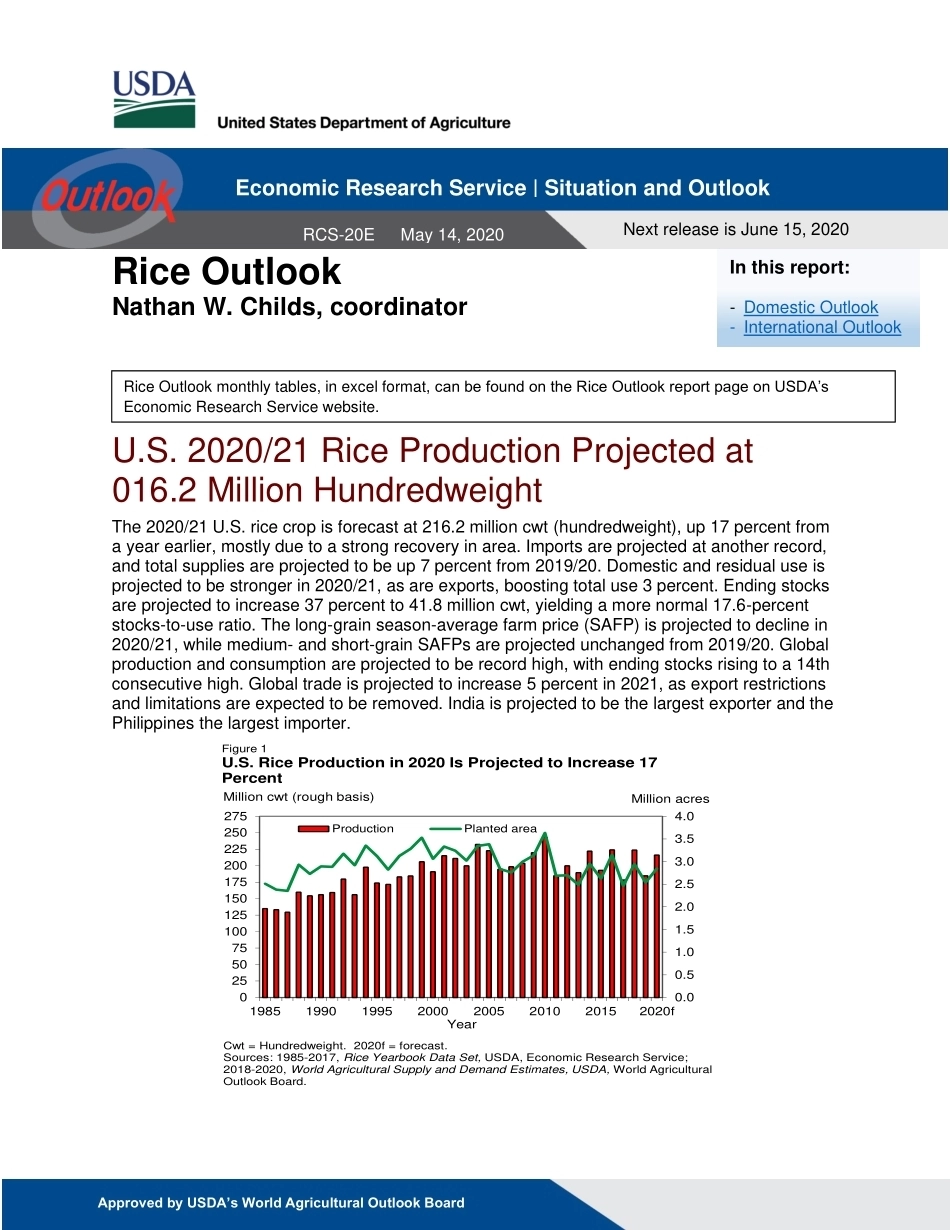
Approved by USDA’s World Agricultural Outlook BoardApproved by USDA’s World Agricultural Outlook Board , Rice Outlook Nathan W. Childs, coordinator U.S. 2020/21 Rice Production Projected at 016.2 Million Hundredweight The 2020/21 U.S. rice crop is forecast at 216.2 million cwt (hundredweight), up 17 percent from a year earlier, mostly due to a strong recovery in area. Imports are projected at another record, and total supplies are projected to be up 7 percent from 2019/20. Domestic and residual use is projected to be stronger in 2020/21, as are exports, boosting total use 3 percent. Ending stocks are projected to increase 37 percent to 41.8 million cwt, yielding a more normal 17.6-percent stocks-to-use ratio. The long-grain season-average farm price (SAFP) is projected to decline in 2020/21, while medium- and short-grain SAFPs are projected unchanged from 2019/20. Global production and consumption are projected to be record high, with ending stocks rising to a 14th consecutive high. Global trade is projected to increase 5 percent in 2021, as export restrictions and limitations are expected to be removed. India is projected to be the largest exporter and the Philippines the largest importer. 0.00.51.01.52.02.53.03.54.0025507510012515017520022525027519851990199520002005201020152020fProductionPlanted areaFigure 1U.S. Rice Production in 2020 Is Projected to Increase 17 PercentMillion cwt (rough basis)Million acresCwt = Hundredweight. 2020f = forecast. Sources: 1985-2017, Rice Yearbook Data Set, USDA, Economic Research Service; 2018-2020, World Agricultural Supply and Demand Estimates, USDA, World Agricultural Outlook Board. YearNext release is June 15, 2020 RCS-20E May 14, 2020 In this report: - Domestic Outlook - International Outlook Rice Outlook monthly tables, in excel format, can be found on the Rice Outlook report page on USDA’s Economic Research Service website. Economic Research Service | Situation and Outlook Report 2 RCS-20E, May 14, 2020 USDA, Economic Research Service Domestic Outlook U.S. Rice Crop Projected Up 17 Percent in 2020/21 The 2020/21 U.S. rice crop is projected at 216.2 million cwt, up 31.5 million cwt from a year earlier, a result of both larger area and higher yield. At 2.81 million acres, harvested area in 2020/21 is almost 14 percent larger than in 2019/20 when persistent rainfall nearly all spring sharply reduced plantings in much of the South, especially in the Delta. The 2020/21 harvested- area estimate is based on the March 31 intended plantings reported by NASS and uses a 5-year Olympic average planted-to-harvested ratio by class. The first survey of actual plantings of the 2020/21 U.S. rice crop will be reported by NASS in the June Acreage, scheduled for release on June 30. The 2020/21 average rice yield is projected at 7,699 pounds per acre, up 228 pounds from a year earlier and the highest on record. The yield is based on 20-year trends yield by class. The first objective yield forecast for the 2020/21 U.S. rice crop will be released on August 12 in the NASS Crop Production. By class, long-grain rice production in 2020/21 is projected at 155.5 million cwt, up 24 percent from a year earlier. Almost all U.S. long-grain rice is grown in the South. The 2020/21 combined medium- and short-grain crop is projected at 60.7 million cwt, up 2.8 percent from a year earlier and the largest since 2011/12. About 80 percent of the U.S. medium- and short-grain crop is grown in California. Progress of the 2020/21 U.S. rice crop remains behind normal in the Delta, a result of persistent rain and wet conditions. For the week ending May 10, 70 percent of the U.S. rice crop was reported planted, well ahead of last year’s rain-delayed 53 percent but slightly behind the U.S. 5-year average of 75 percent. Progress varied by region and State. On the Gulf Coast, planting was nearly complete in Texas by May 10, with 95 percent of the crop reported in the ground, up from 82 percent a year earlier and the Texas 5-year average of 84 percent. Early planting bodes well for both a higher main-crop yield and a good quality ratoon crop. Progress was only slightly slower in Louisiana, with 87 percent of the crop reported planted by May 10, 2 percentage points behind a year earlier and behind the Louisiana 5-year average of 93 percent. In the Delta, the Arkansas crop was reported 67 percent planted by May 10, up from a year- earlier, rain-delayed 51 percent but well behind the Arkansas 5-year average of 82 percent. Missouri’s crop was reported 51 percent planted by May 10, fractionally behind a year earlier but well behind the Missouri 5-year average of 74 percent, a result of continued rain, wet conditions, and storm damage in some areas. Mississippi’s crop was reported 57 percent planted by May 10, 5 percentage points ahead of a year earlier but well behind the Mississippi 5-year average of 76 percent. Finally, in California, 65 percent of the rice crop was reported planted by May 10, well ahead of last year’s ...





发表评论取消回复