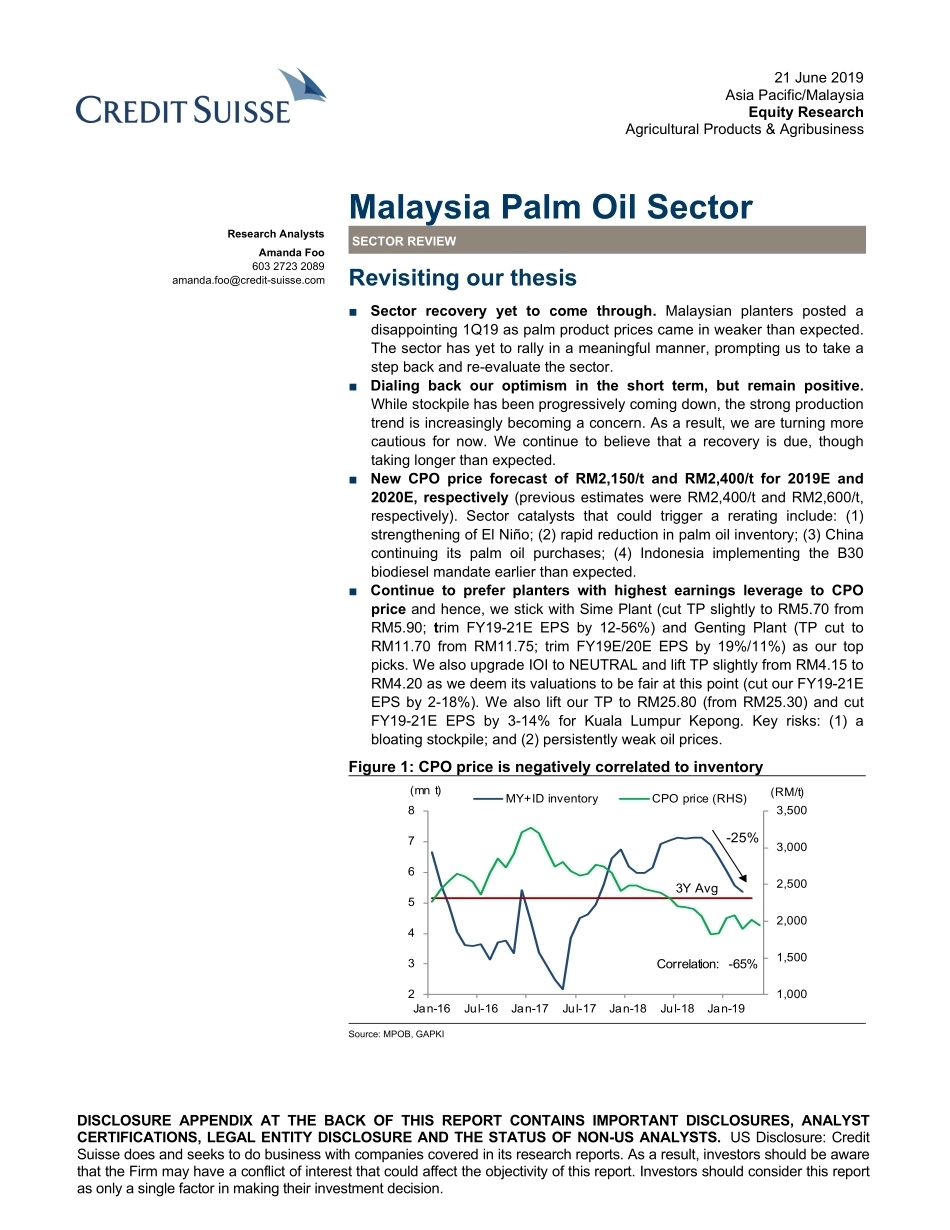
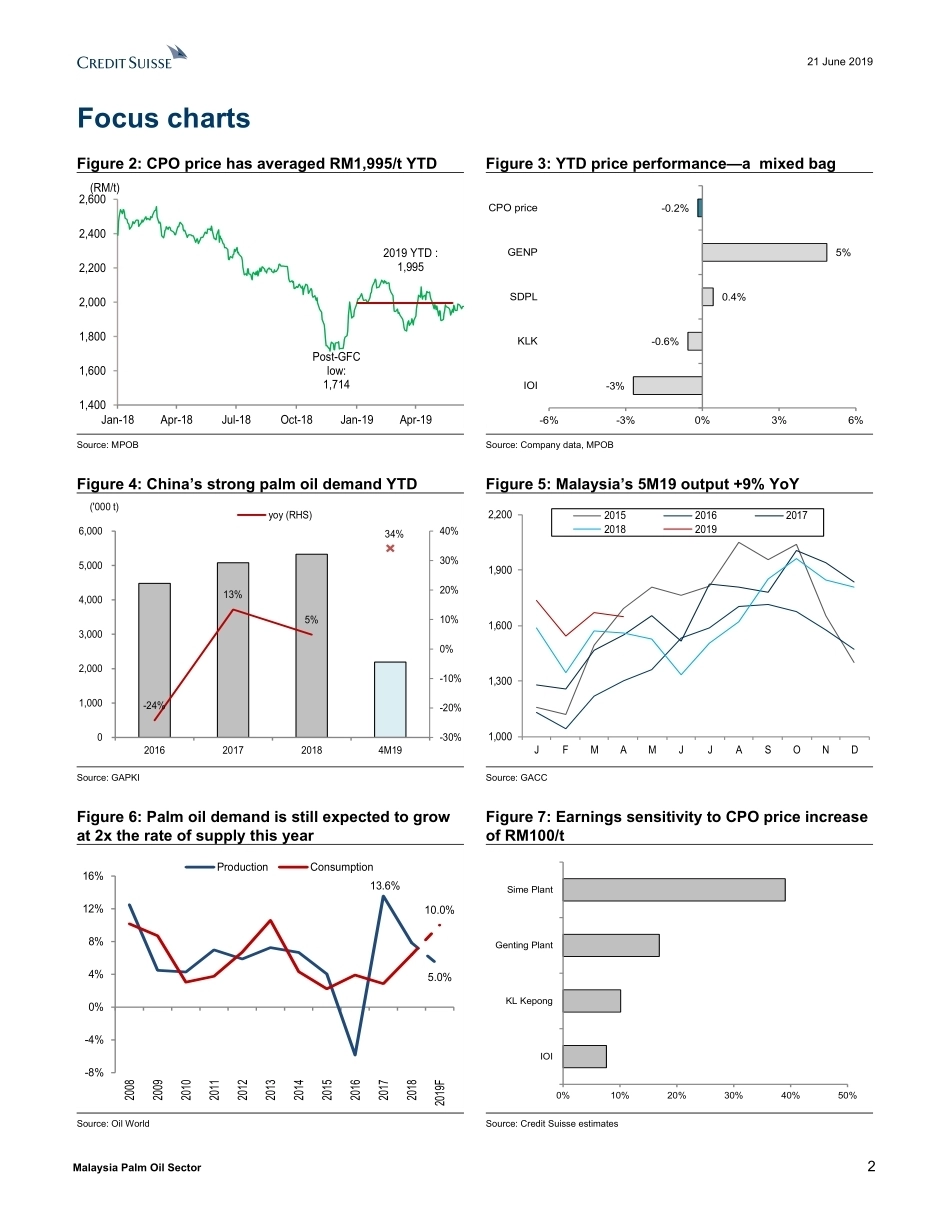
DISCLOSURE APPENDIX AT THE BACK OF THIS REPORT CONTAINS IMPORTANT DISCLOSURES, ANALYST CERTIFICATIONS, LEGAL ENTITY DISCLOSURE AND THE STATUS OF NON-US ANALYSTS. US Disclosure: Credit Suisse does and seeks to do business with companies covered in its research reports. As a result, investors should be aware that the Firm may have a conflict of interest that could affect the objectivity of this report. Investors should consider this report as only a single factor in making their investment decision. 21 June 2019Asia Pacific/MalaysiaEquity ResearchAgricultural Products & Agribusiness Malaysia Palm Oil Sector SECTOR REVIEWResearch AnalystsAmanda Foo603 2723 2089amanda.foo@credit-suisse.comRevisiting our thesis■Sector recovery yet to come through. Malaysian planters posted a disappointing 1Q19 as palm product prices came in weaker than expected. The sector has yet to rally in a meaningful manner, prompting us to take a step back and re-evaluate the sector. ■Dialing back our optimism in the short term, but remain positive. While stockpile has been progressively coming down, the strong production trend is increasingly becoming a concern. As a result, we are turning more cautious for now. We continue to believe that a recovery is due, though taking longer than expected. ■New CPO price forecast of RM2,150/t and RM2,400/t for 2019E and 2020E, respectively (previous estimates were RM2,400/t and RM2,600/t, respectively). Sector catalysts that could trigger a rerating include: (1) strengthening of El Niño; (2) rapid reduction in palm oil inventory; (3) China continuing its palm oil purchases; (4) Indonesia implementing the B30 biodiesel mandate earlier than expected. ■Continue to prefer planters with highest earnings leverage to CPO price and hence, we stick with Sime Plant (cut TP slightly to RM5.70 from RM5.90; trim FY19-21E EPS by 12-56%) and Genting Plant (TP cut to RM11.70 from RM11.75; trim FY19E/20E EPS by 19%/11%) as our top picks. We also upgrade IOI to NEUTRAL and lift TP slightly from RM4.15 to RM4.20 as we deem its valuations to be fair at this point (cut our FY19-21E EPS by 2-18%). We also lift our TP to RM25.80 (from RM25.30) and cut FY19-21E EPS by 3-14% for Kuala Lumpur Kepong. Key risks: (1) a bloating stockpile; and (2) persistently weak oil prices.Figure 1: CPO price is negatively correlated to inventory3Y Avg1,0001,5002,0002,5003,0003,5002345678Jan-16Jul-16Jan-17Jul-17Jan-18Jul-18Jan-19(RM/t)(mn t)MY+ID inventoryCPO price (RHS)Correlation: -65%-25%Source: MPOB, GAPKI 21 June 2019Malaysia Palm Oil Sector2Focus chartsFigure 2: CPO price has averaged RM1,995/t YTDFigure 3: YTD price performance—a mixed bagPost-GFC low:1,7142019 YTD : 1,9951,4001,6001,8002,0002,2002,4002,600Jan-18Apr-18Jul-18Oct-18Jan-19Apr-19(RM/t)-3%-0.6%0.4%5%-0.2%-6%-3%0%3%6%IOIKLKSDPLGENPCPO priceSource: MPOBSource: Company data, MPOBFigure 4: China’s strong palm oil demand YTDFigure 5: Malaysia’s 5M19 output +9% YoY-24%13%5%34%-30%-20%-10%0%10%20%30%40%01,0002,0003,0004,0005,0006,0002016201720184M19('000 t)yoy (RHS)1,0001,3001,6001,9002,200JFMAMJJASOND20152016201720182019Source: GAPKISource: GACCFigure 6: Palm oil demand is still expected to grow at 2x the rate of supply this yearFigure 7: Earnings sensitivity to CPO price increase of RM100/t13.6%5.0%10.0%-8%-4%0%4%8%12%16%200820092010201120122013201420152016201720182019FProductionConsumption0%10%20%30%40%50%IOIKL KepongGenting PlantSime PlantSource: Oil WorldSource: Credit Suisse estimates21 June 2019Malaysia Palm Oil Sector3Revisiting our thesisA disappointing 1Q19It was another lackluster quarter as palm product prices continued to weigh on profits. CPO price marginally improved QoQ (+2.4%) but was still well below 1Q18 levels (-20.5% YoY), while PK prices continued to decline (-10% QoQ and -40% YoY). Sector recovery yet to come throughThe sector has not quite recovered, as we had anticipated at the start of the year. Though CPO price is now 15% above its post-GFC low, it is still trading below RM2,000/t and is significantly below our 2019 forecast of RM2,400/t. Hence, we’ve decided to review our thesis to see if it still stands.So far, palm oil inventory has been contracting steadily. As of 1Q19, combined stockpile (Malaysia and Indonesia) is 25% below peak and normalising towards 3-year average levels. The demand drivers have generally played out as predicted, with the exception of China which exceeded expectations (owing to the African swine fever outbreak).However, the strong production trend is becoming a concern as latest statistics show Malaysian palm oil production to be 9% higher YoY and Indonesia’s at 21% higher (vs 2018 global production growth of 8%). Should production maintain its momentum, there is a chance we may see a repeat of 2018’s bloated stockpile situation in 4Q19. We’d like to point out, however, that inventory levels today are 10% lower relative to the corresponding period last year and tree stress may likely kick in if production continues to be in the o...




发表评论取消回复