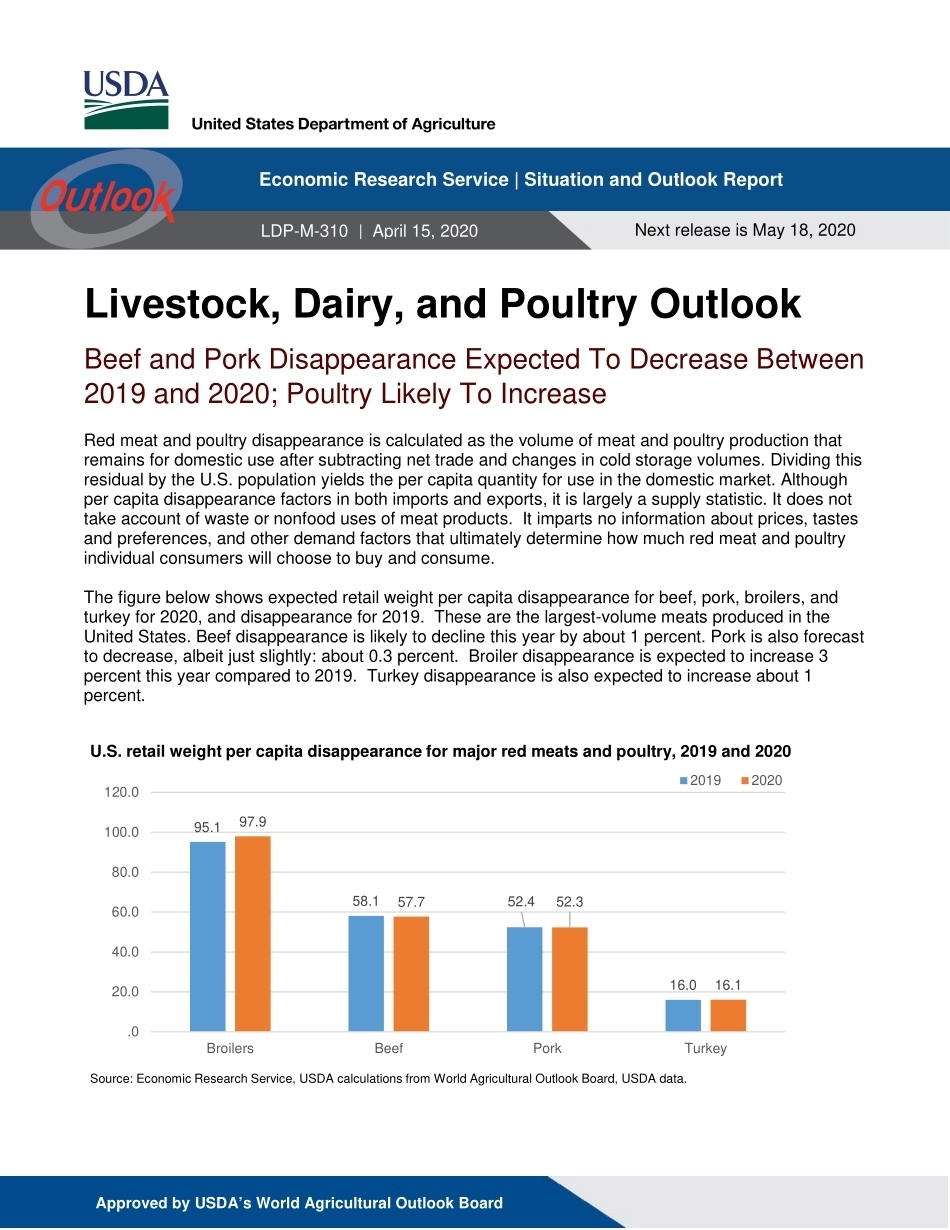
Approved by USDA’s World Agricultural Outlook Board Livestock, Dairy, and Poultry Outlook Beef and Pork Disappearance Expected To Decrease Between 2019 and 2020; Poultry Likely To Increase Red meat and poultry disappearance is calculated as the volume of meat and poultry production that remains for domestic use after subtracting net trade and changes in cold storage volumes. Dividing this residual by the U.S. population yields the per capita quantity for use in the domestic market. Although per capita disappearance factors in both imports and exports, it is largely a supply statistic. It does not take account of waste or nonfood uses of meat products. It imparts no information about prices, tastes and preferences, and other demand factors that ultimately determine how much red meat and poultry individual consumers will choose to buy and consume. The figure below shows expected retail weight per capita disappearance for beef, pork, broilers, and turkey for 2020, and disappearance for 2019. These are the largest-volume meats produced in the United States. Beef disappearance is likely to decline this year by about 1 percent. Pork is also forecast to decrease, albeit just slightly: about 0.3 percent. Broiler disappearance is expected to increase 3 percent this year compared to 2019. Turkey disappearance is also expected to increase about 1 percent. 95.158.152.416.097.957.752.316.1.020.040.060.080.0100.0120.0BroilersBeefPorkTurkey20192020U.S. retail weight per capita disappearance for major red meats and poultry, 2019 and 2020 Source: Economic Research Service, USDA calculations from World Agricultural Outlook Board, USDA data.Economic Research Service | Situation and Outlook Report Next release is May 18, 2020 LDP-M-310 | April 15, 2020 2 Livestock, Dairy, and Poultry Outlook, LDP-M-310, April 15, 2020 USDA, Economic Research Service Beef/Cattle: The first-quarter production forecast was raised on a faster pace than a year ago of cattle slaughter along with heavier dressed weights. However, production for the remainder of the year is reduced on lower expected fed cattle slaughter that is partially offset by higher nonfed cattle slaughter, as well as by heavier dressed weights. Slower beef demand and potentially slower rates of slaughter are expected to pressure cattle prices. February’s beef imports rose to 230.6 million pounds, and the first-quarter forecast was raised by 25 million pounds based on the pace of shipments from Oceania. U.S. beef exports in February were up 21 percent from a year earlier. However, forecasts for the second, third, and fourth quarters were revised down, partly due to the potential global economic downturn driven by the pandemic. Dairy: Wholesale dairy product prices and milk price forecasts have been lowered substantially from last month’s forecasts. The all-milk price forecast is $14.35 per hundredweight, a reduction of $3.90 from the previous forecast. Demand for dairy products is expected to be much lower due to the COVID-19 pandemic. Export forecasts have been lowered based on lower expectations for global demand. Pork/Hogs: Information reported in the March 2020 Quarterly Hogs and Pigs report suggests diminishing hog production growth toward the end of 2020. It is likely also that pork production growth will slow as processors adjust to disruptions in slaughter schedules due to labor force absences caused by the COVID-19 virus. 2020 growth in U.S. pork exports is also likely to slow due to peso depreciation and demand uncertainties generated by the virus. Even so, U.S. pork exports are expected to increase more than 18 percent this year compared with exports in 2019. Poultry/Eggs: The 2020 broiler production forecast was decreased on expectations for decreased demand from food service and foreign markets, while the price forecast was revised down on recent price movements and weakening demand. The 2020 export forecast was decreased on expectations for weakening economic conditions in global markets. The table egg production forecast was revised down on expectations for a smaller layer flock, while the 2020 price forecast was increased on expectations for strong demand and tightening supplies. The first-quarter egg export forecast was increased on strong export demand, while the second- and third-quarter forecasts were decreased on expectations for slowing exports due to higher egg prices and a strong dollar. The 2020 turkey production forecast was decreased on lower-than-expected average weights. Wholesale turkey prices for the remainder of 2020 were revised up on expectations for strengthening demand. Turkey exports for 2020 were revised down after lower-than-expected exports in January and February and expectations for weakening demand from Mexico. rMqMtRuMuM9PaO6MsQpPtRqQfQmMqMlOoPpR9PmNsMNZoOsRwMmPxOBeef/Cattle Russell Knight and Christopher Davis COVID-19 and Economic Uncertainty Impacting Beef Industry The spread of COVID-19 has caused shifts in the beef demand structure...





发表评论取消回复