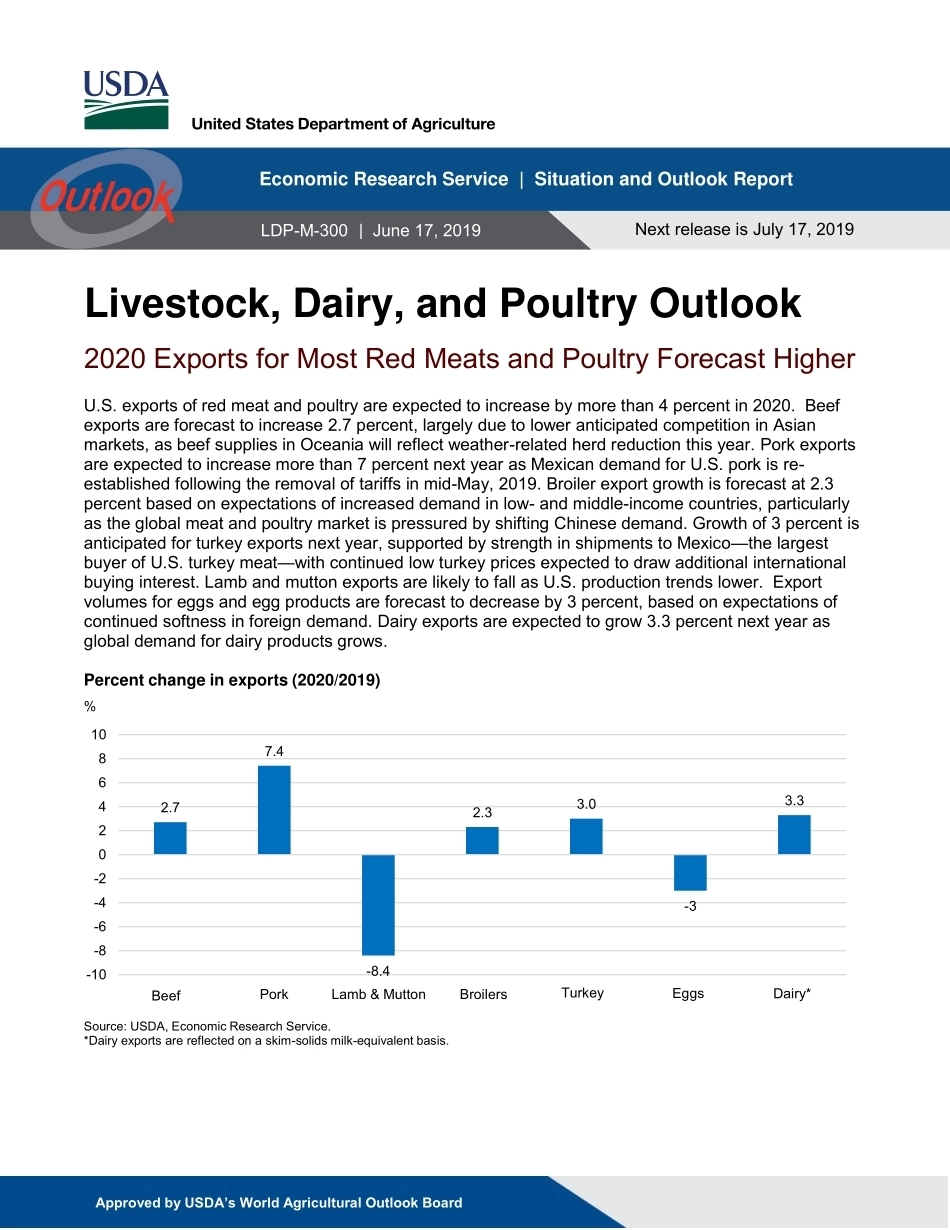
Approved by USDA’s World Agricultural Outlook Board Livestock, Dairy, and Poultry Outlook 2020 Exports for Most Red Meats and Poultry Forecast Higher U.S. exports of red meat and poultry are expected to increase by more than 4 percent in 2020. Beef exports are forecast to increase 2.7 percent, largely due to lower anticipated competition in Asian markets, as beef supplies in Oceania will reflect weather-related herd reduction this year. Pork exports are expected to increase more than 7 percent next year as Mexican demand for U.S. pork is re-established following the removal of tariffs in mid-May, 2019. Broiler export growth is forecast at 2.3 percent based on expectations of increased demand in low- and middle-income countries, particularly as the global meat and poultry market is pressured by shifting Chinese demand. Growth of 3 percent is anticipated for turkey exports next year, supported by strength in shipments to Mexico—the largest buyer of U.S. turkey meat—with continued low turkey prices expected to draw additional international buying interest. Lamb and mutton exports are likely to fall as U.S. production trends lower. Export volumes for eggs and egg products are forecast to decrease by 3 percent, based on expectations of continued softness in foreign demand. Dairy exports are expected to grow 3.3 percent next year as global demand for dairy products grows. 2.77.4-8.42.33.0-33.3-10-8-6-4-20246810BeefPorkLamb & MuttonBroilersEggs%Percent change in exports (2020/2019)Dairy*Source: USDA, Economic Research Service.*Dairy exports are reflected on a skim-solids milk-equivalent basis.TurkeyEconomic Research Service | Situation and Outlook Report Next release is July 17, 2019 LDP-M-300 | June 17, 2019 2 Livestock, Dairy, and Poultry Outlook, LDP-M-300, June 17, 2019 USDA, Economic Research Service Beef/Cattle: The cost of feeding cattle is expected to rise this year, likely slowing the pace of placements in feedlots and reducing anticipated marketings. This prompted forecasts for beef production in 2019 and 2020 to be reduced slightly on lower expected fed cattle slaughter. Cattle price forecasts were lowered to reflect current price weakness. Beef imports continue to exceed year-earlier levels, but exports lag behind in early 2019. Dairy: Due to recent declines in milk cow numbers, relatively high slaughter levels, and higher expected feed prices, milk production forecasts have been lowered for 2019 and 2020. Dairy exports were relatively weak in April, and export forecasts have been lowered for both 2019 and 2020. The all-milk price forecast for 2019 is $18.00 per cwt, 5 cents lower than last month’s forecast. The all-milk price forecast for 2020 is $18.90 per cwt, 10 cents higher than last month’s forecast. Pork/Hogs: Estimated gross processing margins have been consistently year-over-year lower since early April. While second-quarter prices of both hogs and wholesale pork cuts have been year-over-year higher, hog prices have increased relatively faster, and processor margins have been squeezed as a result. The rescission of Mexican tariffs on U.S. pork largely prompted upward revisions in U.S. pork export forecasts for both 2019 and 2020. Poultry/Eggs: Second-quarter broiler forecast was revised up based on higher average weights, while the 2020 production forecast was lowered on expectations for higher feed costs. The 2019 and 2020 broiler price forecasts were lowered based on weak domestic demand and higher-than-anticipated cold storage inventories. The 2019 second-quarter export forecast was revised down on slower-than-expected global demand. The 2020 egg production forecast was decreased based on expectations for tightening producer margins. The egg price forecast was decreased for both 2019 and 2020 on the anticipation that supply will continue to outpace demand. The 2019 second-quarter egg and egg product export forecast was revised up based on increasing shipments of shell eggs. Turkey production is revised downward by 5 million pounds in 2019 and 40 million pounds in 2020 due to anticipated increased feed costs. If the forecast is realized, production growth would be virtually flat between 2018 and 2020. 3 Livestock, Dairy, and Poultry Outlook, LDP-M-300, June 17, 2019 USDA, Economic Research Service Beef/Cattle Russell Knight and Lekhnath Chalise 2019 and 2020 Beef Production Marginally Lower from Last Month The 2019 beef production forecast was reduced marginally from last month to 27.2 billion pounds, as expected fourth-quarter production more than offsets a slight increase in expected second-quarter production. Production in second-quarter 2019 was raised based on greater expected fed cattle slaughter (i.e., steers and heifers) that was partially offset by lower expected carcass weights. Fourth-quarter 2019 production was lowered on anticipated reduced fed cattle slaughter due to fewer expected placements in second-quarter 2019. The forecast for 2020 beef production was lowered marginally f...





发表评论取消回复