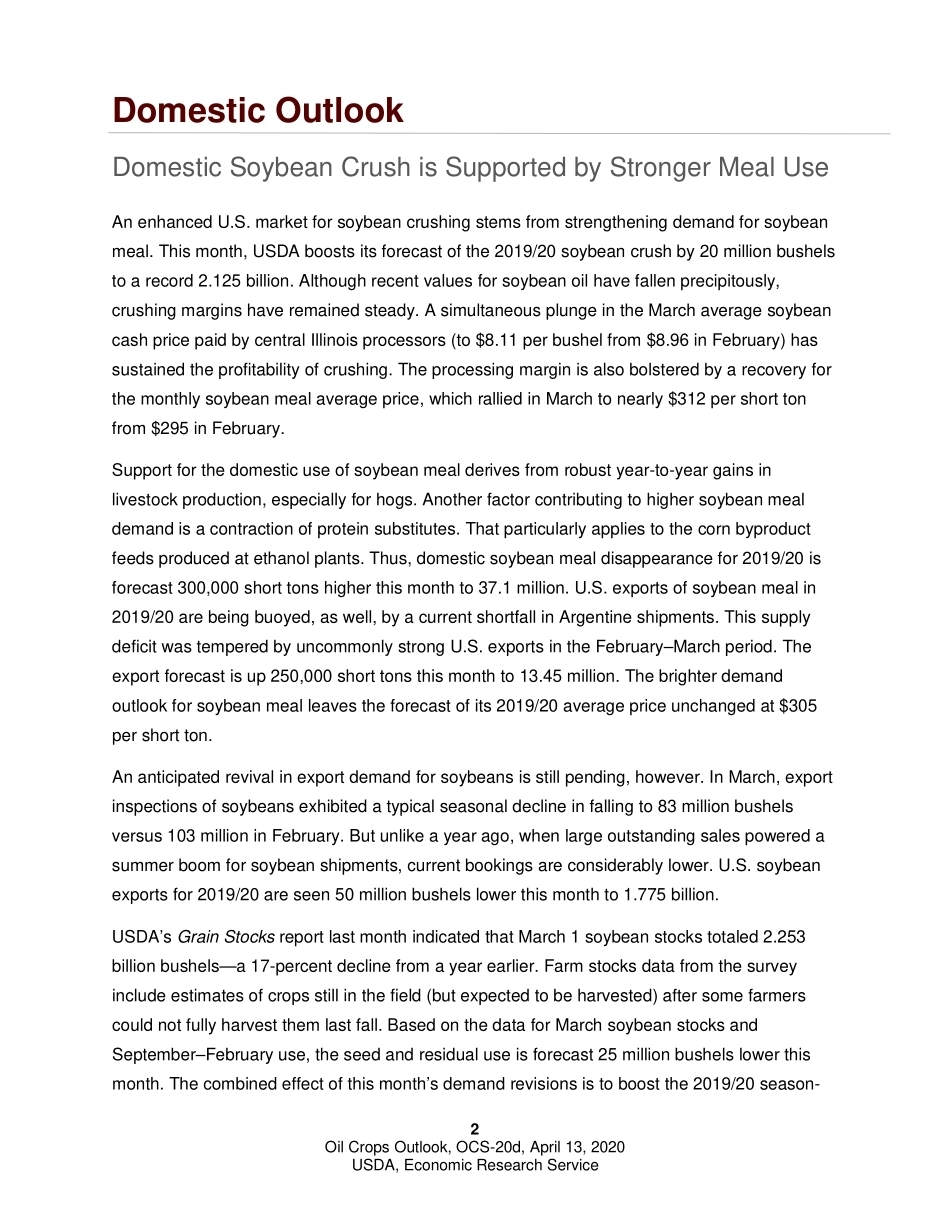
Approved by USDA’s World Agricultural Outlook Board Oil Crops Outlook Mark Ash U.S. Soybean Product Exports Gain from Lagging Argentine Trade This month, USDA boosts its forecast of the 2019/20 soybean crush by 20 million bushels to a record 2.125 billion, based on steady soybean meal demand. A current shortfall in Argentine shipments raises forecast soybean meal exports by 250,000 short tons this month to 13.45 million. A higher crush is more than offset by a decline for soybean exports (by 50 million bushels to 1.775 billion). Demand revisions boost the 2019/20 season-ending stocks forecast by 55 million bushels to 480 million. 0510152025Sep 5Oct 10Nov 14Dec 19Jan 23Feb 27Apr 2May 7Jun 11Jul 16Aug 20Million metric tonsSource: USDA, Foreign Agricultural Service, Export Sales.Figure 1Outstanding U.S. export soybean sales lack signs of previous summer revivals 2016/172017/182018/192019/20Economic Research Service | Situation and Outlook Report Next release is May 14, 2020 OCS-20d | April 13, 2020 2 Oil Crops Outlook, OCS-20d, April 13, 2020 USDA, Economic Research Service Domestic Outlook Domestic Soybean Crush is Supported by Stronger Meal Use An enhanced U.S. market for soybean crushing stems from strengthening demand for soybean meal. This month, USDA boosts its forecast of the 2019/20 soybean crush by 20 million bushels to a record 2.125 billion. Although recent values for soybean oil have fallen precipitously, crushing margins have remained steady. A simultaneous plunge in the March average soybean cash price paid by central Illinois processors (to $8.11 per bushel from $8.96 in February) has sustained the profitability of crushing. The processing margin is also bolstered by a recovery for the monthly soybean meal average price, which rallied in March to nearly $312 per short ton from $295 in February. Support for the domestic use of soybean meal derives from robust year-to-year gains in livestock production, especially for hogs. Another factor contributing to higher soybean meal demand is a contraction of protein substitutes. That particularly applies to the corn byproduct feeds produced at ethanol plants. Thus, domestic soybean meal disappearance for 2019/20 is forecast 300,000 short tons higher this month to 37.1 million. U.S. exports of soybean meal in 2019/20 are being buoyed, as well, by a current shortfall in Argentine shipments. This supply deficit was tempered by uncommonly strong U.S. exports in the February–March period. The export forecast is up 250,000 short tons this month to 13.45 million. The brighter demand outlook for soybean meal leaves the forecast of its 2019/20 average price unchanged at $305 per short ton. An anticipated revival in export demand for soybeans is still pending, however. In March, export inspections of soybeans exhibited a typical seasonal decline in falling to 83 million bushels versus 103 million in February. But unlike a year ago, when large outstanding sales powered a summer boom for soybean shipments, current bookings are considerably lower. U.S. soybean exports for 2019/20 are seen 50 million bushels lower this month to 1.775 billion. USDA’s Grain Stocks report last month indicated that March 1 soybean stocks totaled 2.253 billion bushels—a 17-percent decline from a year earlier. Farm stocks data from the survey include estimates of crops still in the field (but expected to be harvested) after some farmers could not fully harvest them last fall. Based on the data for March soybean stocks and September–February use, the seed and residual use is forecast 25 million bushels lower this month. The combined effect of this month’s demand revisions is to boost the 2019/20 season-tOmQoMvNyQ7NdN8OtRrRpNrRfQqQnRfQoPsO8OnMtNNZmQrQNZrQzQ3 Oil Crops Outlook, OCS-20d, April 13, 2020 USDA, Economic Research Service ending stocks forecast by 55 million bushels to 480 million. A higher stocks carryout may pressure soybean prices but that may only modestly affect the 2019/20 average. Due to the advanced level of farm marketing, USDA’s forecast of the U.S. season-average farm price is trimmed by 5 cents this month to $8.65 per bushel. The soybean oil market may encounter a pronounced impact on domestic consumption this year from rising unemployment and temporary closures of restaurants nationwide. U.S. soybean oil domestic disappearance for 2019/20 is seen down by 500 million pounds this month to 22.4 billion. Of that amount, edible use may decline by 200 million pounds to 14.7 billion pounds. Lagging demand for use in biodiesel accounts for the remaining reduction, which is forecast contracting 300 million pounds to 7.7 billion. In contrast, U.S. export demand for soybean oil is quite solid. Cumulative 2019/20 soybean oil shipments through March now exceed last year’s pace by more than 400 million pounds. Recent U.S. export sales have accelerated on account of slower Argentine deliveries. Also aiding the soybean oil sales in developing countries is a rationing of Southeast Asian ...





发表评论取消回复