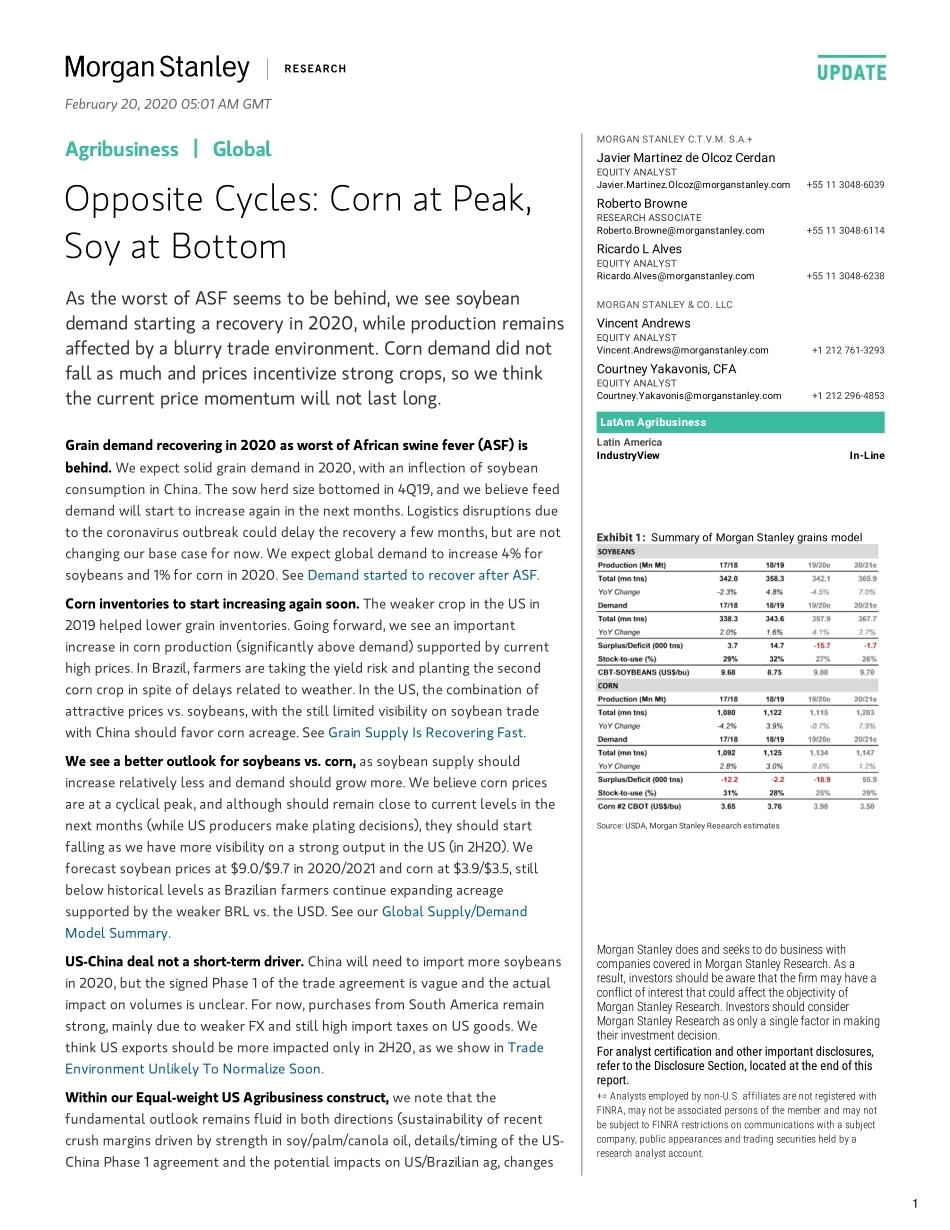
Javier.Martinez.Olcoz@morganstanley.comRoberto.Browne@morganstanley.comRicardo.Alves@morganstanley.comVincent.Andrews@morganstanley.comCourtney.Yakavonis@morganstanley.comIn-LineMORGAN STANLEY C.T.V.M. S.A.+Javier Martinez de Olcoz CerdanEQUITY ANALYST+55 11 3048-6039Roberto BrowneRESEARCH ASSOCIATE+55 11 3048-6114Ricardo L AlvesEQUITY ANALYST+55 11 3048-6238MORGAN STANLEY & CO. LLCVincent AndrewsEQUITY ANALYST+1 212 761-3293Courtney Yakavonis, CFAEQUITY ANALYST+1 212 296-4853LatAm AgribusinessLatin AmericaIndustryViewAgribusinessAgribusiness || Global GlobalOpposite Cycles: Corn at Peak,Soy at BottomAs the worst of ASF seems to be behind, we see soybeandemand starting a recovery in 2020, while production remainsaffected by a blurry trade environment. Corn demand did notfall as much and prices incentivize strong crops, so we thinkthe current price momentum will not last long.Grain demand recovering in 2020 as worst of African swine fever (ASF) isbehind. We expect solid grain demand in 2020, with an inflection of soybeanconsumption in China. The sow herd size bottomed in 4Q19, and we believe feeddemand will start to increase again in the next months. Logistics disruptions dueto the coronavirus outbreak could delay the recovery a few months, but are notchanging our base case for now. We expect global demand to increase 4% forsoybeans and 1% for corn in 2020. See Demand started to recover after ASF.Corn inventories to start increasing again soon. The weaker crop in the US in2019 helped lower grain inventories. Going forward, we see an importantincrease in corn production (significantly above demand) supported by currenthigh prices. In Brazil, farmers are taking the yield risk and planting the secondcorn crop in spite of delays related to weather. In the US, the combination ofattractive prices vs. soybeans, with the still limited visibility on soybean tradewith China should favor corn acreage. See Grain Supply Is Recovering Fast.We see a better outlook for soybeans vs. corn, as soybean supply shouldincrease relatively less and demand should grow more. We believe corn pricesare at a cyclical peak, and although should remain close to current levels in thenext months (while US producers make plating decisions), they should startfalling as we have more visibility on a strong output in the US (in 2H20). Weforecast soybean prices at $9.0/$9.7 in 2020/2021 and corn at $3.9/$3.5, stillbelow historical levels as Brazilian farmers continue expanding acreagesupported by the weaker BRL vs. the USD. See our Global Supply/DemandModel Summary.US-China deal not a short-term driver. China will need to import more soybeansin 2020, but the signed Phase 1 of the trade agreement is vague and the actualimpact on volumes is unclear. For now, purchases from South America remainstrong, mainly due to weaker FX and still high import taxes on US goods. Wethink US exports should be more impacted only in 2H20, as we show in TradeEnvironment Unlikely To Normalize Soon.Within our Equal-weight US Agribusiness construct, we note that thefundamental outlook remains fluid in both directions (sustainability of recentcrush margins driven by strength in soy/palm/canola oil, details/timing of the US-China Phase 1 agreement and the potential impacts on US/Brazilian ag, changesExhibit 1: Summary of Morgan Stanley grains modelSource: USDA, Morgan Stanley Research estimatesMorgan Stanley does and seeks to do business withcompanies covered in Morgan Stanley Research. As aresult, investors should be aware that the firm may have aconflict of interest that could affect the objectivity ofMorgan Stanley Research. Investors should considerMorgan Stanley Research as only a single factor in makingtheir investment decision.For analyst certification and other important disclosures,refer to the Disclosure Section, located at the end of thisreport.+= Analysts employed by non-U.S. affiliates are not registered withFINRA, may not be associated persons of the member and may notbe subject to FINRA restrictions on communications with a subjectcompany, public appearances and trading securities held by aresearch analyst account.1February 20, 2020 05:01 AM GMTto Argentina export policy) and, therefore, we continue to favor Bunge over ADMat the confluence of: (i) a more conservative underlying outlook; and (ii) themedium to long-term strategic optionality arising from the recentmanagement/portfolio overhaul.We remain Equal-weight key fertilizer names NTR, CF, MOS, and ICL asnitrogen, potash, and phosphate markets remain challenged. Like CF, NTR islikely to see negative earnings revisions in nitrogen (as well as potash) following4Q19 earnings (note CF stock is down over 8% since 4Q19 reporting), thoughRetail remains the ballast and should have a better 2020. For MOS, while we donot expect things to get materially worse, we do not envision meaningfulimprovement in the medium-term. The stock is trading below tangible book valueof $23, and we expect TBV to be an anchor for the st...





发表评论取消回复