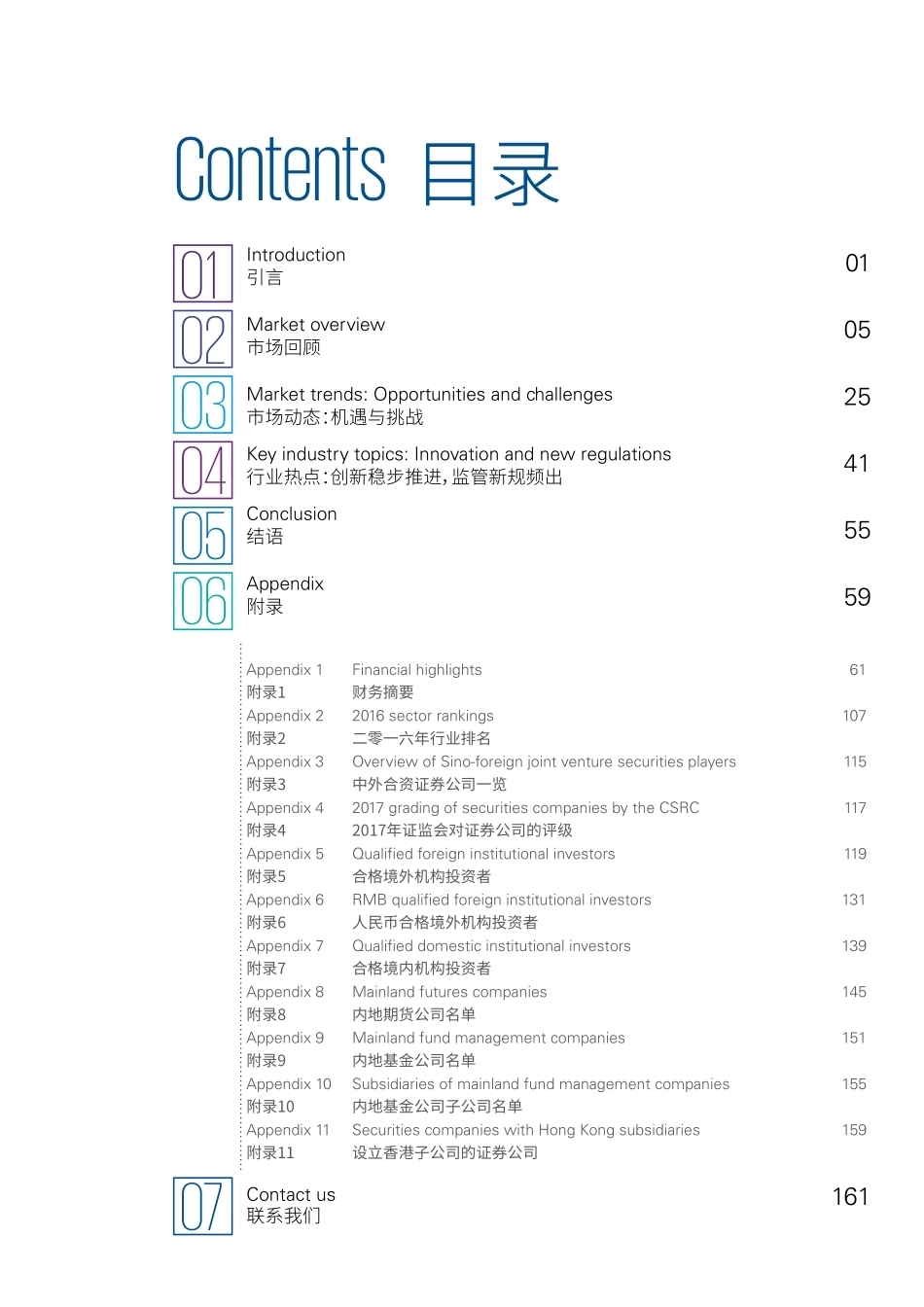
Financial services金融服务kpmg.com/cnMainland ChinaSecurities Survey 2017二零一七年 中国证券业调查报告Contents 目录Introduction 引言Market overview市场回顾Market trends: Opportunities and challenges市场动态:机遇与挑战Key industry topics: Innovation and new regulations行业热点:创新稳步推进,监管新规频出Conclusion结语Appendix 附录Appendix 1 Financial highlights 61附录1 财务摘要Appendix 2 2016 sector rankings 107附录2 二零一六年行业排名Appendix 3 Overview of Sino-foreign joint venture securities players 115附录3 中外合资证券公司一览Appendix 4 2017 grading of securities companies by the CSRC 117附录4 2017年证监会对证券公司的评级Appendix 5 Qualified foreign institutional investors 119附录5 合格境外机构投资者Appendix 6 RMB qualified foreign institutional investors 131附录6 人民币合格境外机构投资者Appendix 7 Qualified domestic institutional investors 139附录7 合格境内机构投资者Appendix 8 Mainland futures companies 145附录8 内地期货公司名单Appendix 9 Mainland fund management companies 151附录9 内地基金公司名单Appendix 10 Subsidiaries of mainland fund management companies 155附录10 内地基金公司子公司名单Appendix 11 Securities companies with Hong Kong subsidiaries 159附录11 设立香港子公司的证券公司07161Contact us联系我们0 10203 04 0506010525 41 5559Introduction 引言011 | Mainland China Securities Survey 2017© 2017 KPMG Huazhen LLP, a People’s Republic of China partnership and a member firm of the KPMG network of independent member firms affiliated with KPMG International Cooperative (“KPMG International”), a Swiss entity. All rights reserved. Printed in China. The KPMG name and logo are registered trademarks or trademarks of KPMG International.二零一七年中国证券业调查报告 | 2 Introduction2016 was a year of consolidation for the China securities sector with market conditions relatively calmer compared to a busy 2015. While 2015 experienced record A-share turnover, high levels of investor enthusiasm, and rapid industry growth, 2016 started off in a very different note when the circuit breaker mechanism was triggered twice in the first week of trading. The securities sector, however, managed to recover from the early volatility by seizing the opportunities generated by supply-side reforms, continued privatisation of state-owned enterprise and an accelerated approval of initial public offerings (IPOs).According to Securities Association of China (SAC) data, the securities sector realised operating income of RMB 328.6 billion (company level) and total profits of RMB 123.2 billion in 2016. While they were 43 percent and 50 percent lower than 2015, respectively, the 2016 numbers were, in fact, still the third highest annual figures on record – behind only 2015 and 2007. The total assets of securities companies stood at RMB 5.8 trillion, representing a year-on-year decrease of 10 percent, while net assets amounted to RMB 1.65 trillion, a year-on-year increase of 13 percent. The relatively stable growth in net assets was a reflection of the consolidation of the securities sector in 2016.Significant changes were seen in the income structure of various businesses within the securities sector. Lower transaction volumes in the stock markets weighed on the brokerage business with their contribution to overall income declining to 34 percent from 48 percent in 2016. Nonetheless, it remained the largest source of income for securities companies. Benefiting from state policies such as an accelerated approval of IPOs and corporate/enterprise bonds, the investment banking segment realised net income of RMB 68.1 billion, a year-on-year increase of 30 percent. Investment banking accounted for 21 percent of total income in 2016, up from nine percent. Supported by a stable monetary supply and growing residential wealth, the asset management segment recorded net income of RMB 29.9 billion in 2016, representing a year-on-year increase of 9 percent, and accounted for 9 percent of total income, up from 5 percent. However, income from proprietary trading, margin financing and securities lending businesses went down in 2016.The tightening of regulations was the theme of the securities market in 2016. The promulgation of the Management Measures on Risk Indicators of Securities Companies and the Measures on Major Asset Restructuring of Listed Companies, the new eight ‘bottom lines’ regulatory requirements for the asset management business, comprehensive regulatory inspections as well as a record number of fines, showcased the regulators’ resolve to stabilise the market and mitigate risk.Securities companies are actively exploring opportunities to innovate their businesses, make strategic transformations, while, at the same time, strengthen their own risk management. For example, many are gradually shifting their focus from being a funding channel provider for their clients to wealth management. Securities companies are also improving their active management capabilities in order to improve the product structure of their asset management business. The accelerated development of the proprietary Fixed Income, Currencies and Commodities (FICC) business has become a new growth driver for securities companies. Meanwhile, the expansion of international ...





发表评论取消回复