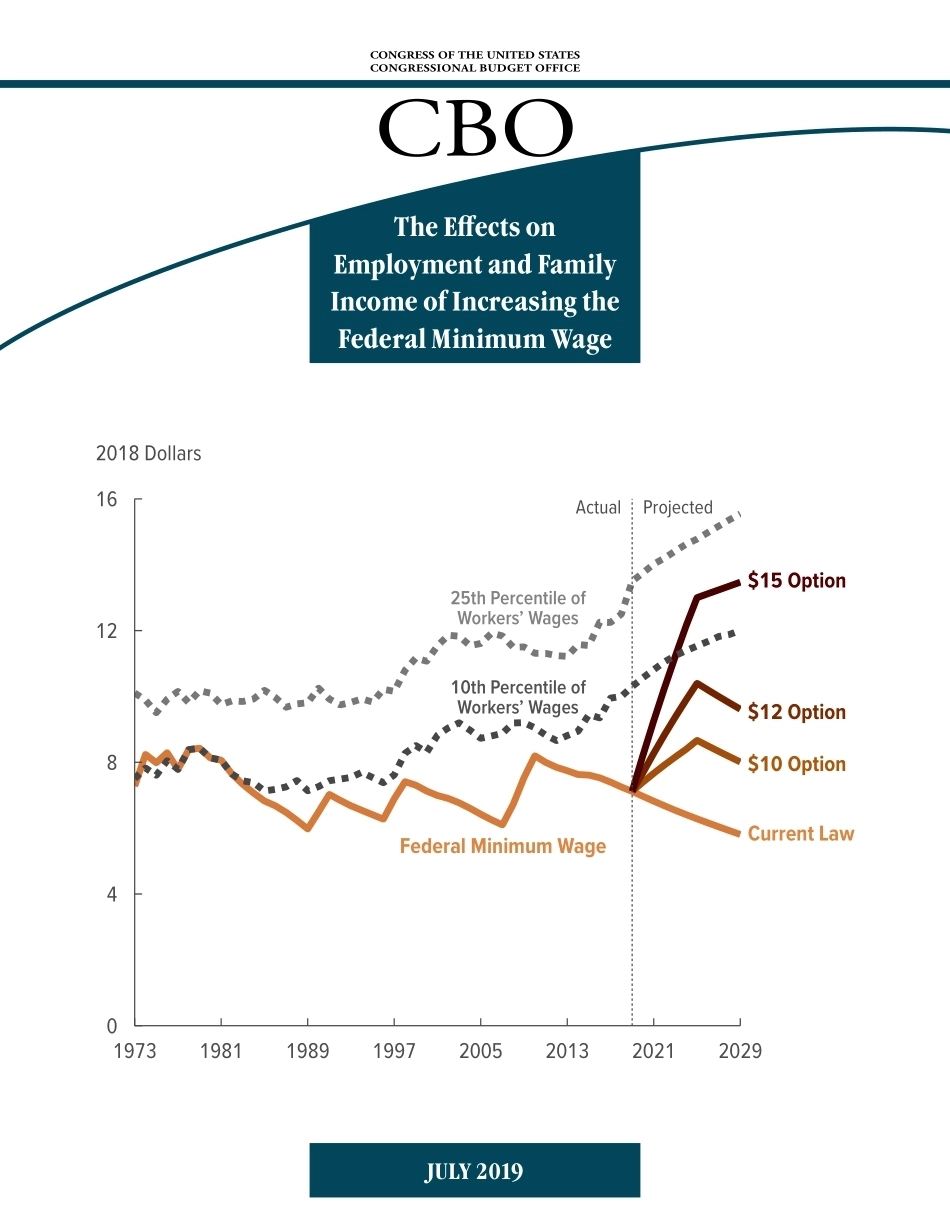
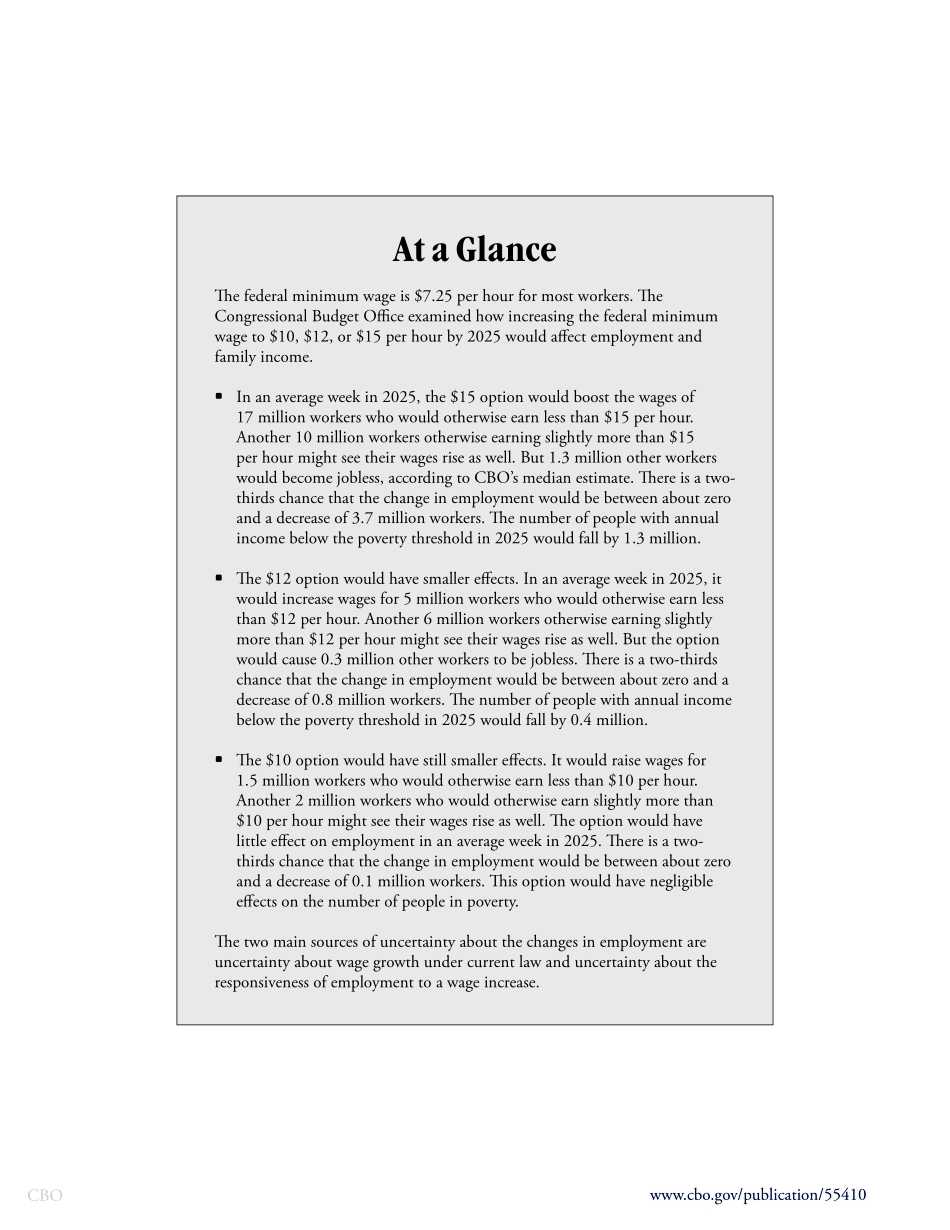
$15 Option$12 Option$10 OptionCurrent LawFederal Minimum Wage25th Percentile of Workers’ Wages10th Percentile of Workers’ WagesProjectedActual0481216197319811989199720052013202120292018 DollarsThe Effects on Employment and Family Income of Increasing the Federal Minimum WageJULY 2019CONGRESS OF THE UNITED STATESCONGRESSIONAL BUDGET OFFICEAt a GlanceThe federal minimum wage is $7.25 per hour for most workers. The Congressional Budget Office examined how increasing the federal minimum wage to $10, $12, or $15 per hour by 2025 would affect employment and family income. • In an average week in 2025, the $15 option would boost the wages of 17 million workers who would otherwise earn less than $15 per hour. Another 10 million workers otherwise earning slightly more than $15 per hour might see their wages rise as well. But 1.3 million other workers would become jobless, according to CBO’s median estimate. There is a two-thirds chance that the change in employment would be between about zero and a decrease of 3.7 million workers. The number of people with annual income below the poverty threshold in 2025 would fall by 1.3 million. • The $12 option would have smaller effects. In an average week in 2025, it would increase wages for 5 million workers who would otherwise earn less than $12 per hour. Another 6 million workers otherwise earning slightly more than $12 per hour might see their wages rise as well. But the option would cause 0.3 million other workers to be jobless. There is a two-thirds chance that the change in employment would be between about zero and a decrease of 0.8 million workers. The number of people with annual income below the poverty threshold in 2025 would fall by 0.4 million. • The $10 option would have still smaller effects. It would raise wages for 1.5 million workers who would otherwise earn less than $10 per hour. Another 2 million workers who would otherwise earn slightly more than $10 per hour might see their wages rise as well. The option would have little effect on employment in an average week in 2025. There is a two-thirds chance that the change in employment would be between about zero and a decrease of 0.1 million workers. This option would have negligible effects on the number of people in poverty.The two main sources of uncertainty about the changes in employment are uncertainty about wage growth under current law and uncertainty about the responsiveness of employment to a wage increase.www.cbo.gov/publication/55410ContentsSummary 1What Options for Increasing the Federal Minimum Wage Did CBO Examine? 1What Effects Would the Options Have? 1Why Are the Outcomes Uncertain? 5The Current Federal Minimum Wage 5Three Options for Increasing the Federal Minimum Wage 5The $15 Option 6The $12 Option 7The $10 Option 8How Increases in the Minimum Wage Affect Employment and Family Income 8Employment 9Family Income 11Effects of the Three Options on Employment and Family Income 12Effects of the Options on Employment 12BOX 1. HOW AN INCREASE IN THE MINIMUM WAGE WOULD AFFECT THE FEDERAL BUDGET 13Effects of the Options on Family Income 14BOX 2. THE MINIMUM WAGE AND THE EARNED INCOME TAX CREDIT 18Uncertainty About the Estimates 19Appendix A: The Basis for CBO’s Findings 21Appendix B: Research About the Effects of Minimum-Wage Increases 39List of Tables and Figures 47About This Document 48NotesNumbers in the text, tables, and figures may not add up to totals because of rounding.Federal minimum wages are expressed in nominal (current-year) dollars. Unless otherwise indicated, other dollar values are expressed in 2018 dollars, adjusted to remove the effects of inflation using the price index for personal consumption expenditures published by the Bureau of Economic Analysis. The data underlying the figures in this report are posted along with the report on CBO’s website (www.cbo.gov/publication/55410). The Effects on Employment and Family Income of Increasing the Federal Minimum WageSummaryThe federal minimum wage of $7.25 per hour has not changed since 2009, though many states and localities have set their minimum wage above that level. Increasing the federal minimum wage would have two principal effects on low-wage workers. For most low-wage workers, earnings and family income would increase, which would lift some families out of poverty. But other low-wage workers would become jobless, and their family income would fall—in some cases, below the poverty threshold. What Options for Increasing the Federal Minimum Wage Did CBO Examine?The Congressional Budget Office examined three options for increasing the federal minimum wage. The first option would raise the federal minimum wage to $15 per hour as of January 1, 2025. That increase would be implemented in six annual increments starting on January 1, 2020. After reaching $15 in 2025, the minimum wage would be indexed, or tied, to median hourly wages. The $15 option would also gradually eliminate exceptions to the minimum wage for tipped workers, teenage ...




发表评论取消回复