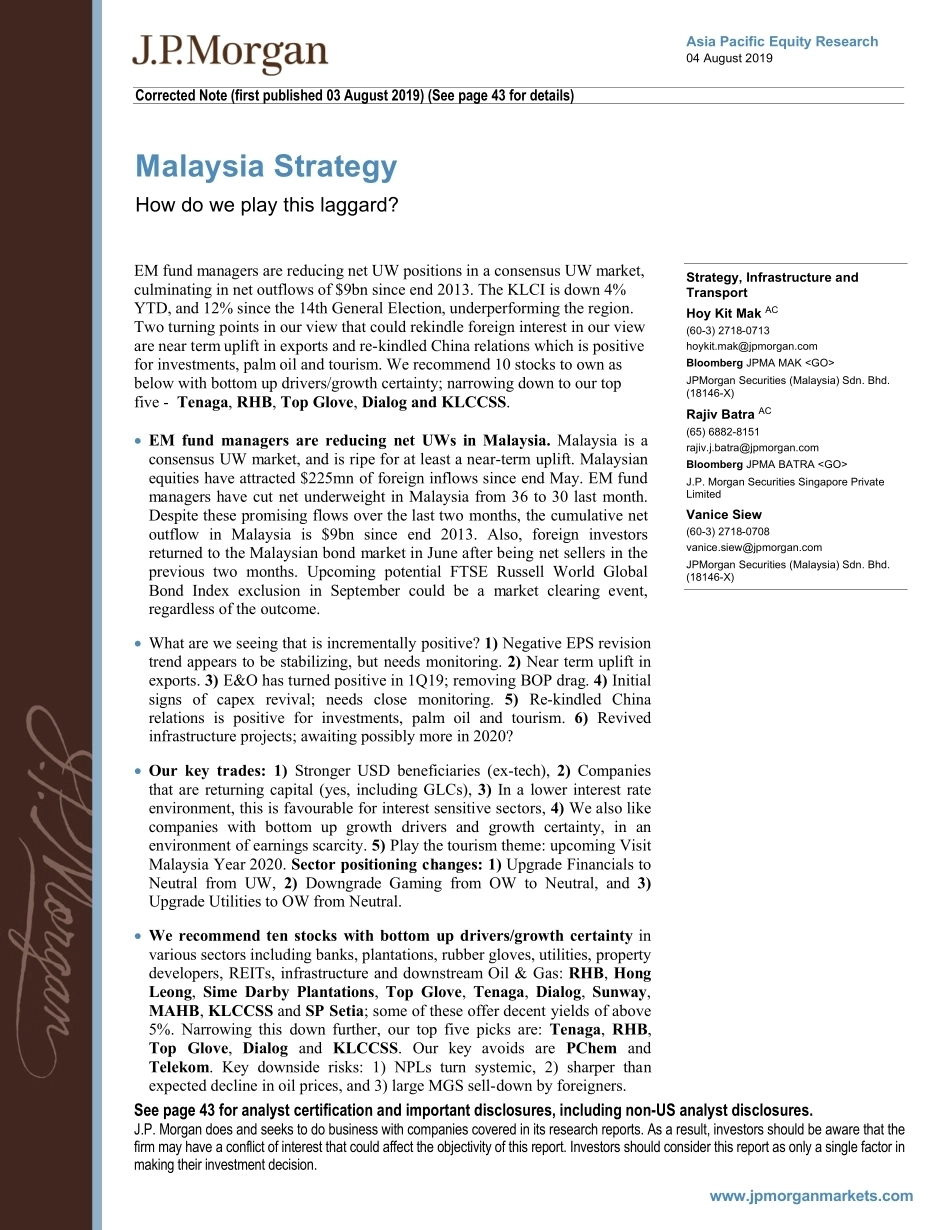
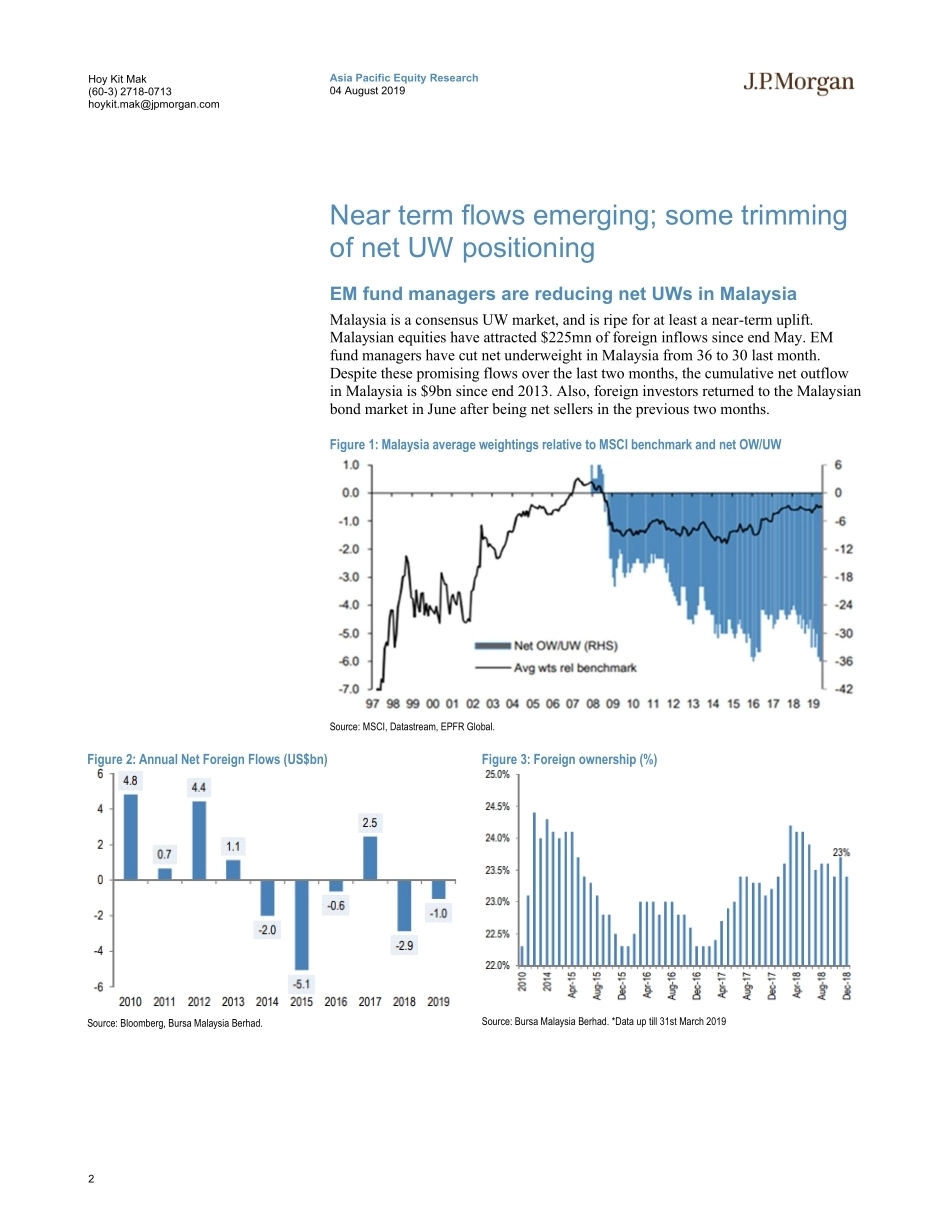
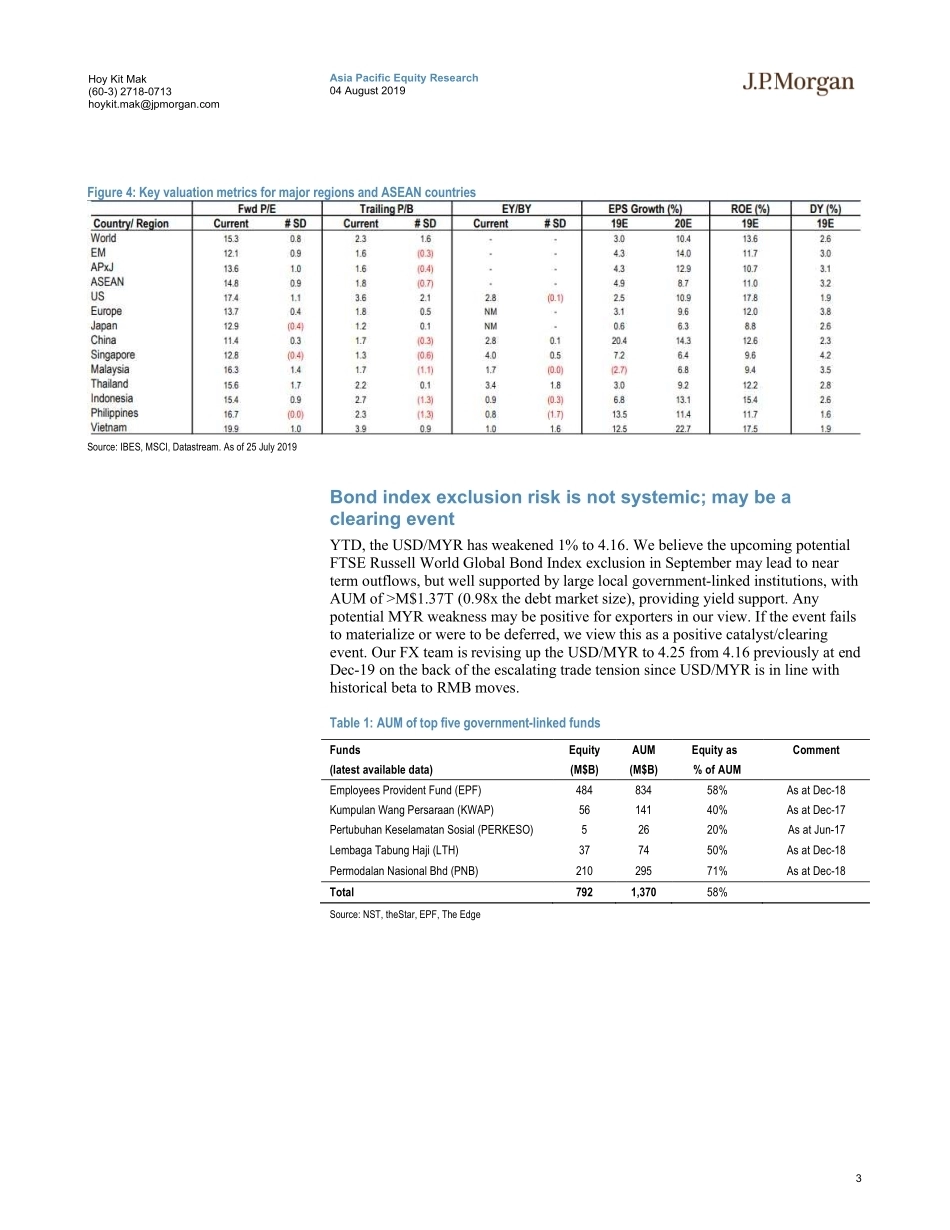
Asia Pacific Equity Research04 August 2019Corrected Note (first published 03 August 2019) (See page 43 for details) Malaysia StrategyHow do we play this laggard?Strategy, Infrastructure and TransportHoy Kit Mak AC(60-3) 2718-0713hoykit.mak@jpmorgan.comBloomberg JPMA MAK JPMorgan Securities (Malaysia) Sdn. Bhd. (18146-X)Rajiv Batra AC(65) 6882-8151rajiv.j.batra@jpmorgan.comBloomberg JPMA BATRA J.P. Morgan Securities Singapore Private LimitedVanice Siew(60-3) 2718-0708vanice.siew@jpmorgan.comJPMorgan Securities (Malaysia) Sdn. Bhd. (18146-X)See page 43 for analyst certification and important disclosures, including non-US analyst disclosures.J.P. Morgan does and seeks to do business with companies covered in its research reports. As a result, investors should be aware that the firm may have a conflict of interest that could affect the objectivity of this report. Investors should consider this report as only a single factor in making their investment decision.www.jpmorganmarkets.comEM fund managers are reducing net UW positions in a consensus UW market, culminating in net outflows of $9bn since end 2013. The KLCI is down 4% YTD, and 12% since the 14th General Election, underperforming the region. Two turning points in our view that could rekindle foreign interest in our vieware near term uplift in exports and re-kindled China relations which is positive for investments, palm oil and tourism. We recommend 10 stocks to own as below with bottom up drivers/growth certainty; narrowing down to our top five - Tenaga, RHB, Top Glove, Dialog and KLCCSS. EM fund managers are reducing net UWs in Malaysia. Malaysia is a consensus UW market, and is ripe for at least a near-term uplift. Malaysian equities have attracted $225mn of foreign inflows since end May. EM fund managers have cut net underweight in Malaysia from 36 to 30 last month. Despite these promising flows over the last two months, the cumulative net outflow in Malaysia is $9bn since end 2013. Also, foreign investors returned to the Malaysian bond market in June after being net sellers in the previous two months. Upcoming potential FTSE Russell World Global Bond Index exclusion in September could be a market clearing event, regardless of the outcome. What are we seeing that is incrementally positive? 1) Negative EPS revision trend appears to be stabilizing, but needs monitoring. 2) Near term uplift in exports. 3) E&O has turned positive in 1Q19; removing BOP drag. 4) Initial signs of capex revival; needs close monitoring. 5) Re-kindled China relations is positive for investments, palm oil and tourism. 6) Revived infrastructure projects; awaiting possibly more in 2020? Our key trades: 1) Stronger USD beneficiaries (ex-tech), 2) Companies that are returning capital (yes, including GLCs), 3) In a lower interest rate environment, this is favourable for interest sensitive sectors, 4) We also like companies with bottom up growth drivers and growth certainty, in an environment of earnings scarcity. 5) Play the tourism theme: upcoming Visit Malaysia Year 2020. Sector positioning changes: 1) Upgrade Financials to Neutral from UW, 2) Downgrade Gaming from OW to Neutral, and 3)Upgrade Utilities to OW from Neutral. We recommend ten stocks with bottom up drivers/growth certainty in various sectors including banks, plantations, rubber gloves, utilities, property developers, REITs, infrastructure and downstream Oil & Gas: RHB, Hong Leong, Sime Darby Plantations, Top Glove, Tenaga, Dialog, Sunway, MAHB, KLCCSS and SP Setia; some of these offer decent yields of above 5%. Narrowing this down further, our top five picks are: Tenaga, RHB, Top Glove, Dialog and KLCCSS. Our key avoids are PChem andTelekom. Key downside risks: 1) NPLs turn systemic, 2) sharper than expected decline in oil prices, and 3) large MGS sell-down by foreigners. 2Asia Pacific Equity Research04 August 2019Hoy Kit Mak(60-3) 2718-0713hoykit.mak@jpmorgan.com Near term flows emerging; some trimming of net UW positioningEM fund managers are reducing net UWs in MalaysiaMalaysia is a consensus UW market, and is ripe for at least a near-term uplift. Malaysian equities have attracted $225mn of foreign inflows since end May. EM fund managers have cut net underweight in Malaysia from 36 to 30 last month. Despite these promising flows over the last two months, the cumulative net outflow in Malaysia is $9bn since end 2013. Also, foreign investors returned to the Malaysian bond market in June after being net sellers in the previous two months.Figure 1: Malaysia average weightings relative to MSCI benchmark and net OW/UWSource: MSCI, Datastream, EPFR Global.Figure 2: Annual Net Foreign Flows (US$bn)Source: Bloomberg, Bursa Malaysia Berhad.Figure 3: Foreign ownership (%)Source: Bursa Malaysia Berhad. *Data up till 31st March 20193Asia Pacific Equity Research04 August 2019Hoy Kit Mak(60-3) 2718-0713hoykit.mak@jpmorgan.com Figure 4: Key valuation metrics for major regions and ASEAN countriesSource: IBES, MSCI, Datast...




发表评论取消回复