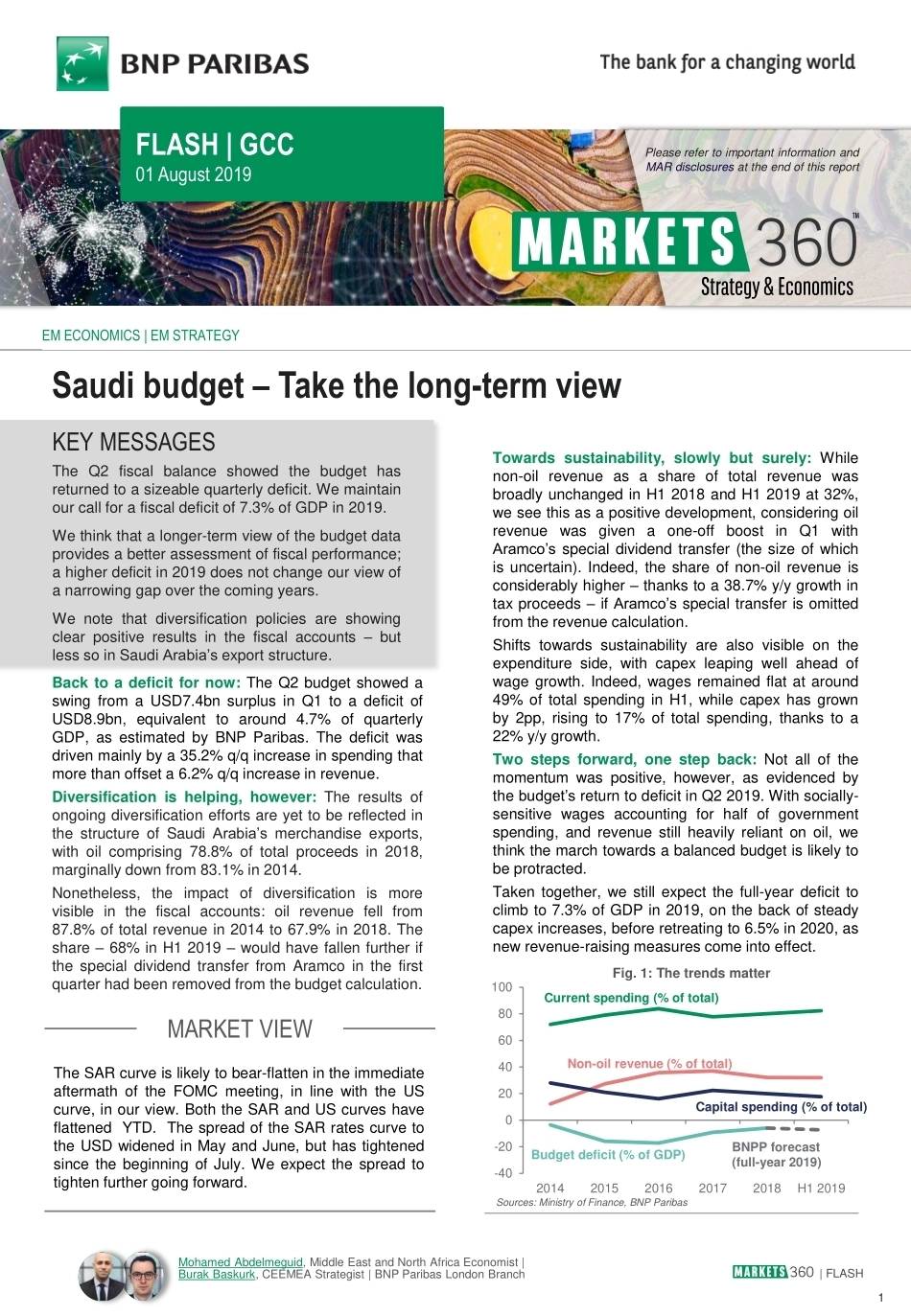
-40-2002040608010020142015201620172018H1 2019MARKET VIEW The SAR curve is likely to bear-flatten in the immediate aftermath of the FOMC meeting, in line with the US curve, in our view. Both the SAR and US curves have flattened YTD. The spread of the SAR rates curve to the USD widened in May and June, but has tightened since the beginning of July. We expect the spread to tighten further going forward. EM ECONOMICS | EM STRATEGY KEY MESSAGES The Q2 fiscal balance showed the budget has returned to a sizeable quarterly deficit. We maintain our call for a fiscal deficit of 7.3% of GDP in 2019. We think that a longer-term view of the budget data provides a better assessment of fiscal performance; a higher deficit in 2019 does not change our view of a narrowing gap over the coming years. We note that diversification policies are showing clear positive results in the fiscal accounts – but less so in Saudi Arabia’s export structure. FLASH | GCC 01 August 2019 Towards sustainability, slowly but surely: While non-oil revenue as a share of total revenue was broadly unchanged in H1 2018 and H1 2019 at 32%, we see this as a positive development, considering oil revenue was given a one-off boost in Q1 with Aramco’s special dividend transfer (the size of which is uncertain). Indeed, the share of non-oil revenue is considerably higher – thanks to a 38.7% y/y growth in tax proceeds – if Aramco’s special transfer is omitted from the revenue calculation. Shifts towards sustainability are also visible on the expenditure side, with capex leaping well ahead of wage growth. Indeed, wages remained flat at around 49% of total spending in H1, while capex has grown by 2pp, rising to 17% of total spending, thanks to a 22% y/y growth. Two steps forward, one step back: Not all of the momentum was positive, however, as evidenced by the budget’s return to deficit in Q2 2019. With socially-sensitive wages accounting for half of government spending, and revenue still heavily reliant on oil, we think the march towards a balanced budget is likely to be protracted. Taken together, we still expect the full-year deficit to climb to 7.3% of GDP in 2019, on the back of steady capex increases, before retreating to 6.5% in 2020, as new revenue-raising measures come into effect. Mohamed Abdelmeguid, Middle East and North Africa Economist | Burak Baskurk, CEEMEA Strategist | BNP Paribas London Branch Please refer to important information and MAR disclosures at the end of this report Saudi budget – Take the long-term view Fig. 1: The trends matter Sources: Ministry of Finance, BNP Paribas 1 | FLASH Back to a deficit for now: The Q2 budget showed a swing from a USD7.4bn surplus in Q1 to a deficit of USD8.9bn, equivalent to around 4.7% of quarterly GDP, as estimated by BNP Paribas. The deficit was driven mainly by a 35.2% q/q increase in spending that more than offset a 6.2% q/q increase in revenue. Diversification is helping, however: The results of ongoing diversification efforts are yet to be reflected in the structure of Saudi Arabia’s merchandise exports, with oil comprising 78.8% of total proceeds in 2018, marginally down from 83.1% in 2014. Nonetheless, the impact of diversification is more visible in the fiscal accounts: oil revenue fell from 87.8% of total revenue in 2014 to 67.9% in 2018. The share – 68% in H1 2019 – would have fallen further if the special dividend transfer from Aramco in the first quarter had been removed from the budget calculation. Current spending (% of total) Non-oil revenue (% of total) Capital spending (% of total) Budget deficit (% of GDP) BNPP forecast (full-year 2019) Legal Notice This document has been written by our Strategist and Economist teams within the BNP Paribas group of companies (collectively “BNPP”); it does not purport to be an exhaustive analysis, and may be subject to conflicts of interest resulting from their interaction with sales and trading which could affect the objectivity of this report. This document is non-independent research for the purpose of the UK Financial Conduct Authority rules. For the purposes of the recast Markets in Financial Instruments Directive (2014/65/EU) (MiFID II), non-independent research constitutes a marketing communication. This document is not investment research for the purposes of MiFID II. It has not been prepared in accordance with legal requirements designed to provide the independence of investment research, and is not subject to any prohibition on dealing ahead of the dissemination of investment research. The content in this document/communication may also contain “Research” as defined under the MiFID II unbundling rules. If the document/communication contains Research, it is intended for those firms who are either in scope of the MiFID II unbundling rules and have signed up to one of the BNPP Global Markets Research packages, or firms that are out of scope of the MiFID II unbundling rules and therefore not required to pay for Research under MiFID II. Please note ...




发表评论取消回复