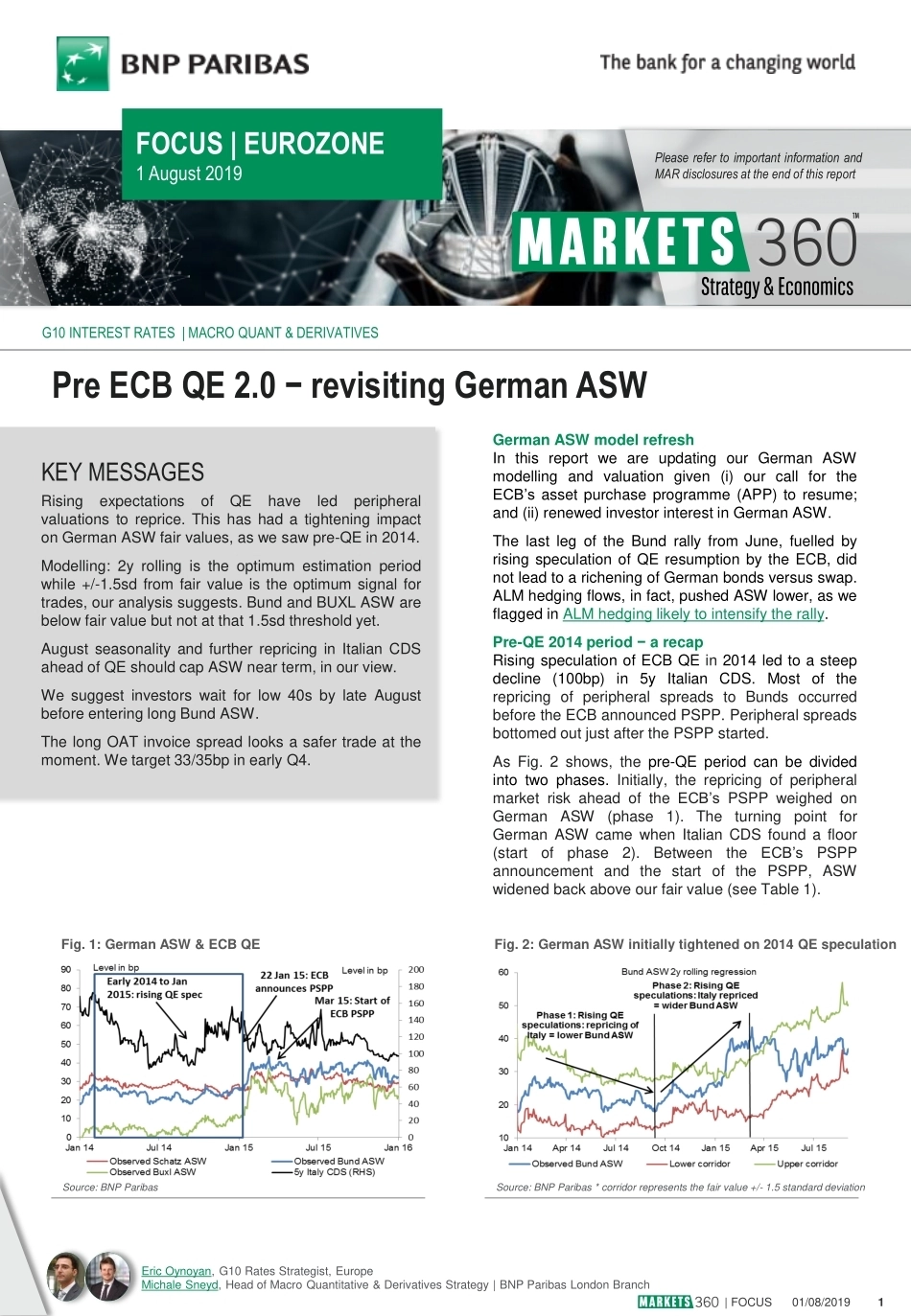
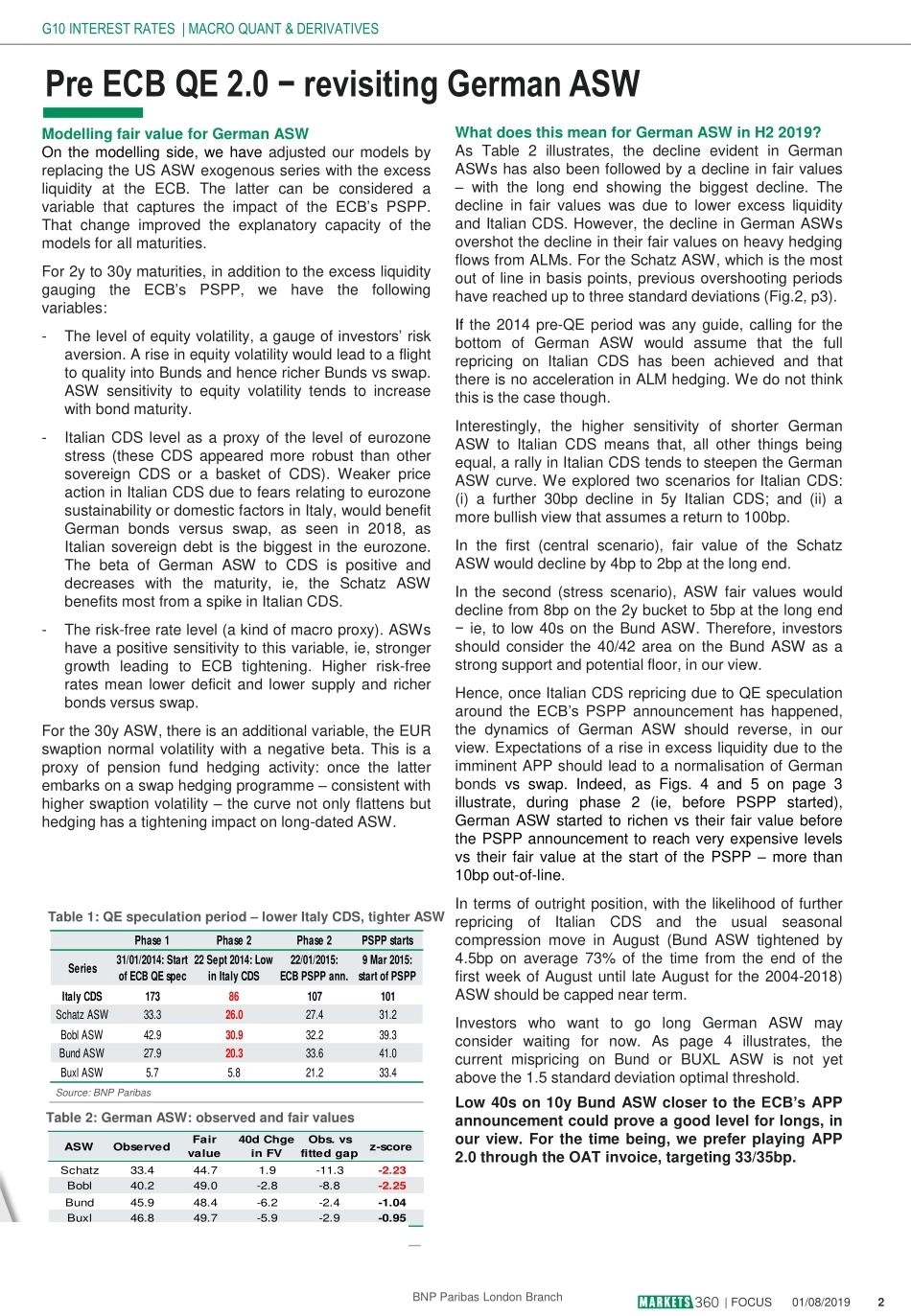
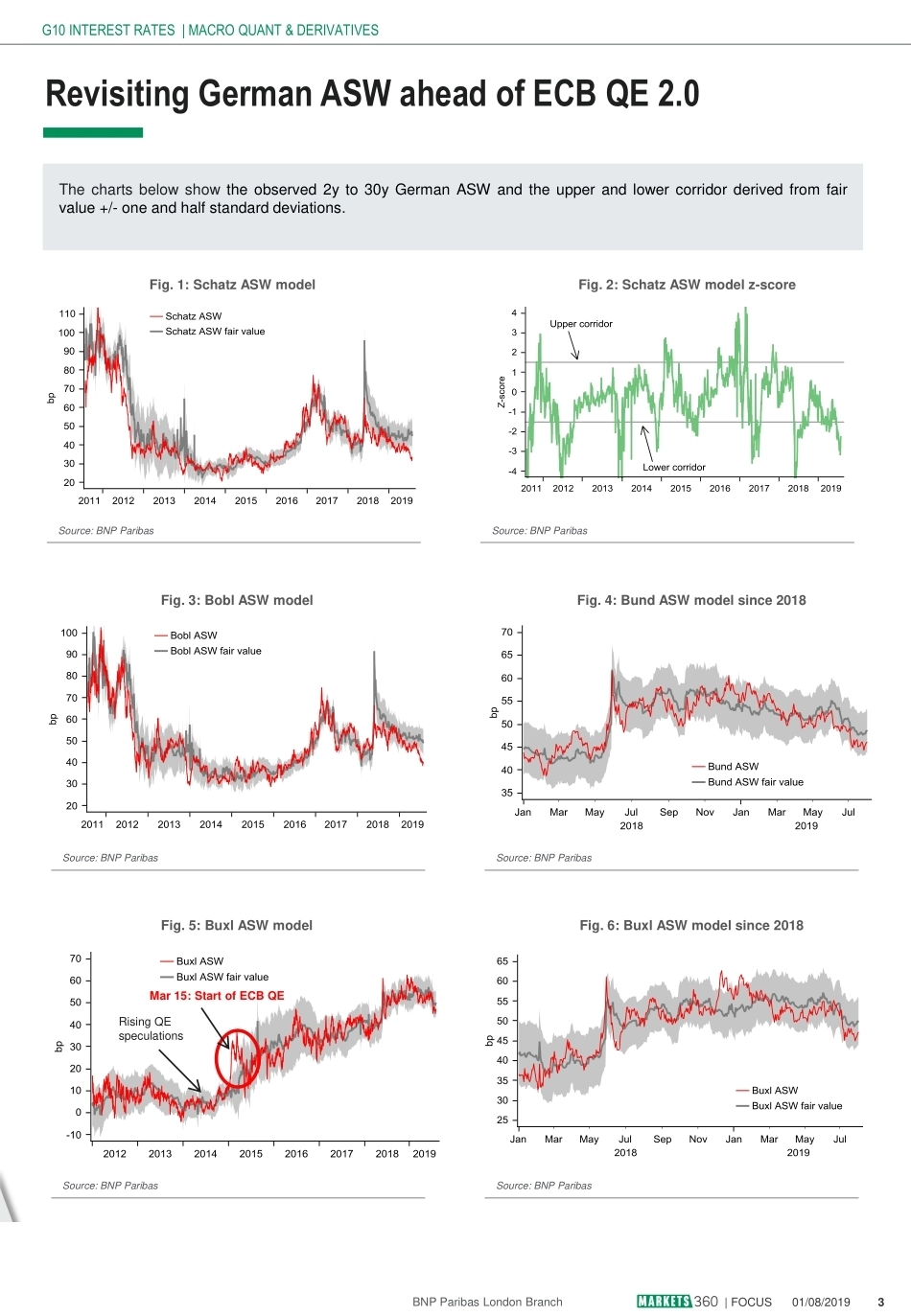
| FOCUS 01/08/2019 1 FOCUS | EUROZONE 1 August 2019 Pre ECB QE 2.0 − revisiting German ASW KEY MESSAGES Rising expectations of QE have led peripheral valuations to reprice. This has had a tightening impact on German ASW fair values, as we saw pre-QE in 2014. Modelling: 2y rolling is the optimum estimation period while +/-1.5sd from fair value is the optimum signal for trades, our analysis suggests. Bund and BUXL ASW are below fair value but not at that 1.5sd threshold yet. August seasonality and further repricing in Italian CDS ahead of QE should cap ASW near term, in our view. We suggest investors wait for low 40s by late August before entering long Bund ASW. The long OAT invoice spread looks a safer trade at the moment. We target 33/35bp in early Q4. German ASW model refresh In this report we are updating our German ASW modelling and valuation given (i) our call for the ECB’s asset purchase programme (APP) to resume; and (ii) renewed investor interest in German ASW. The last leg of the Bund rally from June, fuelled by rising speculation of QE resumption by the ECB, did not lead to a richening of German bonds versus swap. ALM hedging flows, in fact, pushed ASW lower, as we flagged in ALM hedging likely to intensify the rally. Pre-QE 2014 period − a recap Rising speculation of ECB QE in 2014 led to a steep decline (100bp) in 5y Italian CDS. Most of the repricing of peripheral spreads to Bunds occurred before the ECB announced PSPP. Peripheral spreads bottomed out just after the PSPP started. As Fig. 2 shows, the pre-QE period can be divided into two phases. Initially, the repricing of peripheral market risk ahead of the ECB’s PSPP weighed on German ASW (phase 1). The turning point for German ASW came when Italian CDS found a floor (start of phase 2). Between the ECB’s PSPP announcement and the start of the PSPP, ASW widened back above our fair value (see Table 1). Please refer to important information and MAR disclosures at the end of this report Fig. 1: German ASW & ECB QE Fig. 2: German ASW initially tightened on 2014 QE speculation Source: BNP Paribas * corridor represents the fair value +/- 1.5 standard deviation Source: BNP Paribas G10 INTEREST RATES | MACRO QUANT & DERIVATIVES Eric Oynoyan, G10 Rates Strategist, Europe Michale Sneyd, Head of Macro Quantitative & Derivatives Strategy | BNP Paribas London Branch | FOCUS 01/08/2019 2 What does this mean for German ASW in H2 2019? As Table 2 illustrates, the decline evident in German ASWs has also been followed by a decline in fair values – with the long end showing the biggest decline. The decline in fair values was due to lower excess liquidity and Italian CDS. However, the decline in German ASWs overshot the decline in their fair values on heavy hedging flows from ALMs. For the Schatz ASW, which is the most out of line in basis points, previous overshooting periods have reached up to three standard deviations (Fig.2, p3). If the 2014 pre-QE period was any guide, calling for the bottom of German ASW would assume that the full repricing on Italian CDS has been achieved and that there is no acceleration in ALM hedging. We do not think this is the case though. Interestingly, the higher sensitivity of shorter German ASW to Italian CDS means that, all other things being equal, a rally in Italian CDS tends to steepen the German ASW curve. We explored two scenarios for Italian CDS: (i) a further 30bp decline in 5y Italian CDS; and (ii) a more bullish view that assumes a return to 100bp. In the first (central scenario), fair value of the Schatz ASW would decline by 4bp to 2bp at the long end. In the second (stress scenario), ASW fair values would decline from 8bp on the 2y bucket to 5bp at the long end − ie, to low 40s on the Bund ASW. Therefore, investors should consider the 40/42 area on the Bund ASW as a strong support and potential floor, in our view. Hence, once Italian CDS repricing due to QE speculation around the ECB’s PSPP announcement has happened, the dynamics of German ASW should reverse, in our view. Expectations of a rise in excess liquidity due to the imminent APP should lead to a normalisation of German bonds vs swap. Indeed, as Figs. 4 and 5 on page 3 illustrate, during phase 2 (ie, before PSPP started), German ASW started to richen vs their fair value before the PSPP announcement to reach very expensive levels vs their fair value at the start of the PSPP – more than 10bp out-of-line. In terms of outright position, with the likelihood of further repricing of Italian CDS and the usual seasonal compression move in August (Bund ASW tightened by 4.5bp on average 73% of the time from the end of the first week of August until late August for the 2004-2018) ASW should be capped near term. Investors who want to go long German ASW may consider waiting for now. As page 4 illustrates, the current mispricing on Bund or BUXL ASW is not yet above the 1.5 standard deviation optimal threshold. Low 40s on 10y Bund ASW closer to the ECB’s APP announcement could ...




发表评论取消回复