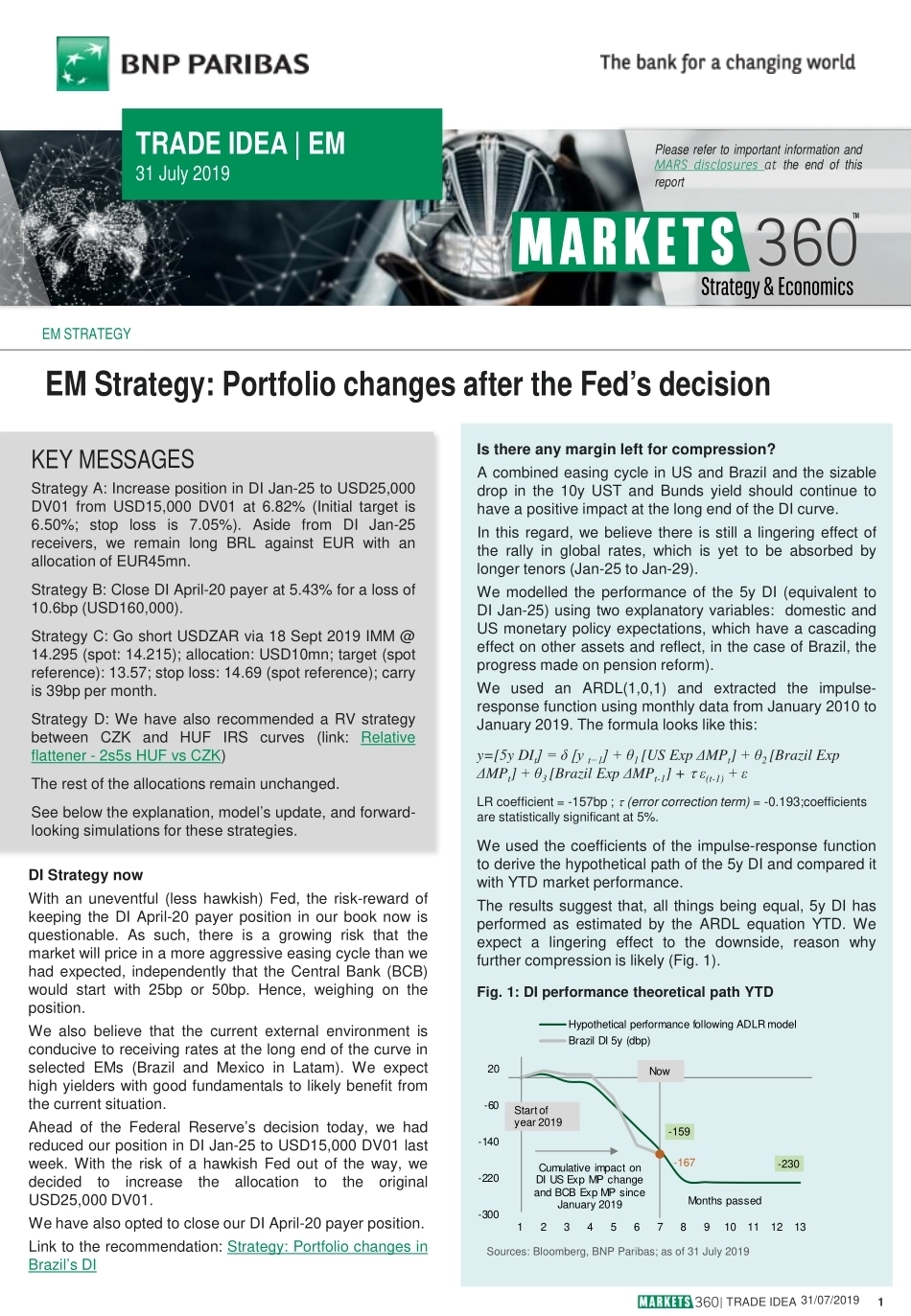
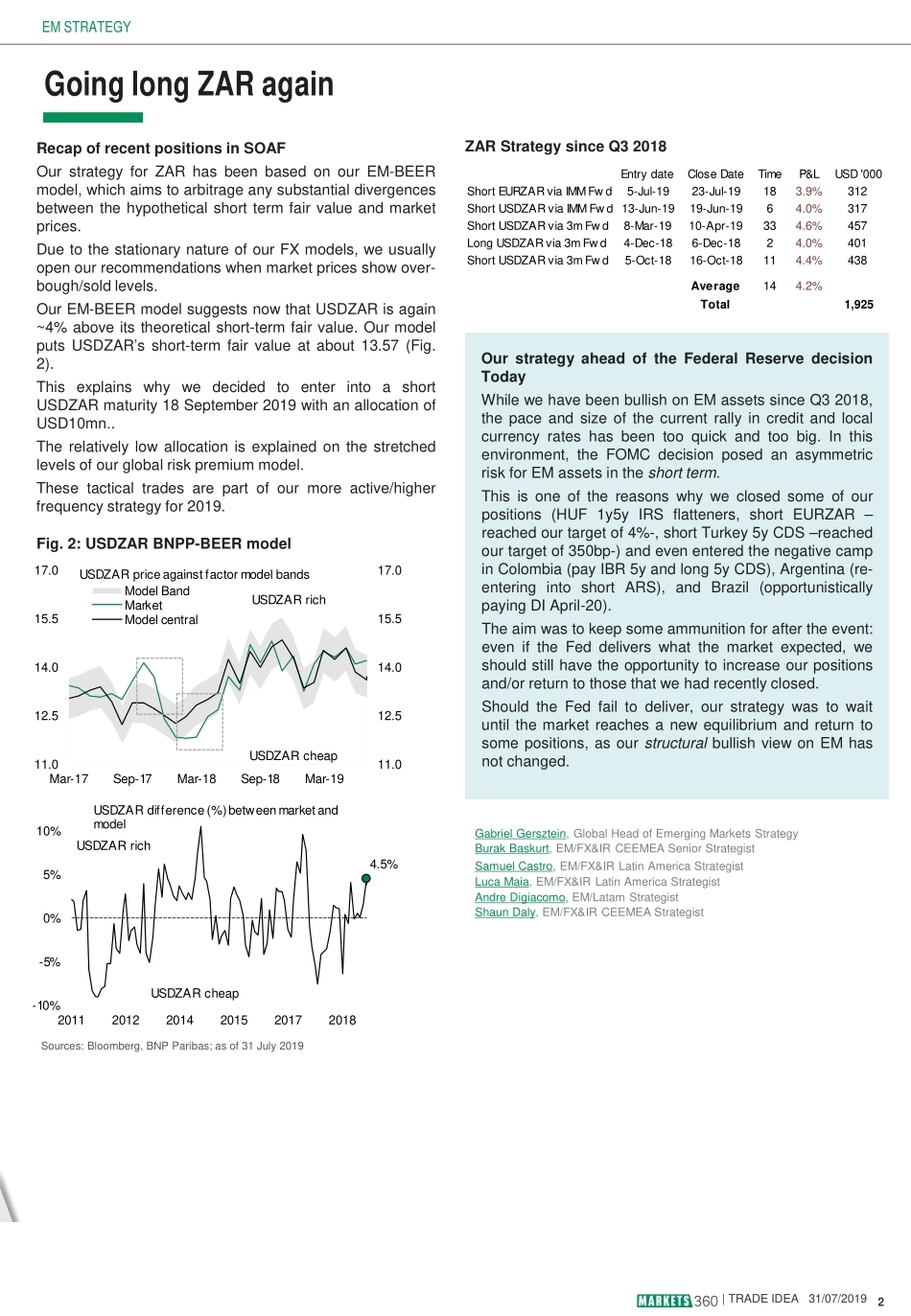
| TRADE IDEA 31/07/2019 1 TRADE IDEA | EM 31 July 2019 EM Strategy: Portfolio changes after the Fed’s decision KEY MESSAGES Strategy A: Increase position in DI Jan-25 to USD25,000 DV01 from USD15,000 DV01 at 6.82% (Initial target is 6.50%; stop loss is 7.05%). Aside from DI Jan-25 receivers, we remain long BRL against EUR with an allocation of EUR45mn. Strategy B: Close DI April-20 payer at 5.43% for a loss of 10.6bp (USD160,000). Strategy C: Go short USDZAR via 18 Sept 2019 IMM @ 14.295 (spot: 14.215); allocation: USD10mn; target (spot reference): 13.57; stop loss: 14.69 (spot reference); carry is 39bp per month. Strategy D: We have also recommended a RV strategy between CZK and HUF IRS curves (link: Relative flattener - 2s5s HUF vs CZK) The rest of the allocations remain unchanged. See below the explanation, model’s update, and forward-looking simulations for these strategies. Please refer to important information and MARS disclosures at the end of this report EM STRATEGY Is there any margin left for compression? A combined easing cycle in US and Brazil and the sizable drop in the 10y UST and Bunds yield should continue to have a positive impact at the long end of the DI curve. In this regard, we believe there is still a lingering effect of the rally in global rates, which is yet to be absorbed by longer tenors (Jan-25 to Jan-29). We modelled the performance of the 5y DI (equivalent to DI Jan-25) using two explanatory variables: domestic and US monetary policy expectations, which have a cascading effect on other assets and reflect, in the case of Brazil, the progress made on pension reform). We used an ARDL(1,0,1) and extracted the impulse-response function using monthly data from January 2010 to January 2019. The formula looks like this: y=[5y DIt] = δ [y t−1] + θ1 [US Exp ΔMPt] + θ2 [Brazil Exp ΔMPt] + θ3 [Brazil Exp ΔMPt-1] + τ ε(t-1) + ε LR coefficient = -157bp ; τ (error correction term) = -0.193;coefficients are statistically significant at 5%. We used the coefficients of the impulse-response function to derive the hypothetical path of the 5y DI and compared it with YTD market performance. The results suggest that, all things being equal, 5y DI has performed as estimated by the ARDL equation YTD. We expect a lingering effect to the downside, reason why further compression is likely (Fig. 1). Fig. 1: DI performance theoretical path YTD Sources: Bloomberg, BNP Paribas; as of 31 July 2019 DI Strategy now With an uneventful (less hawkish) Fed, the risk-reward of keeping the DI April-20 payer position in our book now is questionable. As such, there is a growing risk that the market will price in a more aggressive easing cycle than we had expected, independently that the Central Bank (BCB) would start with 25bp or 50bp. Hence, weighing on the position. We also believe that the current external environment is conducive to receiving rates at the long end of the curve in selected EMs (Brazil and Mexico in Latam). We expect high yielders with good fundamentals to likely benefit from the current situation. Ahead of the Federal Reserve’s decision today, we had reduced our position in DI Jan-25 to USD15,000 DV01 last week. With the risk of a hawkish Fed out of the way, we decided to increase the allocation to the original USD25,000 DV01. We have also opted to close our DI April-20 payer position. Link to the recommendation: Strategy: Portfolio changes in Brazil’s DI -159-230-167-300-220-140-602012345678910111213Hypothetical performance following ADLR modelBrazil DI 5y (dbp)NowStart of year 2019Cumulative impact on DI US Exp MP change and BCB Exp MP since January 2019Months passed | TRADE IDEA 2 EM STRATEGY Going long ZAR again 31/07/2019 Recap of recent positions in SOAF Our strategy for ZAR has been based on our EM-BEER model, which aims to arbitrage any substantial divergences between the hypothetical short term fair value and market prices. Due to the stationary nature of our FX models, we usually open our recommendations when market prices show over-bough/sold levels. Our EM-BEER model suggests now that USDZAR is again ~4% above its theoretical short-term fair value. Our model puts USDZAR’s short-term fair value at about 13.57 (Fig. 2). This explains why we decided to enter into a short USDZAR maturity 18 September 2019 with an allocation of USD10mn.. The relatively low allocation is explained on the stretched levels of our global risk premium model. These tactical trades are part of our more active/higher frequency strategy for 2019. Fig. 2: USDZAR BNPP-BEER model Sources: Bloomberg, BNP Paribas; as of 31 July 2019 Our strategy ahead of the Federal Reserve decision Today While we have been bullish on EM assets since Q3 2018, the pace and size of the current rally in credit and local currency rates has been too quick and too big. In this environment, the FOMC decision posed an asymmetric risk for EM assets in the short term. This is one of the reasons why we closed some of our positions (HUF 1y5y IRS flatten...




发表评论取消回复