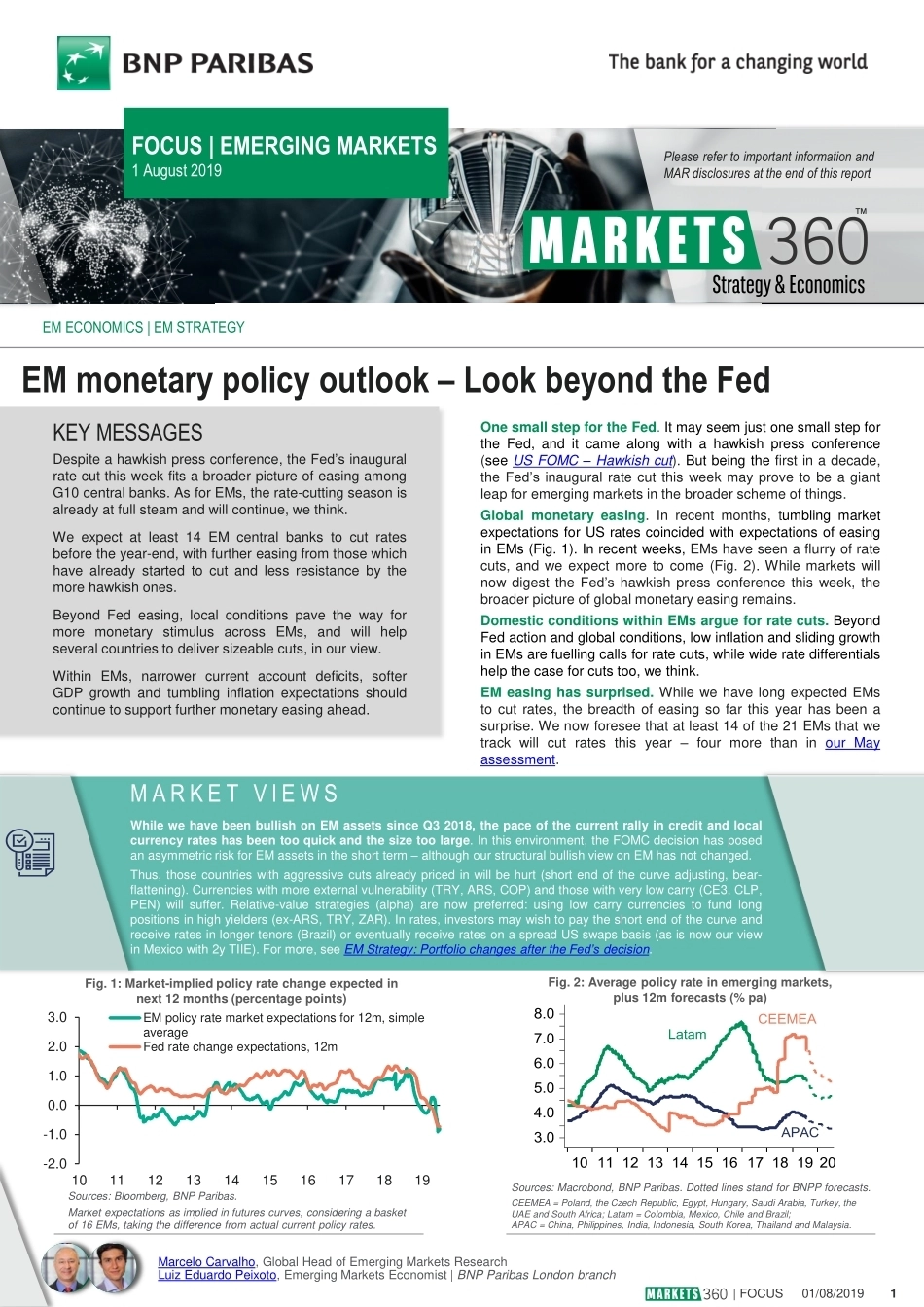
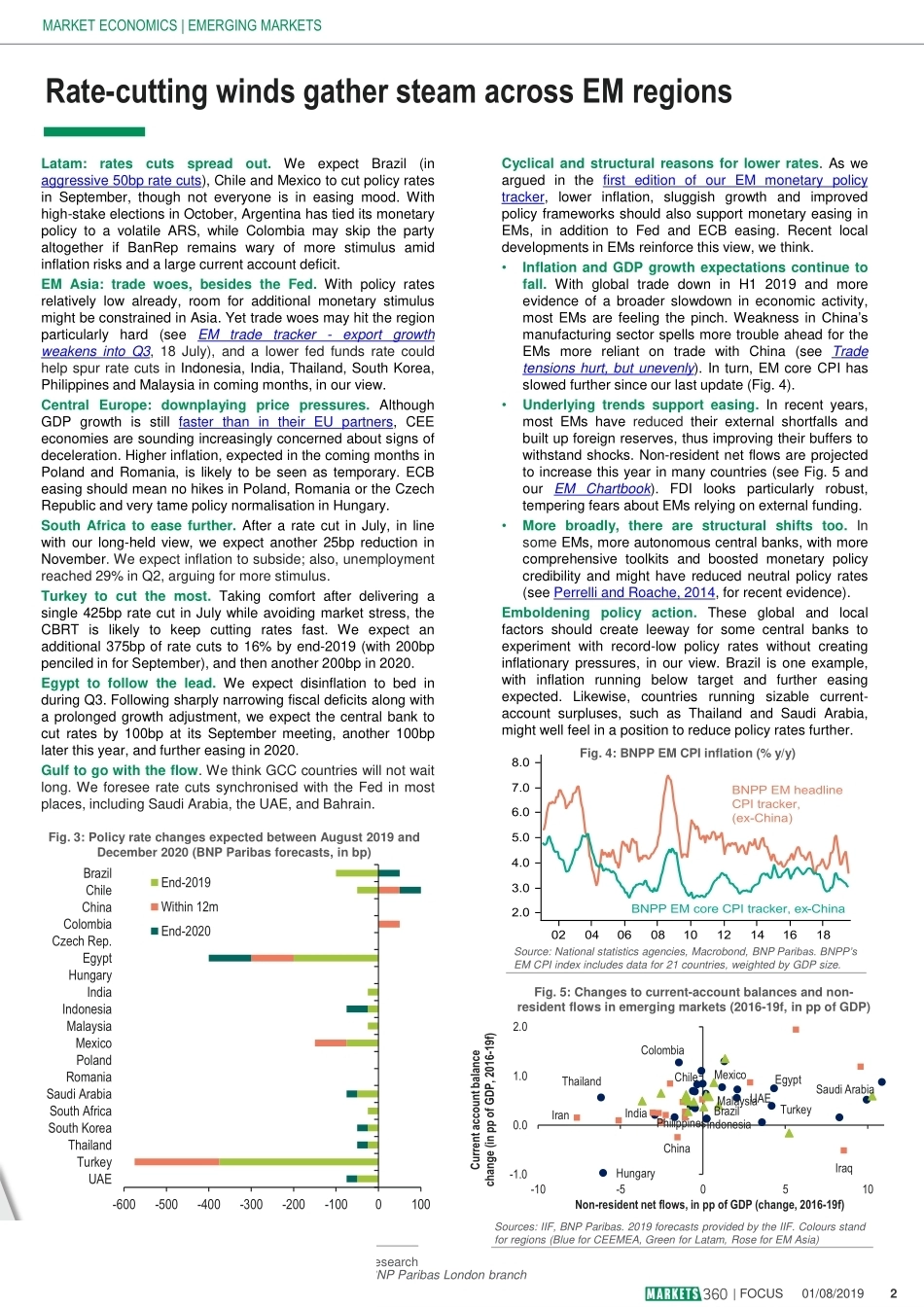
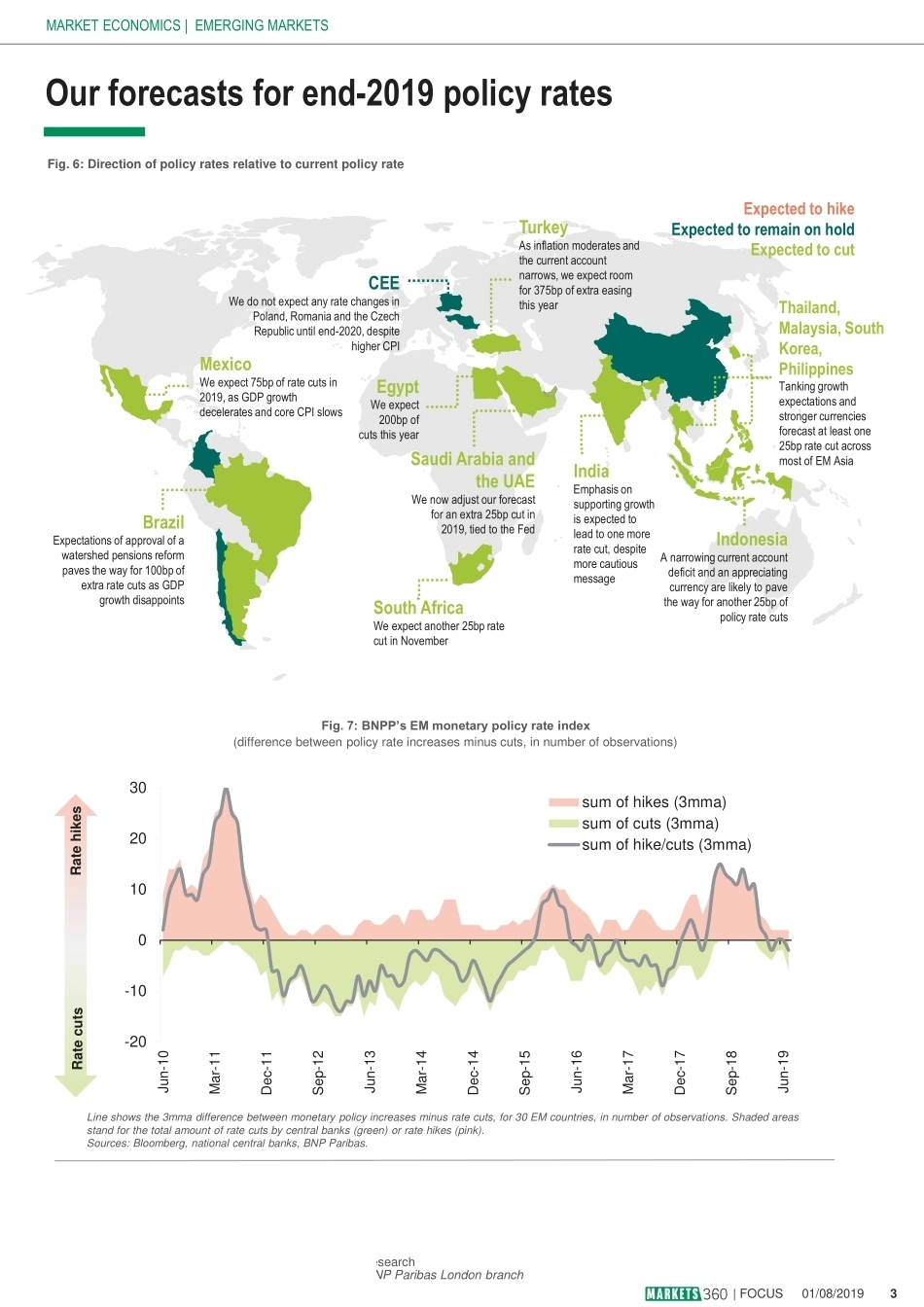
| FOCUS 01/08/2019 1 While we have been bullish on EM assets since Q3 2018, the pace of the current rally in credit and local currency rates has been too quick and the size too large. In this environment, the FOMC decision has posed an asymmetric risk for EM assets in the short term – although our structural bullish view on EM has not changed. Thus, those countries with aggressive cuts already priced in will be hurt (short end of the curve adjusting, bear-flattening). Currencies with more external vulnerability (TRY, ARS, COP) and those with very low carry (CE3, CLP, PEN) will suffer. Relative-value strategies (alpha) are now preferred: using low carry currencies to fund long positions in high yielders (ex-ARS, TRY, ZAR). In rates, investors may wish to pay the short end of the curve and receive rates in longer tenors (Brazil) or eventually receive rates on a spread US swaps basis (as is now our view in Mexico with 2y TIIE). For more, see EM Strategy: Portfolio changes after the Fed’s decision. M A R K E T V I E W SFig. 2: Average policy rate in emerging markets, plus 12m forecasts (% pa) Sources: Macrobond, BNP Paribas. Dotted lines stand for BNPP forecasts. CEEMEA = Poland, the Czech Republic, Egypt, Hungary, Saudi Arabia, Turkey, the UAE and South Africa; Latam = Colombia, Mexico, Chile and Brazil; APAC = China, Philippines, India, Indonesia, South Korea, Thailand and Malaysia. EM ECONOMICS | EM STRATEGY FOCUS | EMERGING MARKETS 1 August 2019 EM monetary policy outlook – Look beyond the Fed KEY MESSAGES Despite a hawkish press conference, the Fed’s inaugural rate cut this week fits a broader picture of easing among G10 central banks. As for EMs, the rate-cutting season is already at full steam and will continue, we think. We expect at least 14 EM central banks to cut rates before the year-end, with further easing from those which have already started to cut and less resistance by the more hawkish ones. Beyond Fed easing, local conditions pave the way for more monetary stimulus across EMs, and will help several countries to deliver sizeable cuts, in our view. Within EMs, narrower current account deficits, softer GDP growth and tumbling inflation expectations should continue to support further monetary easing ahead. One small step for the Fed. It may seem just one small step for the Fed, and it came along with a hawkish press conference (see US FOMC – Hawkish cut). But being the first in a decade, the Fed’s inaugural rate cut this week may prove to be a giant leap for emerging markets in the broader scheme of things. Global monetary easing. In recent months, tumbling market expectations for US rates coincided with expectations of easing in EMs (Fig. 1). In recent weeks, EMs have seen a flurry of rate cuts, and we expect more to come (Fig. 2). While markets will now digest the Fed’s hawkish press conference this week, the broader picture of global monetary easing remains. Domestic conditions within EMs argue for rate cuts. Beyond Fed action and global conditions, low inflation and sliding growth in EMs are fuelling calls for rate cuts, while wide rate differentials help the case for cuts too, we think. EM easing has surprised. While we have long expected EMs to cut rates, the breadth of easing so far this year has been a surprise. We now foresee that at least 14 of the 21 EMs that we track will cut rates this year – four more than in our May assessment. Please refer to important information and MAR disclosures at the end of this report Marcelo Carvalho, Global Head of Emerging Markets Research Luiz Eduardo Peixoto, Emerging Markets Economist | BNP Paribas London branch ™ Fig. 1: Market-implied policy rate change expected in next 12 months (percentage points) Sources: Bloomberg, BNP Paribas. Market expectations as implied in futures curves, considering a basket of 16 EMs, taking the difference from actual current policy rates. -2.0-1.00.01.02.03.010111213141516171819EM policy rate market expectations for 12m, simpleaverageFed rate change expectations, 12m -600-500-400-300-200-1000100UAETurkeyThailandSouth KoreaSouth AfricaSaudi ArabiaRomaniaPolandMexicoMalaysiaIndonesiaIndiaHungaryEgyptCzech Rep.ColombiaChinaChileBrazilEnd-2019Within 12mEnd-2020Cyclical and structural reasons for lower rates. As we argued in the first edition of our EM monetary policy tracker, lower inflation, sluggish growth and improved policy frameworks should also support monetary easing in EMs, in addition to Fed and ECB easing. Recent local developments in EMs reinforce this view, we think. •Inflation and GDP growth expectations continue to fall. With global trade down in H1 2019 and more evidence of a broader slowdown in economic activity, most EMs are feeling the pinch. Weakness in China’s manufacturing sector spells more trouble ahead for the EMs more reliant on trade with China (see Trade tensions hurt, but unevenly). In turn, EM core CPI has slowed further since our last update (Fig. 4). •Underlying trends support easing. In recen...




发表评论取消回复