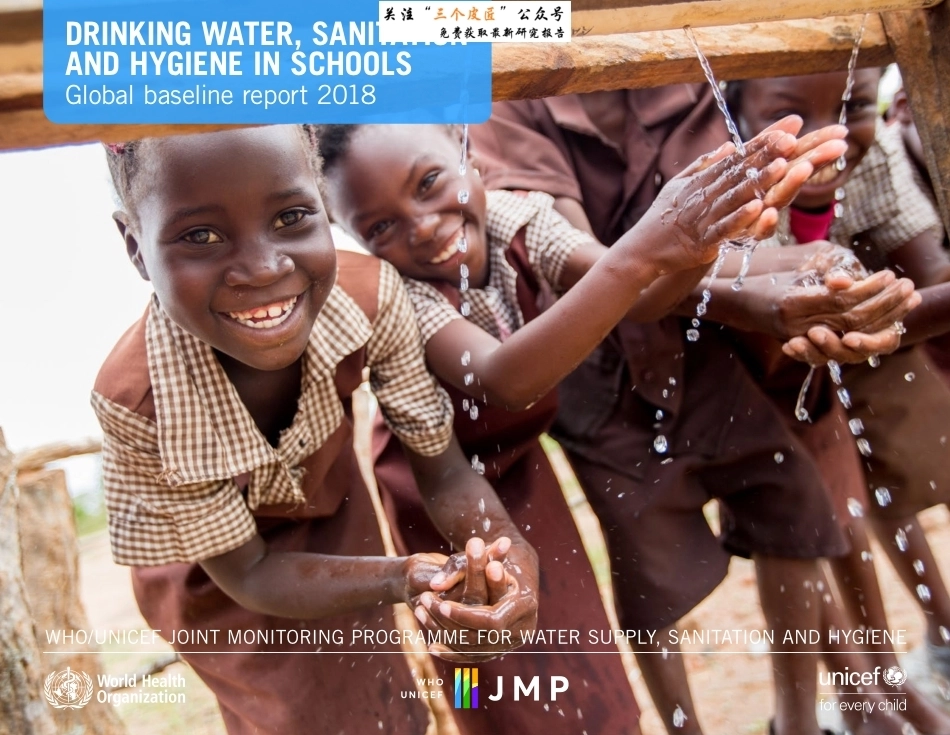
DRINKING WATER, SANITATION AND HYGIENE IN SCHOOLSGlobal baseline report 2018WHO/UNICEF JOINT MONITORING PROGRAMME FOR WATER SUPPLY, SANITATION AND HYGIENEWHO Library Cataloguing-in-Publication DataDrinking water, sanitation and hygiene in schools: global baseline report 2018.1. Water supply - standards. 2. Sanitation - trends. 3. Drinking water - supply and distribution.4. Program evaluation. 5. Schools. I. World Health Organization. II. UNICEF.ISBN TBC © United Nations Children’s Fund (UNICEF) and World Health Organization, 2018Some rights reserved. This work is available under the Creative Commons Attribution-NonCommercial-ShareAlike 3.0 IGO licence (CC BY-NC-SA 3.0 IGO; https://creativecommons.org/licenses/by-nc-sa/3.0/igo). Under the terms of this licence, you may copy, redistribute and adapt the work for non-commercial purposes, provided the work is appropriately cited, as indicated below. In any use of this work, there should be no suggestion that WHO or UNICEF endorse any specific organization, products or services. The unauthorized use of the WHO or UNICEF names or logos is not permitted. If you adapt the work, then you must license your work under the same or equivalent Creative Commons licence. If you create a translation of this work, you should add the following disclaimer along with the suggested citation: “This translation was not created by the World Health Organization (WHO) or the United Nations Children’s Fund (UNICEF). Neither WHO nor UNICEF are responsible for the content or accuracy of this translation. The original English edition shall be the binding and authentic edition”. Any mediation relating to disputes arising under the licence shall be conducted in accordance with the mediation rules of the World Intellectual Property Organization (http://www.wipo.int/amc/en/mediation/rules).Suggested citation. Drinking water, sanitation and hygiene in schools: global baseline report 2018. New York: United Nations Children’s Fund (UNICEF) and World Health Organization, 2018. Licence: CC BY-NC-SA 3.0 IGO.Cataloguing-in-Publication (CIP) data. CIP data are available at http://apps.who.int/iris.Sales, rights and licensing. To purchase WHO publications, see http://apps.who.int/bookorders. To submit requests for commercial use and queries on rights and licensing, see http://www.who.int/about/licensing. Third-party materials. If you wish to reuse material from this work that is attributed to a third party, such as tables, figures or images, it is your responsibility to determine whether permission is needed for that reuse and to obtain permission from the copyright holder. The risk of claims resulting from infringement of any third-party-owned component in the work rests solely with the user.UNICEF and WHO Photographs. UNICEF photographs are copyrighted and are not to be reproduced in any medium without obtaining prior written permission from UNICEF. Permissions may be granted for one-time use in a context that accurately represents the real situation and identity of all human beings depicted. UNICEF photographs are not to be used in any commercial context; content may not be digitally altered to change meaning or context; assets may not be archived by any non-UNICEF entity. Requests for permission to reproduce UNICEF photographs should be addressed to UNICEF, Division of Communication, 3 United Nations Plaza, New York 10017, USA (email: nyhqdoc.permit@unicef.org). Front cover: UNICEF/UN0145995/Schermbrucker; Table of Contents: UNICEF/UNI33682/Pirozzi; Back cover: UNICEF/UNI127727/Vishwanathan; UNICEF/UNI138896/Haque; UNICEF/UNI48008/Noorani. P9: UNICEF/UNI193997/Gilbertson VII Photo; P15: UNICEF/UNI136038/Dean; P16: UNICEF/UNI127727/Vishwanathan; P18: UNICEF/UN0208018/DEJONGH; P20: UNICEF/UNI122111/Haque; P27: UNICEF/UN0145989/Schermbrucker; P31: UNICEF/UNI179356/Lynch; P35: UNICEF/UNI80076/Dicko; P38: UNICEF/UNI79756/Purushotham; P39: UNICEF/UNI79699/Purushotham; P41: UNICEF/UNI138442/Haque; P49: UNICEF/UNI101560/Sujan; P53: UNICEF/UN0199486/Noorani; P54 and 55: UNICEF/UNI114831/Holt; P57: UNICEF/UN016920/Dejongh; P59: UNICEF/UN074056/Pirozzi; P61: UNICEF/UNI185836/Khan; P63: UNICEF/UNI138403/Haque; P80: UNICEF/UNI74568/EsteyGeneral disclaimers. The designations employed and the presentation of the material in this publication do not imply the expression of any opinion whatsoever on the part of WHO or UNICEF concerning the legal status of any country, territory, city or area or of its authorities, or concerning the delimitation of its frontiers or boundaries. Dotted and dashed lines on maps represent approximate border lines for which there may not yet be full agreement. The mention of specific companies or of certain manufacturers’ products does not imply that they are endorsed or recommended by WHO or UNICEF in preference to others of a similar nature that are not mentioned. Errors and omissions excepted, the names of proprietary products are distinguished by initial capital letters.The figures i...



发表评论取消回复